
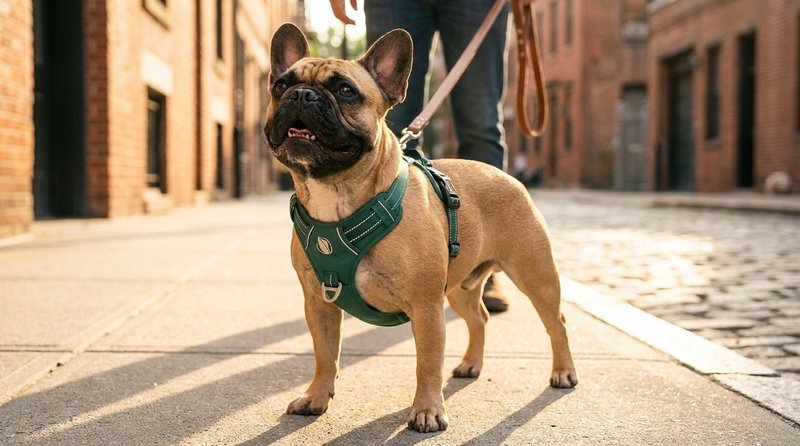
The best no-pull harness for a French Bulldog is a front-clip harness shaped for a broad chest, short neck, and flat-faced breathing. When the leash tightens, the chest attachment steers your dog toward you instead of pressing on the throat. Look for a low front panel that stays off the neck, independently adjustable neck and ribcage straps, breathable material, and a secure fit that resists backing out. Measure your dog’s ribcage girth first; most adult Frenchies wear a small or medium, but sizing varies by brand.
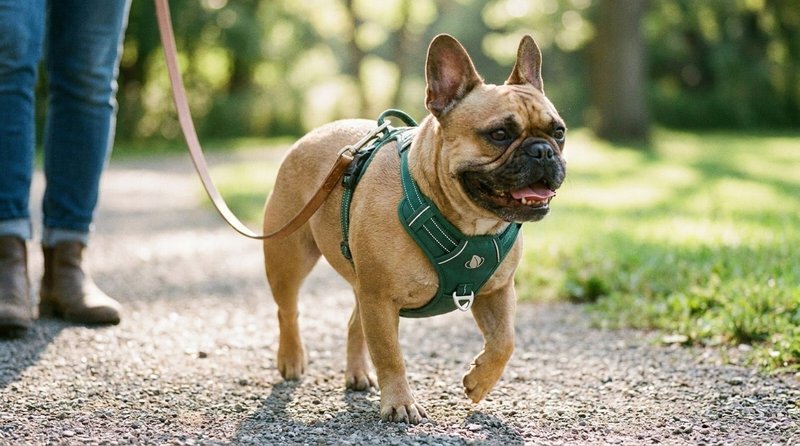
A 20-pound French Bulldog doesn’t look like much of a match for you. Then a squirrel appears, all four little legs dig in, and suddenly you’re the one being walked. Frenchies are compact, muscular, and stubborn - and their flat faces make a collar the worst possible tool for the job.
That combination is exactly why harness shopping for a Frenchie is harder than it looks. A broad barrel chest, a short thick neck, a narrow waist, and a big head mean most standard harnesses ride up toward the throat, twist sideways, rub behind the elbows, or get backed out of entirely. Get it wrong and you’re putting pressure on an airway that’s already working overtime.
Here’s the good news: the right no pull harness for a French Bulldog fixes all of that. This guide covers why Frenchies need breed-specific fit, which features actually work, our honest picks (ours and competitors’), and how to measure and fit so it does its job. We test our gear on our own dogs - including a French Bulldog and an English Bulldog - and every claim here is backed by veterinary sources, not marketing.
Table of Contents
- Why French Bulldogs Need a Different Kind of Harness
- Front-Clip vs Back-Clip: What Actually Stops the Pulling
- What to Look for in a No-Pull Harness for French Bulldogs
- Best No-Pull Harnesses for French Bulldogs: Our 2026 Picks
- How to Size and Fit a Harness on a French Bulldog
- Harnesses for French Bulldog Puppies and English Bulldogs
- Frequently Asked Questions
- Walks Your Frenchie Can Actually Enjoy
Why French Bulldogs Need a Different Kind of Harness
Most harness advice assumes an average dog shape. Frenchies aren’t average, and two things make them a special case.
Their airway is compromised by design. French Bulldogs are brachycephalic - the shortened skull crowds the same amount of soft tissue into a much smaller space. That’s the root of Brachycephalic Obstructive Airway Syndrome (BOAS), which can include narrowed nostrils, an elongated soft palate, and in some dogs a narrow windpipe. It’s genuinely common: across several clinically evaluated groups of French Bulldogs, roughly half showed moderate-to-severe airway impairment. Not every Frenchie has BOAS, but enough do that you should treat the neck as off-limits for leash pressure.
That’s why the veterinary consensus is unusually clear. Cornell’s Riney Canine Health Center advises owners of affected dogs to “use a harness instead of a neck collar.” A collar concentrates force on the trachea and soft tissue right where a brachycephalic dog can least afford it. A well-fitted harness moves that force onto the ribcage instead. The same off-the-neck logic drives our guide to the best harness for dogs with collapsed trachea, and it’s worth a read if your Frenchie already coughs or honks on walks.
Their body shape defeats generic gear. The AKC breed standard describes a compact, heavy-boned dog with a thick well-arched neck, a broad deep chest, and a tucked-up waist, standing about 11-13 inches tall and weighing under 28 pounds. Translated to harness terms: a big ribcage, a small waist, a short back, and a head that’s often wider than the neck. A one-size-shape harness simply can’t sit right on that.
There’s a third practical factor: heat. Because brachycephalic dogs can’t pant as efficiently, they overheat faster - French and English Bulldogs together made up roughly 37% of dogs treated for heat-related illness in one 2022 UK dataset. Lightweight, breathable gear won’t prevent heatstroke on its own (walk timing and shade matter far more), but a bulky harness that traps heat is the wrong choice for this breed.
If you want the wider picture on how different harness styles perform, our full dog harness reviews test ten popular models across fit, comfort, and pull control.
Front-Clip vs Back-Clip: What Actually Stops the Pulling
Every no-pull harness lives or dies on where the leash attaches.
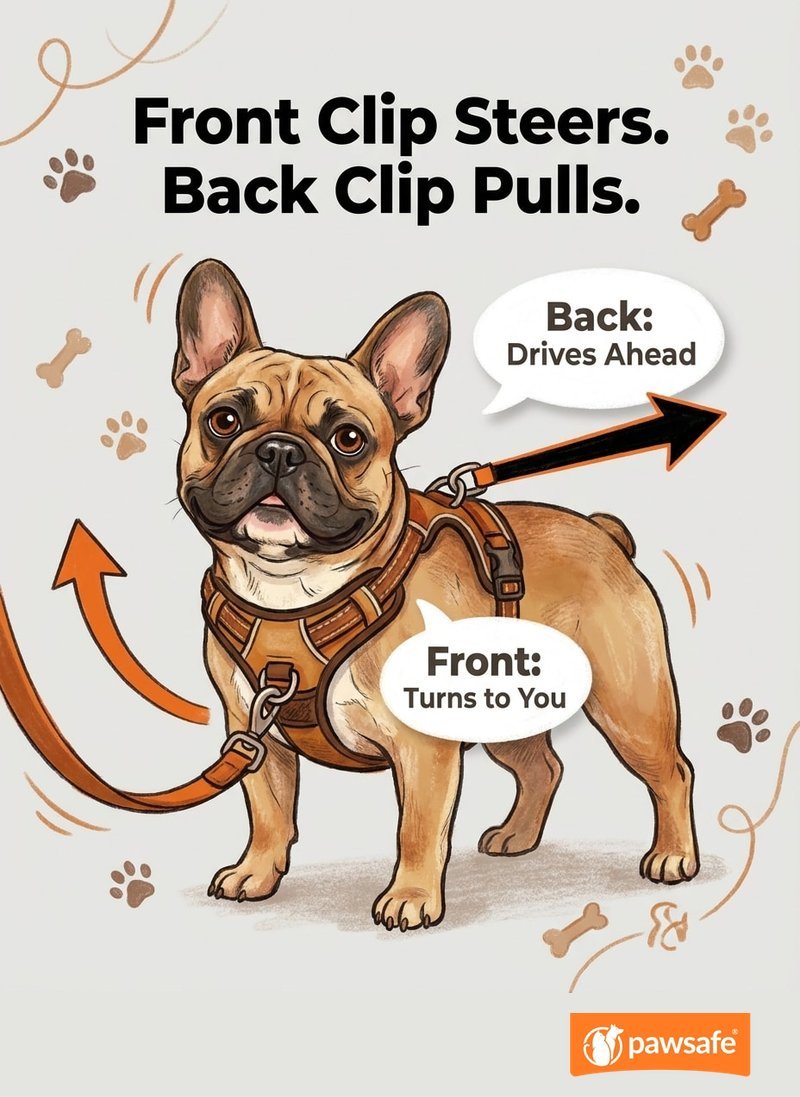
Back-clip harnesses attach between the shoulders. They keep pressure off the neck, which is good - but they also give your dog a stable surface to lean into, like a tiny sled dog. Fine for a Frenchie who already walks politely; frustrating for one who pulls.
Front-clip harnesses attach at the chest. When the leash tightens, the pull turns your dog’s chest back toward you instead of letting them drive straight ahead. The benefit is steering and interruption, not punishment - your dog’s own momentum becomes the correction. In a 2024 shelter-dog study, a front-connected harness produced less pulling force than a martingale collar, though researchers are careful to note it’s a training aid, not a magic fix.
Dual-clip harnesses have both. For a French Bulldog, this is usually the sweet spot: clip the front for training walks and reactive moments, clip the back for relaxed strolls once your dog settles, or use a double-ended leash on both points to stop the harness from rotating. That flexibility is why we recommend dual-clip as the default for pullers.
What to Look for in a No-Pull Harness for French Bulldogs
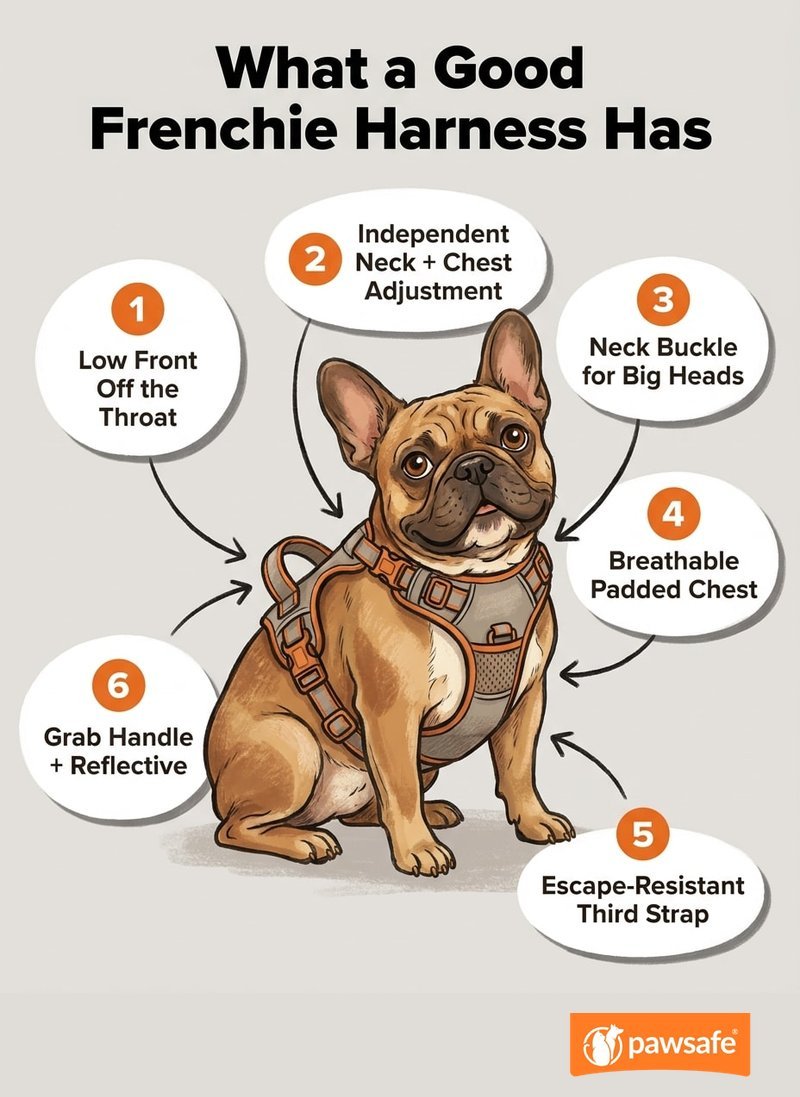
Once you’ve settled on a front- or dual-clip design, these are the features that separate a dog harness for French Bulldogs that actually fits from one that fights the breed’s shape.
A Low Front That Sits Off the Throat
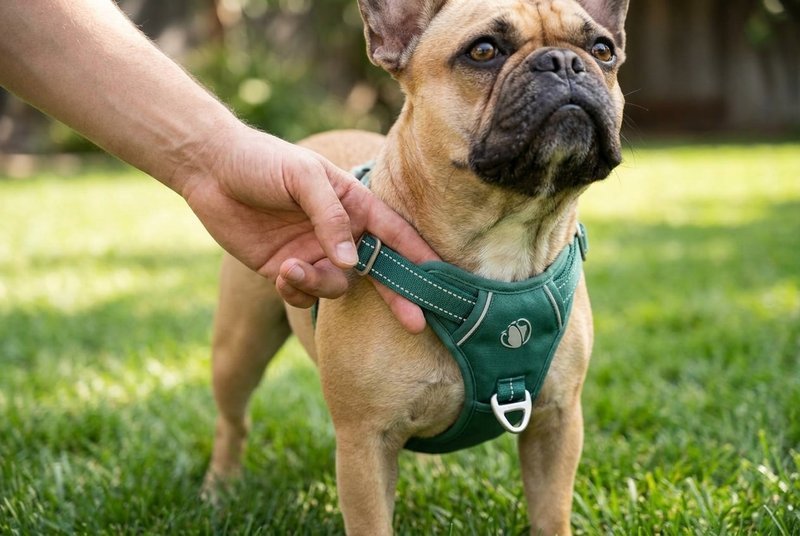
The front panel or chest attachment should rest on the sternum, well below the throat. A Y-shaped or low chest panel helps here - not because “Y-front” is a magic label (gait studies are actually mixed on whether any shape is truly non-restrictive), but because a low front is simply less likely to creep up onto the neck when your Frenchie leans forward.
Independent Neck and Chest Adjustment
This is the single most important feature for the breed. A Frenchie’s ribcage and neck don’t scale together the way they do on a Labrador, so a harness with separate neck and girth adjustment - ideally four or more adjustment points - lets you snug the chest without choking the neck, or open the neck without letting the whole thing gape.
A Neck Buckle for Big Heads
Many Frenchies have a head noticeably wider than their neck, which makes over-the-head harnesses a wrestling match. A harness that unclips at the neck saves your dog’s ears and your patience.
Breathable, Padded Contact Points
Padding on the chest plate spreads pressure when your dog hits the end of the leash. Breathable material keeps a heat-sensitive dog cooler. Watch the armpits especially - the girth strap should sit on the ribcage behind the front legs, never rubbing the soft skin behind the elbows.
Stop Your Dog Pulling On Their Leash
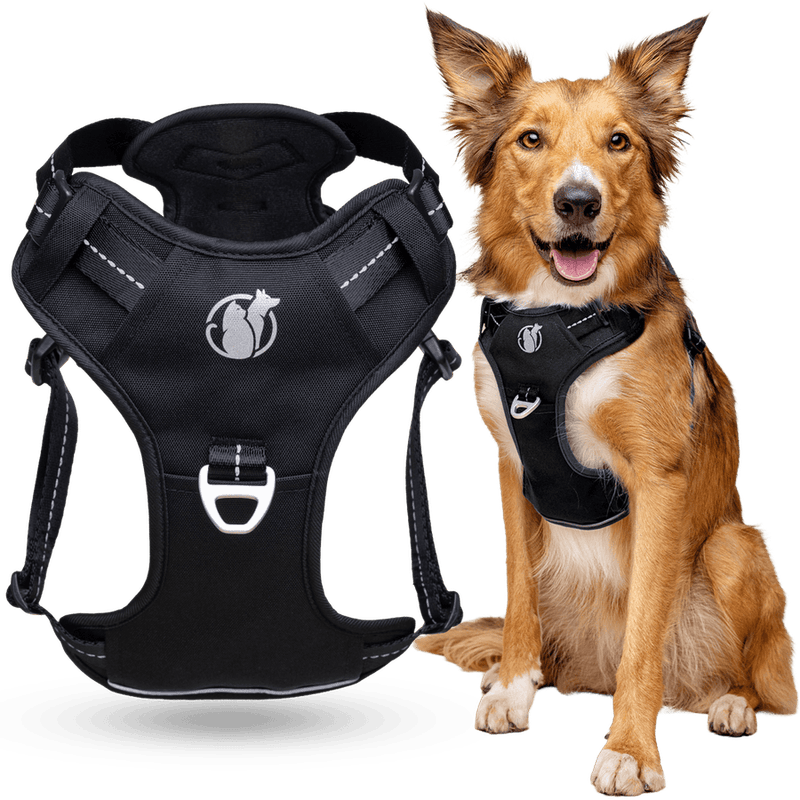
The Steady+Style No Pull Harness uses front and back clip points to redirect pulling, so you get immediate, gentler control and can actually enjoy the walk again.
Shop Now 👉Better Walk Guarantee • 90-Day PawSafe® Promise
Escape Resistance
Frenchies are champion reverse-outers. When a dog backs up, a loose neck opening can slide right over the shoulders. A second body strap sitting over the narrower part of the ribcage stops the harness from sliding forward. For a determined escape artist, a three-strap safety design beats overtightening a two-strap one.
A Grab Handle and Reflective Trim
A padded handle on top gives you instant control at a crosswalk or when lifting a stocky, low-to-the-ground dog into the car. Reflective stitching keeps a small dark shape visible on early or late walks.
Best No-Pull Harnesses for French Bulldogs: Our 2026 Picks
We evaluated harnesses against the features above and against real Frenchie and English Bulldog bodies. Prices are U.S. listings as of 2026 and exclude promotions.
| Harness | Price | Clip type | Sizing basis | Best for |
|---|---|---|---|---|
| PawSafe Steady+Style | $63.96 | Front + back | Weight + adjustable | Most Frenchies and English Bulldogs that pull |
| Blue-9 Balance | $40-50 | Front + back | Chest girth (6-point) | Hard-to-fit, big-headed dogs |
| 2 Hounds Freedom | $33-46 | Front + rear loop | Chest girth | Strong pullers, training |
| PetSafe Easy Walk | $15-23 | Front only | Chest girth | Budget front-clip on hot days |
| Gooby Escape Free X | From $34 | Back only | Chest girth | Reverse-out escape artists |
| BullHug | $33-35 | Back only | Neck + chest | Bulldog-specific proportions |
Best Overall: PawSafe Steady+Style No-Pull Harness
Our Steady+Style No-Pull Harness is the one we reach for on our own dogs, and it’s built around exactly the problems above. The front chest attachment uses a reinforced aluminum D-ring that sits on the sternum to steer a lunging dog back toward you, while a rear D-ring handles relaxed walks - a true dual-clip setup. The padded chest plate spreads pressure off the neck, Duraflex buckles handle the sudden yank of a determined puller, and a padded grab handle up top is genuinely useful for steering a low, stocky Frenchie or boosting an English Bulldog into the car. Reflective stitching and a hidden AirTag pocket round it out - the tracker pocket is a quiet reassurance for a breed that’s both an escape risk and a theft target.
We tested it on Ping Ping, a French Bulldog who wears the small, and Zumo, an English Bulldog who wears the medium. On both, the front clip took the drama out of the first ten minutes of every walk.
Best for: most French Bulldogs and English Bulldogs that pull, especially owners who want one padded, dual-clip harness plus a car-safety option (it’s seatbelt-compatible).
Honest note: the Steady+Style sizes by weight with adjustable straps rather than a separate neck buckle and independent neck measurement. That fits the majority of Frenchies (small) and English Bulldogs (medium) well, but a genuinely hard-to-fit dog with an unusually wide head-to-neck ratio may want a harness with a dedicated neck buckle.
- Sizes: XS (10-18 lbs), S (18-28 lbs), M (28-50 lbs), L (45-70 lbs), XL (70-132 lbs)
- Colors: Classic Black, Ever Green, Wild Berry
- Front + rear attachment, padded chest plate, grab handle, reflective, AirTag pocket
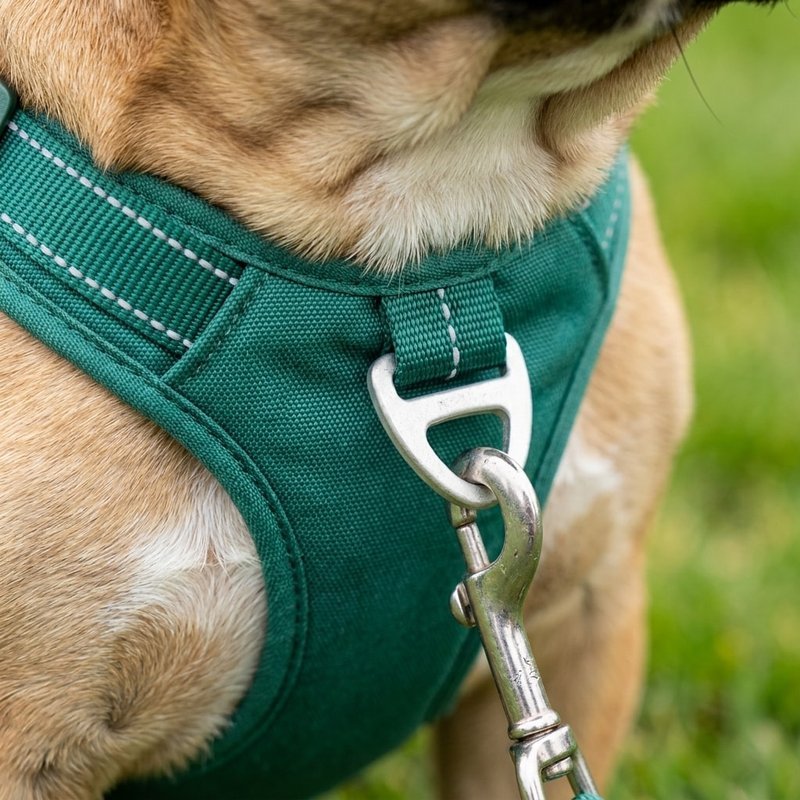
Best for Hard-to-Fit Dogs: Blue-9 Balance
The Blue-9 Balance ($39.95-$50) is the harness trainers reach for when a dog is genuinely hard to fit. Its six adjustment points and neck buckle let you dial in a broad chest and a wide head separately, and its open, lightly padded construction stays cool. Front and back rings cover training and casual walks. The trade-off: the thin straps offer less cushioning than a padded plate, so fit has to be precise, and the webbing isn’t chew-resistant. For a barrel-chested Frenchie who’s defeated every other harness, it’s often the answer.
Best for Strong Pullers in Training: 2 Hounds Freedom
The 2 Hounds Design Freedom ($33-$46) pairs a front ring with a rear martingale loop that gently tightens when your dog pulls, and it’s the front-connected model used in that 2024 pulling study. A Swiss-velvet-lined belly strap reduces chafing - a nice touch for short-bodied dogs. It’s a little fiddlier to put on, and on a very short-backed Frenchie you’ll want to watch that the horizontal chest strap and rear loop sit clear of the armpits. For dedicated loose-leash training, it’s excellent.
Best Budget Front-Clip: PetSafe Easy Walk
At $15-$23, the PetSafe Easy Walk is the cheapest way to get real front-clip steering. It’s lightweight and low-coverage, which is a plus in the heat. The catch: it’s front-only, and its horizontal chest strap can rotate, sag, or creep toward the throat if it isn’t fitted carefully and checked often. On a Frenchie, keep that strap low and level - if it rides up, size or adjust it down.
Make Every Walk Feel Under Control
Adjustable comfort design helps reduce leash tension fast so walks become calm, consistent, and more enjoyable for both of you.
Shop Now 👉Better Walk Guarantee • 90-Day PawSafe® Promise
Best for Escape Artists: Gooby Escape Free X
If your Frenchie’s signature move is throwing it in reverse and stepping out, the Gooby Escape Free Comfort X (from $33.99) is built to contract under backward pressure so it can’t slide over the shoulders. It’s soft, breathable air mesh with a deep V neck. Important honesty: it’s a back-clip harness, so it doesn’t give you front-clip no-pull steering, and “escape free” isn’t a guarantee - size it carefully and test indoors first.
A Note on Bulldog-Specific Brands
Harnesses like BullHug ($33-$35) and the BrilliantK9 Tweener ($64.99) are shaped specifically for the big-ribcage, small-waist bulldog build, which is a real advantage for fit. The catch is that both are back-clip only, so neither delivers front-clip steering for a puller. If your dog pulls hard, pair the bulldog-shaped fit with training, or choose a dual-clip option instead.
How to Size and Fit a Harness on a French Bulldog
The best harness in the world fails if it’s the wrong size - and on a Frenchie, the wrong size actively makes pulling worse, because a loose harness rotates sideways and the front clip slides off center.
Measure, don’t guess. With your dog standing squarely:
- Ribcage girth: wrap a soft tape around the widest part of the chest, just behind the front legs. This is your primary number.
- Lower neck: measure around the base of the neck, where the harness neckline will sit - not high up like a collar.
- Weight: record it, but treat it as a secondary check.
Then use the size chart for that exact model. There is no universal French Bulldog size: a 23-inch chest can map to a small, medium, or large depending on the brand. Most adult Frenchies land around a 19-26 inch chest and wear a small or medium; English Bulldogs run larger, often a 24-35 inch chest. For a breed-by-breed starting point, see our harness size chart by breed.
The two-finger test: once it’s on, you should be able to slip two fingers under every strap - snug enough that your dog can’t back out, loose enough not to pinch. AKC’s well-fitting harness guidance recommends the neckline rest at the top of the sternum rather than on the throat, roughly two-finger clearance, and free shoulder movement. Check that the chest panel sits flat and centered, the neckline rests at the top of the sternum, the armpits are clear, and nothing rotates when your dog leans into the leash. Watch your Frenchie walk and turn; if the stride shortens, the elbows bow out, or the harness twists, it’s the wrong size or shape.
Harnesses for French Bulldog Puppies and English Bulldogs
Two close cousins of this search deserve their own notes.
French Bulldog Puppy Harness
For a Frenchie puppy, the priorities shift toward comfort, adjustability, and low cost, because they grow fast. The best harness for a bulldog puppy is light, soft, highly adjustable, and low-coverage, with an easy neck buckle or step-in opening. Start harness habituation indoors right away - reward your puppy for sniffing it, putting their head through it, and standing calmly while you fasten it. Never force it on.
On timing: the old “wait until 16 weeks” rule is an oversimplification. Puppies need their core vaccine series (typically three doses between 6 and 16 weeks), but safe, managed socialization can begin earlier. Follow your vet’s guidance on when public walks are safe based on your area’s disease risk - and until then, practice in a clean garden. Check a French Bulldog puppy harness fit before every outing and do a fuller refit at least weekly during growth spurts; replace it the moment straps hit their limit or the neckline starts creeping up.
Dog Harness for an English Bulldog
An English Bulldog needs the same brachycephalic-safe principles as a Frenchie, scaled up. At roughly 40-50 pounds and about 15 inches tall, a dog harness for an English Bulldog needs a wider chest range (often 24-35 inches), stronger hardware, and wider straps to distribute the load. Independent neck and chest adjustment matters even more on that broad frame, and a short-enough body section keeps the girth strap off the armpits. Because English Bulldogs are just as heat-sensitive as Frenchies, keep the construction breathable and the walks conservative in warm weather. Any dog harness for a bulldog should keep the front low and open, well clear of the throat.
Frequently Asked Questions
Enjoy Calm Walks Starting Today
Dual-attachment harness distributes pressure and helps turn tug-of-war outings into relaxed, bonding strolls from the first use.
Shop Now 👉Better Walk Guarantee • 90-Day PawSafe® Promise
What type of harness is best for a French Bulldog?
A lightweight dual-clip harness with a low front attachment, a back attachment, and independently adjustable neck and chest sections. The front panel should sit below the throat, straps should clear the shoulders and armpits, and the harness shouldn’t rotate under tension. A neck buckle helps for a big-headed Frenchie, and a third body strap helps if your dog backs out.
Should a French Bulldog wear a harness or a collar?
Use a collar for ID tags and a harness for the leash. Cornell, Tufts, VCA, and the Royal Kennel Club all recommend keeping leash pressure off a brachycephalic dog’s neck. A properly fitted harness matters even more if your Frenchie has noisy breathing, coughing, BOAS, or pulls hard.
What size harness does a French Bulldog need?
Most adult Frenchies land somewhere around a 19-26 inch chest, but there’s no universal breed size. Measure the widest part of the ribcage and the base of the neck, then use the exact size chart for that model. The same 23-inch chest can be a small, medium, or large depending on the brand.
Are no-pull harnesses safe for brachycephalic dogs?
They can be safer than running leash force through a collar, as long as the front panel stays below the throat, straps don’t restrict the shoulders, the harness doesn’t rotate, and your dog can pant freely. See a vet before relying on any gear if your dog has noisy breathing at rest, blue or pale gums, fainting, or severe exercise intolerance.
Can a French Bulldog back out of a harness?
Yes. A loose neck opening can slide over the shoulders when a dog reverses. Rather than overtightening a standard harness, use a properly sized three-strap safety harness with the rear strap sitting over the narrowing ribcage, and consider a slack backup connection to the collar.
What harness is best for a French Bulldog puppy?
Choose a light, soft, highly adjustable harness with low body coverage and an easy neck buckle or step-in opening. Introduce it indoors with treats, check the fit before every walk, and refit weekly during growth spurts. Follow your vet’s advice on when public walks are safe rather than a fixed age rule.
What harness works for an English Bulldog?
The same principles apply, but English Bulldogs are larger (roughly 40-50 lbs) and usually need a wider chest range, stronger hardware, and wider load-distributing straps. Independent neck and chest adjustment, a low front that clears the throat, and breathable construction all help on a broad, heat-sensitive body.
Walks Your Frenchie Can Actually Enjoy
Finding the right no pull harness for a French Bulldog comes down to a few honest priorities: a low front that steers off the throat, real independent adjustment for that big-chest-small-waist build, breathable comfort, and a fit secure enough that your dog can’t back out. Get those right, pair the harness with reward-based training, and walks stop being a tug-of-war.
Here’s what to remember:
- Keep leash pressure off the neck - it matters more for a flat-faced breed than almost any other.
- Dual-clip beats front- or back-only for most pulling Frenchies.
- Measure the ribcage and neck, then use the model’s own chart - breed and weight alone aren’t enough.
- Fit before you judge the training - a rotating, riding-up harness undoes everything.
Our Steady+Style No-Pull Harness was built for exactly this: front-clip steering, a padded chest plate, and a fit we trust on our own Frenchie and English Bulldog. If you want to compare styles first, browse our other dog harness guides - and then pick the harness that lets you and your Frenchie enjoy the walk again.