

A dog harness distributes leash pressure across the chest and shoulders rather than the neck, providing safer, more comfortable control during walks. Based on our dog harness reviews, the best choice depends on the dog’s size, pulling behavior, and activity level. Our top pick is the PawSafe Steady Style ($64) for its effective no-pull design and premium features. Budget-friendly alternatives include the Rabbitgoo No Pull ($18-30) and Ruffwear Front Range ($60) for lighter pullers. Key factors include clip placement (front for pullers, back for trained dogs), proper fit using chest girth measurements, and durable construction.
Finding the right harness for your dog can feel overwhelming. Walk into any pet store and you’ll face walls of options - back-clip, front-clip, step-in, vest-style - each promising to be the perfect solution for your pup. And if you’ve ever bought a harness that your dog slipped out of, rubbed raw spots, or did nothing to stop pulling, you know how frustrating the wrong choice can be.
You’re not alone in the struggle. Research shows that approximately 83% of dog owners report leash pulling as a problem behavior, making it one of the most common challenges pet parents face. That’s why we put together these dog harness reviews, spending months testing 10 of the most popular options on the market, putting each through real-world use with dogs of different sizes, breeds, and pulling tendencies.
Whether you’re looking for a durable everyday harness, a solution for a stubborn puller, or something budget-friendly that still gets the job done, this guide will help you make the right choice for your four-legged family member.

Table of Contents
- Our Top Picks at a Glance
- Best Overall Dog Harness: PawSafe Steady Style
- Best Everyday Dog Harness: Ruffwear Front Range
- Best Budget Dog Harness: Rabbitgoo No Pull
- Best Harness for Large Dogs: Ruffwear Web Master
- Best Harness for Small Dogs: Voyager Step-In Air
- Best Harness for Hiking and Adventure: Kurgo Journey Air
- More Top-Rated Harnesses We Tested
- How We Tested These Harnesses
- How to Choose the Right Dog Harness
- Harness vs. Collar: When to Use Each
- Why Pulling Matters (For You and Your Dog)
- Frequently Asked Questions
- The Bottom Line
Our Top Picks at a Glance
| Category | Winner | Price | Best For |
|---|---|---|---|
| Best Overall | PawSafe Steady Style | $64 | Most dogs, especially pullers |
| Best Budget | Rabbitgoo No Pull | $18-30 | Value-conscious pet parents |
| Best Everyday | Ruffwear Front Range | $60 | Casual walks, light pullers |
| Best Large Dog | Ruffwear Web Master | $80 | Dogs over 50 lbs |
| Best Small Dog | Voyager Step-In Air | $15 | Dogs under 20 lbs |
| Best for Hiking | Kurgo Journey Air | $42-47 | Active outdoor dogs |
| Best Escape-Proof | Ruffwear Flagline | $70 | Escape artists and anxious dogs |
| Best for Training | 2 Hounds Freedom | $33-50 | Double-leash training setups |
Best Overall Dog Harness: PawSafe Steady Style
Price: $64 (regularly $80) | Sizes: XS-XL (10-132 lbs) | Best for: Most dogs, especially pullers
If walks with your dog feel more like a tug-of-war than quality time together, our PawSafe Steady Style No-Pull Harness was designed specifically for you. With 83% of dogs pulling on leash, we built this harness to solve the most common problem pet parents face - and it works.
The secret is in the biomechanics. When your dog pulls against a back-clip harness, they’re essentially doing what sled dogs do - leaning into the pressure. The Steady Style’s front-mounted aluminum D-ring sits at chest level, so when your dog lunges forward, their own momentum gently redirects them back toward you. It’s not punishment - it’s simple physics that makes pulling less rewarding.
What impressed us most during testing was how quickly dogs adapted. One tester reported that their 115-pound mixed breed stopped dragging them on the very first walk. Another noted that “once attached to the front clip, pulling almost completely stops.” The padded design distributes pressure across the chest and shoulders rather than concentrating it on the neck, making it safer than traditional collars for strong pullers.
Beyond the no-pull functionality, we packed in features that matter: a padded grab handle on top for instant control in crowded spaces or at crosswalks, a rear D-ring for relaxed walks once your dog masters loose-leash walking, and a hidden zipper pocket that fits an Apple AirTag for peace of mind. Duraflex buckles - the same hardware trusted by premium outdoor gear manufacturers - ensure the connection points can handle even the most enthusiastic pullers.
Pros:
- Effective front-clip design stops pulling quickly
- Dual attachment points for training flexibility
- Hidden AirTag pocket for location tracking
- Padded grab handle for instant control
- 90-day satisfaction guarantee
- Free rope leash included
Cons:
- Front clip requires attention to prevent leash tangling
Why Pet Parents Love It
The Steady Style has earned a 4.81 out of 5 rating from over 75 verified buyers. Pet parents consistently mention how the harness transformed their walks from stressful struggles to enjoyable outings. As one reviewer put it: “I have tried four to five leash collar setups and have never been successful at stopping the pulling until now. It’s astonishing.”
The harness comes in three colors (Classic Black, Ever Green, and Wild Berry) and five sizes ranging from X-Small (10-18 lbs) to X-Large (70-132 lbs). We include a free rope leash with each purchase and back every harness with our 90-day Better Walk Guarantee.
Best Everyday Dog Harness: Ruffwear Front Range
Price: $59.99 | Sizes: XXS-L/XL (13-42" girth) | Best for: Daily walks, hiking, light pullers
The Ruffwear Front Range is a solid choice for pet parents whose dogs don’t pull heavily and who want a comfortable everyday harness. It’s well-constructed and durable, though not specifically designed for no-pull training.
The shell uses 300-denier polyester ripstop (bluesign-approved, 63% recycled content) with a non-fluorinated DWR coating. PE foam padding lines the chest and belly, while recycled polyester knit mesh keeps dogs comfortable. ITW Nexus side-release buckles and an anodized 6061-T6 aluminum V-ring handle the attachment points.
Two buckles on the side let you slide the harness over your dog’s head like a collar, then click the belly straps together - no wrestling with paws or struggling to get legs through loops. The dual attachment points give you flexibility, though the front webbing loop isn’t a dedicated no-pull system.
Pros:
- Easy on/off design (no paw lifting required)
- Dual clip points for versatility
- Excellent durability with quality materials
- Comfortable padding with breathable mesh lining
- Four adjustment points for custom fit
- ID pocket and reflective trim included
Cons:
- Must slip over dog’s head (challenging for head-shy dogs)
- Fit is critical - can rub behind elbows if adjusted poorly
- Not a dedicated no-pull training harness
- Front clip less effective than purpose-built no-pull designs
Who Should Buy This Harness
The Front Range is ideal for dogs who already walk reasonably well on leash and don’t need serious pull correction. It’s durable enough for hiking, comfortable enough for daily walks, and works well for moderately enthusiastic dogs. If your dog is a strong puller, the PawSafe Steady Style will deliver better results.
Best Budget Dog Harness: Rabbitgoo No Pull
Price: $18-30 | Sizes: XS-XXL | Best for: Budget-conscious pet parents, puppies
You don’t need to spend $60+ to get a functional no-pull harness. The Rabbitgoo No Pull consistently ranks among Amazon’s best sellers for good reason - it delivers workable performance at a fraction of premium prices.
Like more expensive options, the Rabbitgoo features dual attachment points (front and back) and a no-pull design that redirects forward momentum. The padded “Oxford” style outer with breathable construction helps keep dogs comfortable, and multiple adjustment points allow for a customized fit. A top handle adds convenience for quick control.
Where does the Rabbitgoo compromise? Independent reviewers and user reviews commonly flag durability concerns - buckles and clips may not hold up for strong pullers over time. Sizing and fit issues can put straps too close to the armpit on some body shapes, causing rubbing. The materials (polyester and nylon construction) aren’t as rugged as premium options.
But for pet parents on a budget, puppies who will quickly outgrow their gear, or those who want to try a no-pull harness before investing in a premium option, the Rabbitgoo punches above its price point. Just don’t expect maximum hardware strength or high-safety escape prevention.
Pros:
- Exceptional value for the price
- Dual clip points like premium harnesses
- Wide size range (XS-XXL)
- Easy to adjust
- Good for mild to moderate pullers
Cons:
- Durability concerns with buckles/clips for strong pullers
- Sizing/fit can be inconsistent
- Not ideal for escape prevention
Best Harness for Large Dogs: Ruffwear Web Master
Price: $79.99 | Sizes: XXS-L/XL (13-42" girth) | Best for: Dogs over 50 lbs, lift-assist needs, escape artists
Large dogs need harnesses built to handle their strength and weight. The Ruffwear Web Master was designed for working dogs and challenging terrain, making it ideal for big, powerful pups who need extra security.
The Web Master’s signature feature is its two-belly-strap design (chest strap plus two girth straps) that creates a secure fit nearly impossible to escape. The 2025 version added a neck buckle to avoid the over-the-head experience and a front leash attachment point for redirecting pullers. The reinforced handle on top is sturdy enough to assist dogs over obstacles, into vehicles, or up stairs.
Materials include 150D polyester ripstop with DWR coating, PE foam padding, and polypropylene webbing. The construction is robust enough for mobility assistance, service dog work, and “Houdini” dogs where escape prevention is the priority.
Pros:
- Secure three-strap design (nearly escape-proof)
- Sturdy handle for lifting assistance
- Five adjustment points for precise fit
- Now includes front attachment point
- Excellent for hiking, scrambling, and technical terrain
Cons:
- More structure/coverage than many harnesses - can feel warm
- More straps mean more adjustment time and fitting complexity
- Higher price point
- Can feel like “a lot of harness” for casual walks
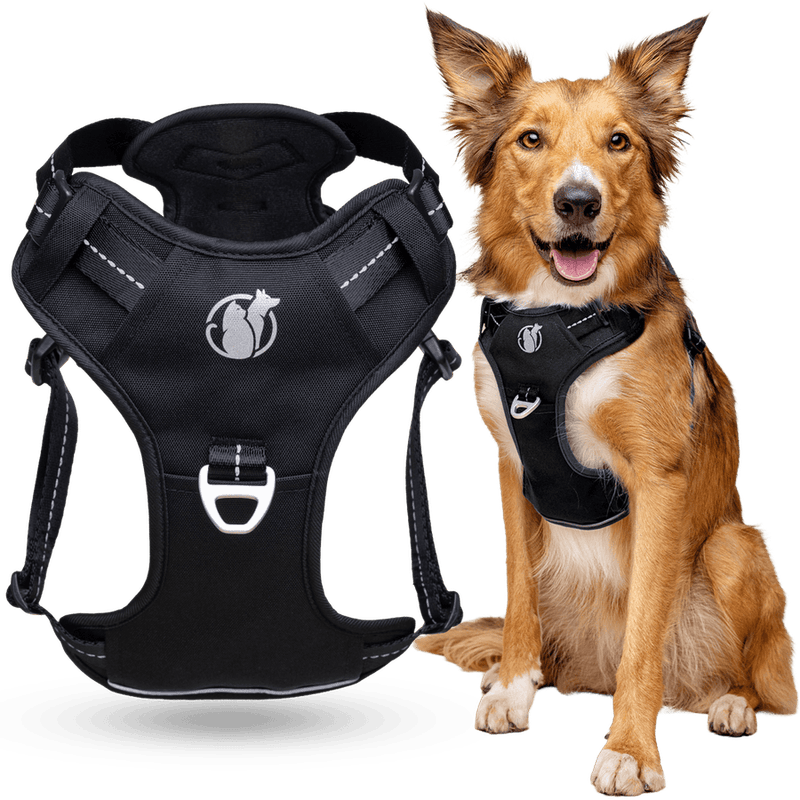
Stop Your Dog Pulling On Their Leash
The Steady+Style No Pull Harness uses front and back clip points to redirect pulling, so you get immediate, gentler control and can actually enjoy the walk again.
Shop Now 👉Better Walk Guarantee • 90-Day PawSafe® Promise
Best Harness for Small Dogs: Voyager Step-In Air
Price: $14.99 | Sizes: XXXS-XL | Best for: Small dogs, cats, head-shy dogs
Small dogs have unique harness needs. Their delicate tracheas are particularly vulnerable to collar pressure. VCA Hospitals recommends harnesses rather than collars for dogs with tracheal disease or suspected collapse because harnesses avoid direct pressure on delicate neck structures. The Voyager Step-In Air addresses this concern with a lightweight, neck-friendly design.
The step-in “clip and go” design means no pulling anything over your dog’s head - you simply lay the harness flat, have your dog step into the two leg openings, and secure the buckle on their back. Security features include hook-and-loop closure plus buckle plus double D-rings.
The breathable air mesh construction keeps small dogs cool (important since smaller breeds can overheat quickly), and the lightweight build doesn’t weigh them down. Reflective bands on many versions add visibility for evening walks.
Pros:
- Easy step-in design (great for head-shy dogs)
- Lightweight and breathable mesh
- Very affordable
- Wide size range including very small sizes
Cons:
- Often lacks a true front-clip training attachment
- Some reviews note chest-area irritation (typically a fit issue)
- Not ideal as a primary anti-pull harness for strong pullers
Best Harness for Hiking and Adventure: Kurgo Journey Air
Price: $42-47 | Sizes: XS-XL (12-44" chest) | Best for: Active dogs, outdoor adventures
For dogs who spend more time on trails than sidewalks, the Kurgo Journey Air was built to keep up. The deep V-neck design keeps shoulders freer for natural movement, while the wide padded chest plate reduces neck strain during activity.
The back handle provides assist capability, and front plus back leash attachments offer flexibility. At approximately 8 oz with lightweight rust-resistant aluminum hardware, it won’t weigh your dog down on long hikes. Reflective trim adds visibility for early morning or evening outings.
Materials include ripstop outer and breathable mesh inner construction. The Journey Air frequently appears in “adventure harness” testing roundups with praise for padding and trail-ready durability.
Pros:
- Excellent breathability for active dogs
- Deep V-neck preserves shoulder freedom
- Dual clip points
- Lightweight construction (~8 oz)
- Reflective trim for visibility
Cons:
- Neck-area adjustment can be fiddly
- Fit can vary by dog build (especially narrow “pencil-neck” types)
- May be overkill for casual walkers
More Top-Rated Harnesses We Tested
2 Hounds Design Freedom Harness
Price: $33-50 | Best for: Strong pullers, training
In a 2025 no-pull harness test, the Freedom Harness ranked as the “easy top choice” for its excellent construction, secure fit, and effective training results. The signature Swiss velvet-lined chest strap reduces rubbing and chafing behind the front legs - a common complaint with other harnesses.
Designed to work with a double-ended leash (front and back attachment), stainless steel hardware, and heavy-duty nylon webbing make this a serious training tool. Like other front-clip systems, the leash can sometimes end up under the dog’s legs, and fit setup requires attention - but for strong pullers paired with reward-based training, this is hard to beat.
Ruffwear Flagline
Price: $69.99 | Best for: Escape artists, tripod dogs, anxious dogs
The Flagline offers six adjustment points and three leash connection points in a lightweight package with lift-assist capability. It’s especially popular among tripod dog owners for its load-dispersing chest/belly panel and balanced support.
The low-profile fit makes it extremely difficult for dogs to back out, making it our top pick for reactive dogs who may panic and try to escape when startled. Like most multi-strap harnesses, it rewards careful fitting - lift panels can rub if placed too close to the armpit.
Julius K9 IDC Powerharness
Price: $35-50 | Sizes: Baby 1 through large working-dog sizes | Best for: Working dogs, urban control, high visibility
The Julius K9 is instantly recognizable by its interchangeable label patches and “one-click” quick on/off design. The manufacturer emphasizes chest-zone load distribution and neck freedom, with the chest strap sitting lower than most harnesses.
Important note: this is not inherently a no-pull harness. The base design focuses on a single girth strap plus chest plate (no between-the-legs strap), so escape risk exists for certain dogs if fitting and supervision aren’t careful. Some reviewers note the material feels stiffer than older versions. Best for urban control with handle access and high-visibility needs rather than dedicated no-pull training.
Blue-9 Balance Harness
Price: $39.95 (standard), $49.95 (reflective) | Best for: Sensitive dogs, professional training, oddly-shaped dogs
Professional trainers often recommend the Balance Harness for its six-point adjustment system that accommodates deep-chested, narrow, and “oddly shaped” dogs better than most competitors. Front plus back rings support single-clip or double-ended leash setups.
Major review outlets highlight comfort and humane control compared with aversive collars. The tradeoff: more adjustment points mean a steeper learning curve. Some users expect “no-pull” results without training and are disappointed - the front clip helps, but it’s not a magic fix without consistent training.
How We Tested These Harnesses
We evaluated each harness across six key criteria:
Fit and Adjustability: How many adjustment points does the harness have? Can it accommodate different body shapes? Does it stay in place during activity?
Pull Control: Does the harness reduce pulling behavior? How effective is the front-clip design (if present)? Does it redirect without causing discomfort?
Comfort: Is the harness padded where it matters? Does it allow natural movement? Does the material breathe during activity? Any signs of rubbing or chafing after extended wear?
Durability: How does the material hold up to regular use? Are the buckles and hardware sturdy? How do seams and stitching fare over time?
Ease of Use: How quickly can you put the harness on and take it off? Is it intuitive for first-time users? Can you adjust it without your dog’s cooperation?
Safety Features: Does the harness have secure buckles? Reflective elements? A handle for quick control? Is the design escape-resistant?
Make Every Walk Feel Under Control
Adjustable comfort design helps reduce leash tension fast so walks become calm, consistent, and more enjoyable for both of you.
Shop Now 👉Better Walk Guarantee • 90-Day PawSafe® Promise
How to Choose the Right Dog Harness
Types of Dog Harnesses

Back-Clip Harnesses: The leash attaches to a D-ring on the dog’s back. Comfortable for dogs that already walk politely, but can give many dogs stronger leverage to pull forward. Veterinary guidance notes that while harnesses distribute pressure across the body, back-clip designs can make pulling more comfortable - which is why some dogs pull more in them without training.
Front-Clip Harnesses: The leash attaches at the chest, redirecting forward momentum when dogs pull. The AKC explains that when a dog pulls, a front-clip harness gives the handler more leverage because the leash is attached to the front of the body. Pulling tends to turn the dog slightly sideways, making pulling less rewarding.
Dual-Clip Harnesses: Feature both front and back attachment points. AKC notes that using a harness with two points of contact can help reduce pulling while you work on training - and allows switching between “training walks” (front) and relaxed walks (back) without changing gear.
Step-In Harnesses: Your dog steps into two leg holes, and you secure it on their back. Easier for dogs that dislike overhead gear and common in small-dog mesh vest harnesses.
Overhead Harnesses: Slip over the dog’s head, then buckle around the belly. Usually more secure than step-in designs, but some dogs dislike the over-the-head experience.
Vest-Style Harnesses: Broader fabric panels for comfort and pressure distribution, but extra coverage can increase heat retention and may rub if edges sit in the armpit zone. For more on each harness style, see our complete guide to dog harness types.
Understanding Y-Shaped Harness Design
You’ll often hear trainers recommend “Y-front” or “Y-shaped” harnesses. These route straps from the sternum up toward the shoulders, creating a Y shape rather than a straight strap across the front of the shoulders. The theory is that this geometry avoids compressing the shoulder joint, preserving natural reach during movement.
However, research paints a more nuanced picture. A treadmill study published in Veterinary Record found that both restrictive and non-restrictive harnesses decreased shoulder extension compared with no harness at all. The practical takeaway: prioritize harnesses that avoid a hard straight strap sitting over the shoulder, but understand that any harness can affect movement if poorly designed or poorly fitted - and even “non-restrictive” marketing claims don’t guarantee zero gait impact.
Key Features to Consider
Clip Location: Front clips help with pulling; back clips are more comfortable for well-trained dogs.
Padding: Essential for comfort, especially around the chest. Watch for straps that sit too close to the armpit - this is where most rubbing occurs.
Adjustability: More adjustment points mean better fit customization. Look for at least four adjustment points, especially for dogs with unusual proportions.
Material: Breathable mesh for active dogs; padded nylon for comfort; ripstop fabrics for durability. Polyester webbing generally has stronger UV/color retention than nylon, while nylon offers high abrasion resistance.
Reflective Elements: Important for early morning or evening walks.
Handle: Useful for quick control in traffic, with other dogs, or when assisting your dog over obstacles.
Sizing Your Dog Correctly

Proper fit is the most important factor in harness performance. A harness that’s too loose won’t control pulling and can allow escape; too tight causes discomfort and restricts movement.
To measure your dog:
-
Chest girth: Measure around the widest part of your dog’s ribcage, just behind the front legs. This is the most important measurement for most harnesses.
-
Neck: Some harnesses (especially Y-front/active designs like the Kurgo Journey Air) also use a neck measurement at the base of the neck.
The two-finger rule: Once the harness is on, you should be able to slide two fingers (flat, not stacked) under straps without forcing. This ensures the harness is snug enough to stay in place without being restrictive.
Common fitting mistakes:
- Choosing size by weight instead of measurement (especially problematic for deep-chested or narrow-necked dogs)
- Letting straps sit too close to the armpit/behind the elbow, causing rub
- Assuming a no-pull harness will fix pulling without training
Signs of poor fit:
- Harness rotates or shifts during walks
- Chafing or hair loss under straps
- Dog can back out of the harness
- Red marks on skin after removal
- Reduced stride or reluctance to move
A Note on Continuous Wear
Harnesses are designed for walks and outings, not 24/7 wear. A 2025 review of no-pull harnesses cautions that continual wear could contribute to skeletal and skin issues. Remove the harness when your dog is resting indoors, and check for any rubbing or irritation after walks.
Harness vs. Collar: When to Use Each
While collars work fine for many dogs, certain situations call for a harness. Our harness vs. collar guide covers this in depth, but here’s the quick version:
Use a harness for:
- Dogs that pull (protects the neck)
- Small breeds (VCA Hospitals recommends harnesses for dogs with tracheal concerns)
- Brachycephalic breeds - the RSPCA explicitly advises walking flat-faced dogs on a harness rather than a collar to avoid neck pressure and help them breathe more easily
- Dogs with neck or spine issues
- Escape artists
- Puppies learning to walk on leash
Collars may be fine for:
- Well-trained dogs who don’t pull
- ID tag display (use with harness for walks)
- Quick bathroom breaks in enclosed areas
Most pet parents find that using both works best - a collar for ID tags that stays on all the time, plus a harness for walks and outdoor activities.
Why Pulling Matters (For You and Your Dog)
Leash pulling isn’t just annoying - it can be dangerous for both you and your dog. A U.S. emergency department study estimated 356,746 dog-leash-related injuries nationally between 2001-2018, with the injury rate increasing substantially over time. Falls, tangles, and sudden pulls account for most human injuries.
For dogs, constant pulling against a collar can contribute to neck strain and, in small breeds, tracheal issues. A harness distributes that pressure across the chest and shoulders, making walks safer for everyone.
Enjoy Calm Walks Starting Today
Dual-attachment harness distributes pressure and helps turn tug-of-war outings into relaxed, bonding strolls from the first use.
Shop Now 👉Better Walk Guarantee • 90-Day PawSafe® Promise
Frequently Asked Questions
Are no-pull harnesses bad for dogs?
No. A 2025 review of collars, harnesses, and head-collars concludes that non-tightening front-clip harnesses can offer a good balance between minimizing discomfort and reducing pulling. The key is choosing a design that doesn’t restrict shoulder movement (look for Y-shaped front panels) and ensuring correct fit. No-pull harnesses are far safer than prong collars, choke chains, or shock collars, which can cause physical and psychological harm.
How tight should a dog harness be?
Use the two-finger rule: you should be able to slide two flat fingers under straps without forcing. The harness should be snug enough that it doesn’t rotate or allow your dog to back out, but loose enough that it doesn’t restrict breathing or movement. Pay special attention to strap placement behind the elbows - this is where rubbing most commonly occurs.
Can dogs wear a harness all day?
It’s not recommended. Extended wear can cause skin irritation, matted fur, and potentially skeletal issues with certain designs. Harnesses are meant for outings (walks, hikes, car rides), not continuous use. Remove the harness when your dog is resting indoors.
How do I stop my dog from pulling on walks?
Based on our no pull dog harness reviews, a no-pull harness is a helpful tool - but it’s not a complete solution. Multiple training sources emphasize that loose-leash walking is a learned skill - equipment can make pulling manageable and safer, but training is what changes behavior long-term.
Combine the harness with consistent training: reward attention and check-ins, reinforce walking near you, and practice in low-distraction environments before graduating to busier areas. The harness makes pulling less rewarding mechanically, but training teaches your dog what you actually want.
What size harness does my dog need?
Measure your dog’s chest girth (around the widest part of the ribcage, behind the front legs) and compare to the manufacturer’s size chart. When in doubt, size up - most harnesses are more adjustable toward the smaller end of their range. If your dog is between sizes, consider their body shape: deep-chested dogs often need to size up.
How often should I replace my dog’s harness?
There’s no universal lifespan - replacement depends on use frequency, dog strength, and environmental exposure (water, sand, UV). Some sources suggest 1-2 years for frequently used harnesses, others 2-3 years for normal walking with proper care.
The most important approach: inspect regularly and replace at the first sign of compromised integrity. Red flags include frayed webbing, loose stitching, damaged/bent hardware, cracked plastic buckles, and degraded reflective elements. Puppies will need new harnesses as they grow - this is why budget harnesses often make sense as “starter” gear.
The Bottom Line
The best dog harness depends on your specific needs and your dog’s behavior. For most pet parents - especially those dealing with pulling - our PawSafe Steady Style delivers the best combination of effective no-pull control, premium features, and value at $64. The front-clip design genuinely stops pulling, and thoughtful additions like the AirTag pocket, padded grab handle, and included rope leash make it a complete walking solution backed by our 90-day Better Walk Guarantee.
For pet parents whose dogs walk well and don’t need pull correction, the Ruffwear Front Range ($60) is a durable everyday option with quality construction. For serious pullers who want a dedicated training tool, the 2 Hounds Design Freedom Harness earned top marks in independent testing. And if budget is tight, the Rabbitgoo No Pull ($18-30) delivers workable performance for mild to moderate pullers.
Whatever you choose, remember that proper fit matters more than brand or price. Take time to measure your dog accurately, adjust the harness carefully at each wearing, and check regularly for signs of wear or discomfort. And remember: a harness is a tool, not a magic fix. Pair it with consistent, reward-based training for the best results.
We hope these dog harness reviews help you find the right fit. A well-fitted harness transforms walks from a battle of wills into what they should be: quality time exploring the world together with your favorite companion. Browse our dog harness collection to find your perfect match.
Looking for more harness recommendations? Check out our guide to the best harnesses for reactive dogs.