

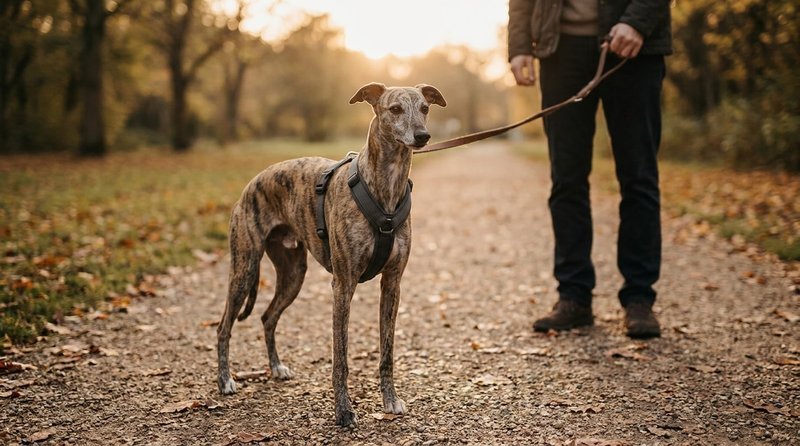
An escape-proof dog harness is a walking harness built to stop a dog backing or slipping out, usually with a third strap around the narrower waist behind the ribcage. It works because a dog’s chest is deeper than its waist, so the rear strap cannot slide forward over the wider chest when the dog reverses. Fit matters more than the label: a snug neck opening and correct strap position are what hold your dog. No harness is 100% escape-proof, so a serious flight risk also needs a backup.
You know the feeling. Your dog ducks their head, throws it into reverse, and in one horrible second the harness is dangling from the leash - empty - while your dog stands loose on a busy pavement. Your heart drops. And once a dog learns that trick, every walk afterward feels different.
Here’s the honest truth most product pages won’t tell you: plenty of harnesses are sold as “escape proof,” and most of them aren’t. Whether a dog can back out comes down to where the straps sit and how well the harness fits - not what the label says. There’s no official “escape proof” standard for walking harnesses, so the word is marketing, not a guarantee.
This guide breaks down what actually stops a dog backing out, which designs hold up on a determined escape artist, how to fit one safely, and honest picks by dog type - including small dogs. We’ve helped 300,000+ pet parents walk their dogs more safely, and we test gear on our own dogs. We’ll also be clear about the limits, because keeping your dog safe matters more than selling you a promise.
Table of Contents
- What Is an Escape Proof Dog Harness?
- Why Dogs Back Out of Their Harness
- What Makes a Harness Escape Proof
- Escape-Resistant Harness Designs Compared
- Are Escape Proof Harnesses Safe?
- The Backup That Stops the Worst Case
- Escape Proof Dog Harnesses for Small Dogs
- How to Fit an Escape Proof Harness So It Actually Works
- Where a No-Pull Harness Fits In
- Frequently Asked Questions
- The Bottom Line on Escape Proof Dog Harnesses
What Is an Escape Proof Dog Harness?
An escape proof dog harness - also sold as a “no escape harness for dogs” or an “escape free harness for dogs” - is a harness designed to make backing or slipping out much harder. They all describe the same idea, and the defining feature is almost always a third strap.
A standard harness has two loops: one around the neck opening and one girth strap around the chest, just behind the front legs. An escape-resistant harness adds a third strap further back, around the narrower part of the body behind the ribcage. The American Kennel Club describes this three-point style - neck, chest, and belly straps - as the design suited to escape artists.
Because it’s more accurate, we’ll often use the term escape-resistant rather than escape proof. As rescue group Best Friends Animal Society puts it, “a harness is not foolproof.” A well-chosen one dramatically lowers the odds of an escape. It doesn’t eliminate them.
Why Dogs Back Out of Their Harness
To pick the right harness, it helps to understand exactly how dogs get loose. It’s not magic - it’s geometry and panic.
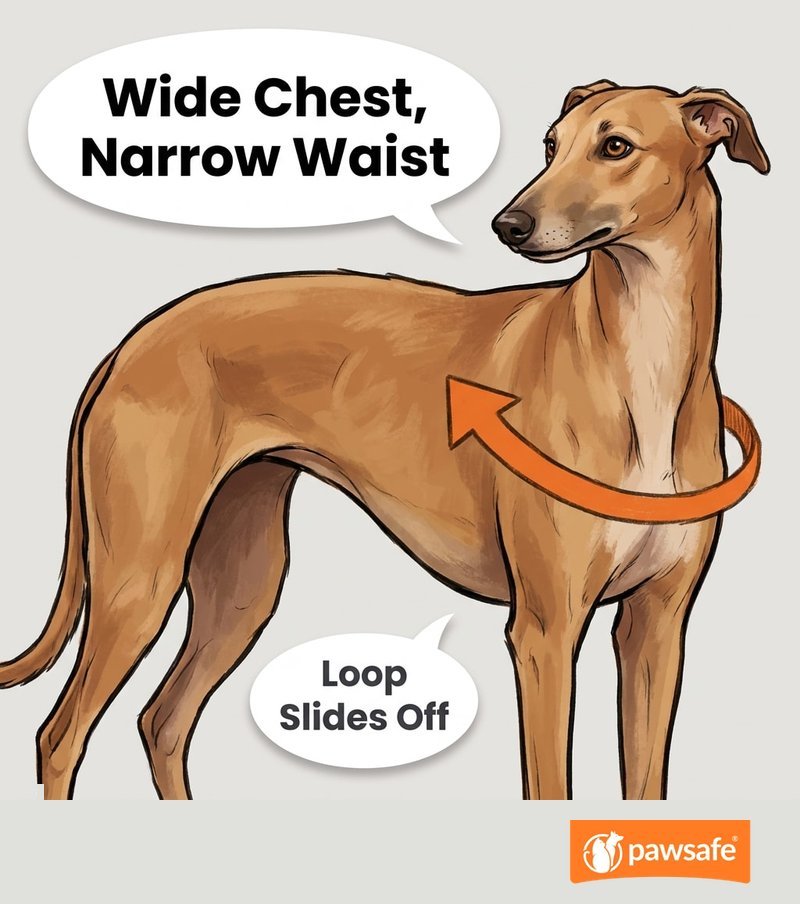
Here’s the sequence: the leash stays tensioned in front of the dog, the dog lowers its head and shoulders, braces its front legs and moves backward. If there’s slack or the neck opening is too big, the harness slides toward the head, the elbows fold through the leg openings, and the whole thing passes over the skull. Trainers sometimes call it the “Superman” reverse.
The reason a two-strap harness is easy to reverse out of comes down to body shape. A dog’s chest, right where the girth strap sits, is the widest part of their torso. Their waist is narrower. When they back up, that girth loop only has to travel forward over an ever-wider chest to come off. This is most obvious on sighthounds - the AKC describes Greyhounds and Whippets as having “a very noticeable ‘tuck-up,’ or waist” in front of a deep chest.
Three things make it worse:
- Panic. A frightened dog - startled by a noise, a stranger, or another dog - doesn’t respond to leash pressure the way they do in calm training. Fear triggers frantic reversing, spinning and lunging.
- Poor fit and slack. This is the single most fixable cause. A harness with loose straps or an oversized neck opening gives a dog the room they need to slip out.
- A narrow head. Small dogs and sighthounds whose heads are barely wider than their necks can slide out of both harnesses and collars.
None of this means your dog is being difficult. Backing out is a normal, physical response - which is exactly why the right equipment and fit solve it.
What Makes a Harness Escape Proof
The mechanism is simpler than the marketing suggests. An escape-resistant harness works by putting a strap where the dog is narrow, so it can’t slide off over the part where they’re wide.
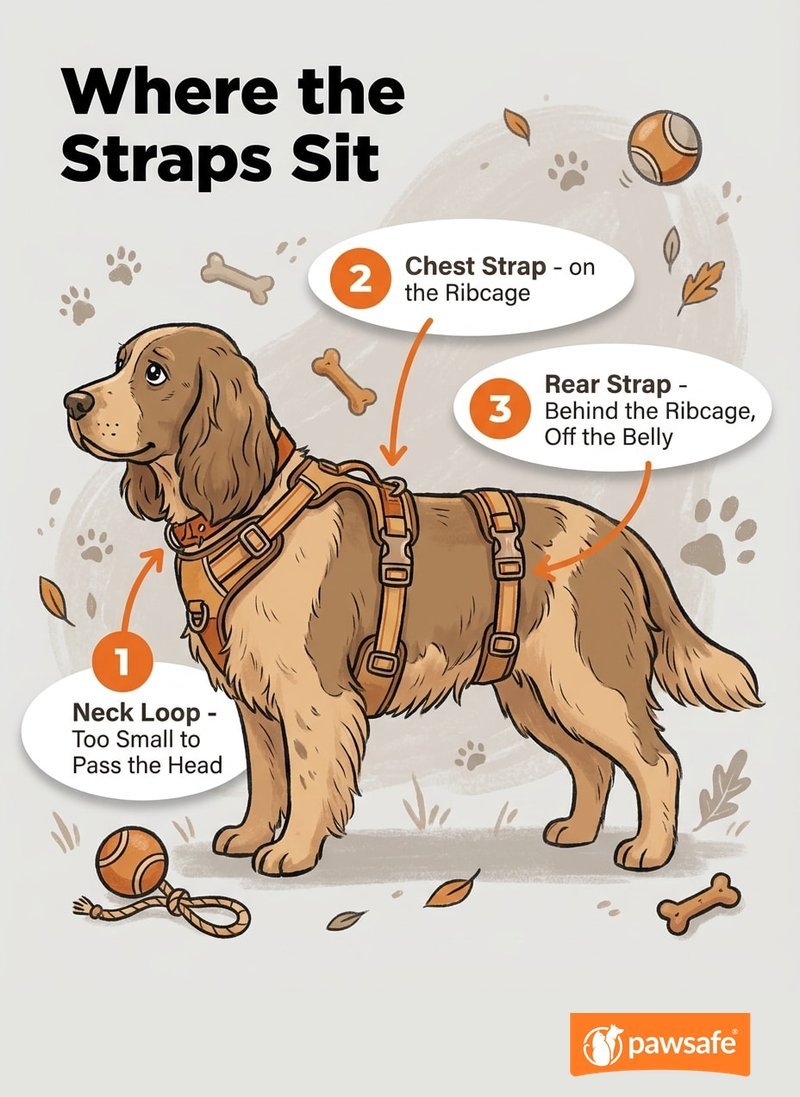
When a rear retention strap sits around the smaller circumference near the back of the ribcage, a dog trying to reverse would have to drag that loop forward over the wider ribs and chest in front of it. It won’t go. That same strap also stops the rest of the harness migrating toward the head.
But there’s an important nuance the honest sources insist on: “behind the ribcage” should not mean “on the stomach.” A load-bearing strap belongs on the rib-supported part of the body, not cinched around the soft belly. Veterinary fitting guidance is clear that both torso straps of a safety harness should rest on the ribcage. The best way to think about it: the rear strap sits near the back of the ribcage, around the waist transition, while staying supported by ribs - not squeezing the abdomen.
Body shape changes how well this works:
- Deep-chested dogs (Greyhounds, Whippets, Italian Greyhounds) have a big change between chest and waist, so a rear strap has a clear anatomical “stop” to catch on. VCA notes these dogs may need a double-H style harness, and says of a correctly fitted one: “The dog can’t back up and slip out of the harness.”
- Barrel-chested dogs (Bulldogs, Boxers) have little tuck. There may be no narrow point behind the chest, and pushing a strap back to find one can put it over vulnerable belly tissue. These dogs need highly adjustable harnesses, a very secure neck opening, and a backup connection.
The neck opening matters just as much as the third strap. Under backward tension it has to stay too small to pass over the skull. No rear strap can rescue a harness whose neck loop slides over the head.
Escape-Resistant Harness Designs Compared
Not every “no escape” harness works the same way. Here’s a fair comparison of the main approaches, with the trade-offs each one carries.
| Design | How it resists escape | Best for | Watch-outs |
|---|---|---|---|
| Three-strap (belly strap) | Rear strap sits behind the ribcage where the dog is narrow | Most escape artists, deep-chested dogs | Rear strap must stay off the soft belly; check armpit clearance |
| Limited-slip / martingale-style | A front section takes up preset slack under leash tension, then stops | Dogs who slip a bit loose; extra steering | Tightening range must be limited; not proven to beat a well-fitted fixed harness |
| Long / tactical | Extra body coverage and rigid panels reduce migration | Strong, powerful dogs; working handlers | Heavier and hotter; still slippable if fit is wrong |
| Well-fitted standard no-pull | Snug adjustment removes the slack that enables backouts | Occasional slippers; dogs whose main issue is pulling | No dedicated rear strap; not enough for a determined deep-chested backer |
The widely trusted benchmark for serious escape artists is a genuine three-strap harness like the Ruffwear Web Master, which independent reviewers and shelters have leaned on for years precisely because its rear strap sits far enough back to stop most backouts. It’s not the only good option, and it isn’t perfect - some dogs find the rear strap sits close to the armpits - but it’s a fair reference point for what “three-strap” really means.
A word on limited-slip designs: they can remove temporary looseness, but “tightens when the dog pulls” is not the same as “escape proof.” A 2025 review of walking equipment cautioned that tightening gear can cause more discomfort than non-tightening options, and there’s no trial showing a cinching harness prevents more escapes than a well-fitted fixed one. Choose one with a hard stop on how far it tightens.
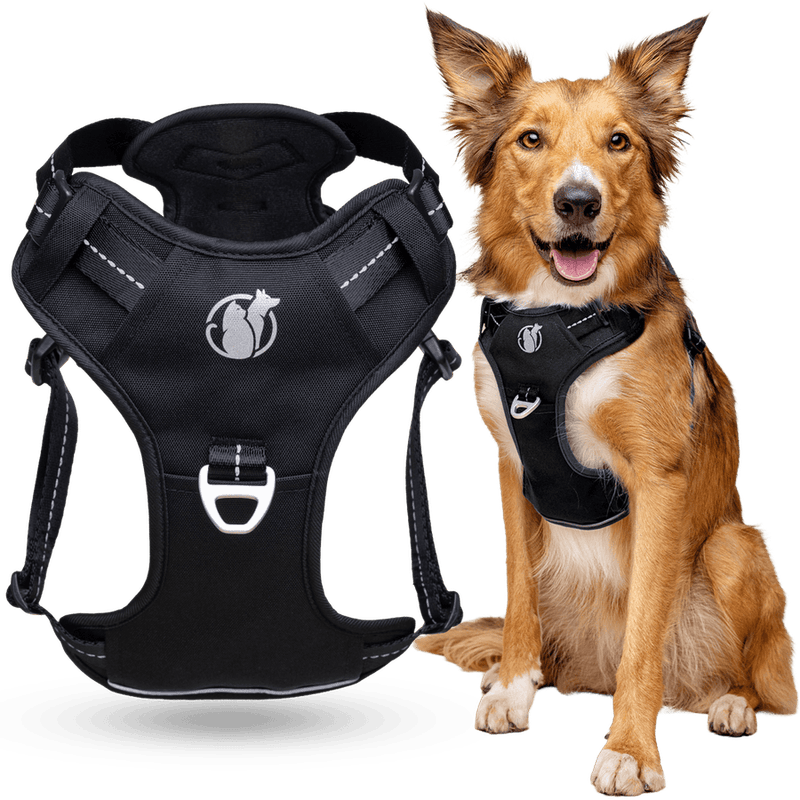
Stop Your Dog Pulling On Their Leash
The Steady+Style No Pull Harness uses front and back clip points to redirect pulling, so you get immediate, gentler control and can actually enjoy the walk again.
Shop Now 👉Better Walk Guarantee • 90-Day PawSafe® Promise
Are Escape Proof Harnesses Safe?
This is the question the product pages skip, and it’s the one that matters most. An escape-resistant harness is safe when it’s designed and fitted well - and genuinely risky when it isn’t.
The core rule: the sternum and ribs are built to carry leash loads. The soft abdomen is not. A rear strap can act as a passive retention loop, but the main pulling force should be spread across the chest and ribcage. Be wary of any harness that puts the leash load on a narrow strap behind the ribs, cinches without a mechanical stop, or tightens directly over the stomach. A panicking dog thrashing against a rope tightening over its belly can be hurt.
A few more honest cautions:
- Shoulder movement. Harness shape alone doesn’t guarantee free movement. A 2019 treadmill study found both harnesses tested reduced shoulder extension compared with no harness - and the one marketed as “non-restrictive” actually reduced it more. Judge movement on your own dog: they should be able to fully extend each front leg, with no shortened stride or flared elbows.
- Armpit chafing. Straps that sit in the armpit, rotate, or stay wet against the skin can rub. Padding feels soft but can trap moisture and grit. Check the armpits and skin after the first few walks.
- Heat. Large padded panels cover more skin and dry slowly. It’s sensible to watch a heavily padded harness in hot weather, though “padded harnesses cause overheating” isn’t an established fact.
If your dog is a true flight risk with no reliable recall, security can reasonably take priority over these smaller concerns - but you should still avoid abdominal cinching and check the fit carefully.
The Backup That Stops the Worst Case
Here’s the mindset shift that changes everything: the harness alone is never truly escape proof. The system is. And the most reliable system uses two independent points of contact.
A short safety connector joins the harness to a separate, properly fitted collar. During a normal walk it stays loose so the harness carries the load. But if your dog ever exits the harness, the leash is still attached through the collar. For a dog with a real flight history, rescue organizations recommend exactly this kind of redundancy - and AKC veterinary behaviorist Amy Pike recommends an escape-resistant harness or a double system for known runners.
For narrow-headed dogs, a properly fitted martingale collar makes a good backup - it tightens only to a preset stop so it can’t pass over the skull, without becoming a choke. Set the stop carefully, never leave it on an unattended dog, and check with your vet first if your dog has any throat, neck or eye condition.
Then there’s the layer that helps after an escape, not before it. A secure harness lowers the odds of a getaway; identification and tracking limit the harm if one happens. A registered microchip is the backbone - in one large study, microchipped dogs were returned to their owners 52.2% of the time, versus a 21.9% median for stray dogs overall, though only 58.1% of owners had kept their registration current. Add a readable ID tag, recent photos, and a tracker for high flight-risk dogs. It’s worth knowing that an Apple AirTag uses the crowdsourced Find My network rather than live GPS, so it’s a locating aid, not a real-time pet tracker. This is one place a thoughtfully built walking harness helps: a rear D-ring for a collar connector, plus somewhere discreet to tuck an AirTag, turns your everyday gear into part of the safety system.
Escape Proof Dog Harnesses for Small Dogs
Small dogs are their own challenge. A neck opening or collar that would never clear a Labrador’s head slides right over a Chihuahua’s, and tiny sizing errors are proportionally huge. If you’re searching for an escape proof dog harness for small dogs, fit is the whole game.
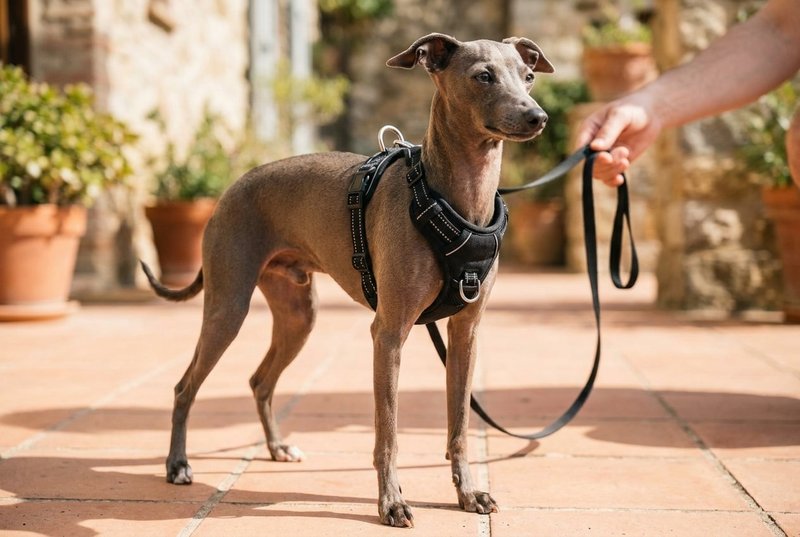
What to look for:
- Measure, don’t guess. Take the actual neck and ribcage measurements rather than sizing by weight. Small frames vary enormously.
- Head-clearance check. The neck loop must be too small to pass over the skull - test it gently before you rely on it.
- Light hardware. Heavy buckles drag a small harness sideways and open gaps. Choose lightweight components that still hold a panic lunge.
- Keep load off the throat. Toy breeds like Yorkies, Pomeranians and Chihuahuas are prone to tracheal collapse, and both VCA and the American College of Veterinary Surgeons recommend a body harness rather than a neck lead for them. A harness reduces external pressure on the throat - just don’t use a collar as the primary brake for a coughing or airway-compromised dog.
- Inspect the armpits often. Small dogs chafe easily; a smooth, clean lining matters.
For a lot of small dogs, a snug, correctly sized harness plus a well-fitted martingale backup is a more comfortable answer than a heavy tactical rig.
How to Fit an Escape Proof Harness So It Actually Works
The best harness in the world won’t hold if it’s fitted loose. This is where escapes are won or lost.
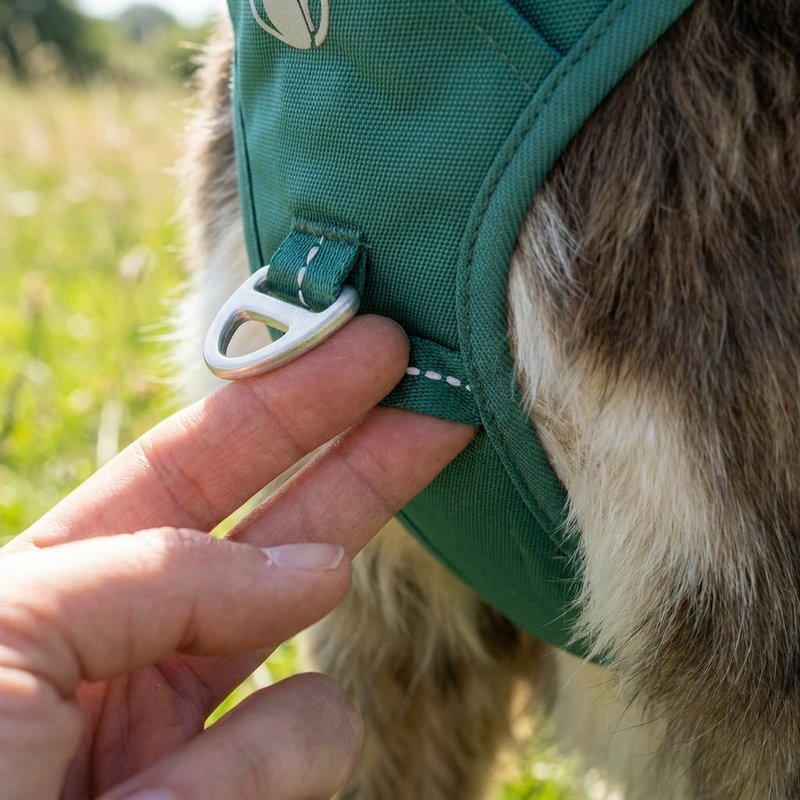
Work through these steps:
- Measure chest girth. Wrap a tape around the widest part of the ribcage, just behind the front legs, while your dog stands. This is your primary measurement - check it against the brand’s chart, because sizes aren’t standardized.
- Apply the two-finger rule. Adjust so you can slide about two fingers under each strap. It’s a starting point, not the finish - coat depth and strap stiffness change the feel.
- Position the straps. The neck/chest junction sits low on the chest toward the sternum, not across the throat. The rear strap sits near the back of the ribcage, never squeezing the belly.
- Run the reverse test. In a secure, fenced area, gently pull the harness forward, backward and sideways. Watch whether the neck loop approaches the ears, and ask your dog to walk, turn, sit and lie down. The AKC recommends deliberately checking what happens when the dog moves backward - if the opening can pass over the head, it isn’t secure enough.
- Recheck after every early walk. Straps settle and slip. Confirm the fit for the first several outings, and never test by frightening your dog.
Watch for signs of poor fit: the harness rotating around the body, a leg entering an opening, straps riding into the throat or armpits, hair loss or sores, a shortened stride, or coughing. Any persistent cough, limp, skin wound or sudden harness intolerance is worth a vet visit. Snug is not the same as tight: tighten to remove the slack a dog can reverse out of, never to the point of restricting breathing, which is the whole idea behind a no-choke dog harness.
Where a No-Pull Harness Fits In
So where does a good everyday harness sit in all this? Honestly - and this is the honest part - most escapes trace back to a loose, poorly fitted harness. A snug, adjustable harness removes that slack, and a front clip plus a top handle give you real control in the exact moment a dog tries to bolt.
That’s the genuine strength of our Steady+Style No Pull Harness. It’s a front-clip, two-point harness with a padded chest plate, multiple adjustment points for a slack-free fit, reflective stitching, a built-in padded top handle for instant control, and a rear D-ring that’s seatbelt-compatible and ready for a collar connector. There’s even a hidden pocket sized for an Apple AirTag - part of that after-the-fact safety layer we talked about.
But we’ll be straight with you: the Steady+Style is a well-fitted no-pull harness, not a dedicated three-strap escape harness. For a confirmed, deep-chested Houdini who has learned to reverse out, a purpose-built three-strap design - paired with a collar backup - is the right tool, and we’d rather tell you that than oversell. If your dog’s main issue is pulling with the occasional slip, a snug no-pull harness plus a collar connector covers a lot of ground. If your dog is a committed escape artist, prioritize the third strap.
For a wider look at how the styles differ, see our guide to the types of dog harnesses, browse hands-on write-ups in our dog harness reviews, or explore the full dog harness collection and guides.
Make Every Walk Feel Under Control
Adjustable comfort design helps reduce leash tension fast so walks become calm, consistent, and more enjoyable for both of you.
Shop Now 👉Better Walk Guarantee • 90-Day PawSafe® Promise
Frequently Asked Questions
What is an escape proof dog harness?
An escape proof dog harness is a walking harness built to stop a dog backing or slipping out, usually with a third strap that sits around the narrower waist behind the ribcage. Because the chest is deeper than the waist, that rear strap can’t slide forward over the wider chest when the dog reverses. “Escape proof,” “no escape,” and “escape free” all describe the same idea, but none is a certified standard - fit is what makes it hold.
Why does my dog back out of the harness?
Most backouts happen when a dog lowers its head, braces its front legs and reverses while there’s slack or an oversized neck opening. The harness migrates toward the head and slips off. Deep-chested dogs and small narrow-headed dogs are especially prone because the girth strap can travel forward over the wider chest. A loose or poorly fitted harness is the single most fixable cause.
Can a dog still escape an escape proof harness?
Yes. No harness is 100% escape proof. Incorrect sizing, loose straps, chewed webbing, broken hardware, an unusual body shape or sheer panic can all defeat one. Rescue guidance from Best Friends Animal Society puts it plainly: a harness is not foolproof. Treat any “escape proof” claim as escape-resistant, and add a backup connection for a serious flight risk.
Enjoy Calm Walks Starting Today
Dual-attachment harness distributes pressure and helps turn tug-of-war outings into relaxed, bonding strolls from the first use.
Shop Now 👉Better Walk Guarantee • 90-Day PawSafe® Promise
Are no escape harnesses safe for my dog?
They can be, when fitted correctly. The load-bearing straps should sit on the ribcage, not cinch across the soft belly, because the abdomen isn’t built to take pulling force. Avoid designs that tighten without a mechanical stop or narrow sharply under load. Check the armpits and skin after early walks, and see your vet if your dog coughs, limps or suddenly resists the harness.
What’s the best escape proof harness for small dogs?
For small dogs, fit matters more than bulk. Measure the actual neck and ribcage rather than sizing by weight, make sure the neck loop can’t pass over the skull, and choose lightweight hardware that won’t drag the harness sideways. Keep pressure off the throat - toy breeds are prone to tracheal collapse - and add a properly fitted martingale collar as a backup only if your vet agrees.
Do no-pull harnesses stop dogs from escaping?
A no-pull harness isn’t the same as an escape-resistant one, but a snug, well-adjusted no-pull harness removes the slack that lets many dogs back out, and a front clip plus a top handle give you control in the panic moment. For a confirmed deep-chested escape artist, choose a dedicated three-strap design and pair it with a collar backup.
How should an escape proof harness fit?
Measure chest girth at the widest part of the ribcage behind the front legs, then adjust so you can slide about two fingers under the straps. The neck opening must be too small to pass over the head - test this by gently pulling the harness forward, backward and sideways in a secure area. The rear strap should sit near the back of the ribcage without compressing the belly.
The Bottom Line on Escape Proof Dog Harnesses
An escape proof dog harness isn’t about a magic buckle or a bold label - it’s about a few things working together:
- The third strap does the work, sitting where your dog is narrow so it can’t slide off over the wider chest.
- Fit beats everything. A snug neck opening that can’t clear the head, and straps on the ribs rather than the belly, are what actually hold.
- Be honest about the limits. No harness is 100% escape proof, so name the trade-offs and skip anything that cinches over the soft stomach.
- Build a system. For a real flight risk, add a collar backup and a registered microchip - two points of contact beat one every time.
Get those right and walks stop being a white-knuckle experience. Whether your dog needs a dedicated three-strap harness or simply a snug, well-fitted no-pull harness with a collar connector, the goal is the same: a dog who stays safely attached, and a pet parent who can finally relax and enjoy the walk.