


Dog harness types include back-clip, front-clip, dual-clip, step-in, over-the-head, Y-harness, H-harness, and no-pull designs. Each type serves different purposes: back-clip harnesses work for calm walkers, front-clip redirects pulling dogs, dual-clip offers versatility, and no-pull designs discourage leash tugging. The right choice depends on your dog’s behavior, body shape, and intended activities. Y-shaped harnesses allow full shoulder movement, while H-harnesses suit dogs with narrow chests. Understanding each type ensures comfortable, effective walks for both you and your dog.
Walking the dog gear aisle can feel overwhelming - harnesses come in more styles than coffee drinks. Front-clip, back-clip, step-in, Y-harness… what actually matters?
The wrong harness choice leads to real frustration. Dogs slip out. Pulling gets worse. Your pup seems uncomfortable. And you’re back at the pet store, trying again.
Here’s what actually matters: with 82.7% of dogs pulling on lead according to a 2021 survey of 2,531 pet parents, choosing the right dog harness type isn’t just about preference. It’s about matching equipment to your dog’s behavior, body, and the activities you do together.
This guide breaks down every harness type, when to use each, and how to match one to your dog’s needs. We’ve helped 300,000+ pet parents find the right walking gear - and we use these harnesses on our own dogs every day.
Table of Contents
Dog Harness Types at a Glance
Before diving into details, here’s every major harness type compared in one table:
| Harness Type | Best For | Clip Location | Pros | Cons |
|---|---|---|---|---|
| Back-Clip | Calm walkers, small dogs | Upper back | Easy to use, comfortable | No pull control |
| Front-Clip | Pullers, training | Chest | Redirects pulling | Leash can tangle |
| Dual-Clip | Versatility, training progression | Front + back | Best of both worlds | Slightly more complex |
| Step-In | Head-shy dogs | Back | No over-head motion | Can slip off narrow chests |
| Over-the-Head | Escape artists | Varies | Harder to slip out | Some dogs resist |
| Y-Harness | Active dogs, full mobility | Varies | Full shoulder movement | May not fit narrow chests |
| H-Harness | Narrow-chested dogs | Varies | Fits slim builds | Can restrict movement |
| No-Pull | Chronic pullers | Usually front | Discourages pulling | Requires proper fit |
| Vest | Small/long-haired dogs | Back | Comfort, style | Less control |
Pro Tip: Screenshot this table for your next shopping trip. It answers 90% of harness questions at a glance.
Understanding Harness Clip Positions
The clip position determines how your harness functions. This is the most important decision you’ll make.

Back-Clip Harnesses
A back-clip harness attaches the leash to a D-ring on your dog’s back, between the shoulder blades. It’s the most common setup and the easiest to use.
How it works: The leash connects behind your dog, giving them freedom of movement. There’s no steering or redirection - just a secure attachment point.
Best for:
- Dogs who already walk calmly on leash
- Small breeds where pulling isn’t an issue
- Casual neighborhood walks
- Long-line decompression walks
The limitation: Back-clip harnesses give dogs sled-dog leverage to pull harder. Research found that dogs pulled with greater maximal and mean leash tension in back-clip harnesses compared to collars when motivated. If pulling is your problem, back-clip makes it worse.
Front-Clip Harnesses
A front-clip harness attaches the leash to your dog’s chest, creating a pivot point that changes everything about pulling dynamics.
How it works: When your dog pulls forward, the front attachment turns them sideways toward you. Their own momentum redirects them back to you instead of propelling them forward. It’s physics, not pain.
The research: A controlled study found front-connection harnesses showed statistically significant differences in pulling impulse compared to collar baselines (Z = −3.69, p < 0.001). This wasn’t subtle - front-clip actually reduces pulling force.

Best for:
- Dogs that pull constantly
- Training loose-leash walking
- Dogs that lunge at triggers
- Managing strong dogs during walks
Consideration: The leash can tangle in legs with longer leads. Keep it at standard length (5-6 feet).
Dual-Clip Harnesses
Dual-clip harnesses offer both front and back attachment points, giving you options for different situations.
How it works: You choose which clip to use based on the situation - or use both simultaneously with a double-ended training leash.
Best for:
- Training progression (start with front, graduate to back)
- Owners wanting “training mode” and “casual mode”
- Dogs transitioning from pulling to loose-leash walking
- Versatile everyday use
Our Steady+Style No-Pull Harness features dual clips for exactly this reason - front for training, back for casual walks, both for maximum control.
Harness Styles by Design
Beyond clip position, harness construction affects fit, movement, and comfort.
Y-Harness vs H-Harness: What’s the Difference?
This is the question pet stores answer wrong most often. Here’s the actual distinction:

Y-Harness:
- Front straps form a Y-shape on the chest
- Vertical strap runs between front legs
- Allows full shoulder blade rotation
- Best for active dogs, running, hiking
A treadmill study found that while both harness types decreased shoulder extension compared to no harness at all, the difference between them was measurable. The key insight: “Y” and “non-restrictive” are marketing shorthand, not guarantees. Fit matters more than the label.
H-Harness:
- Front straps form an H-shape (horizontal across shoulders)
- No strap between legs
- Better for dogs who find Y-harness straps uncomfortable
- Best for narrow-chested breeds where Y-straps rub
Bottom line: Neither is universally better. Y-harnesses suit most dogs; H-harnesses work better for dogs with narrow spacing between front legs.
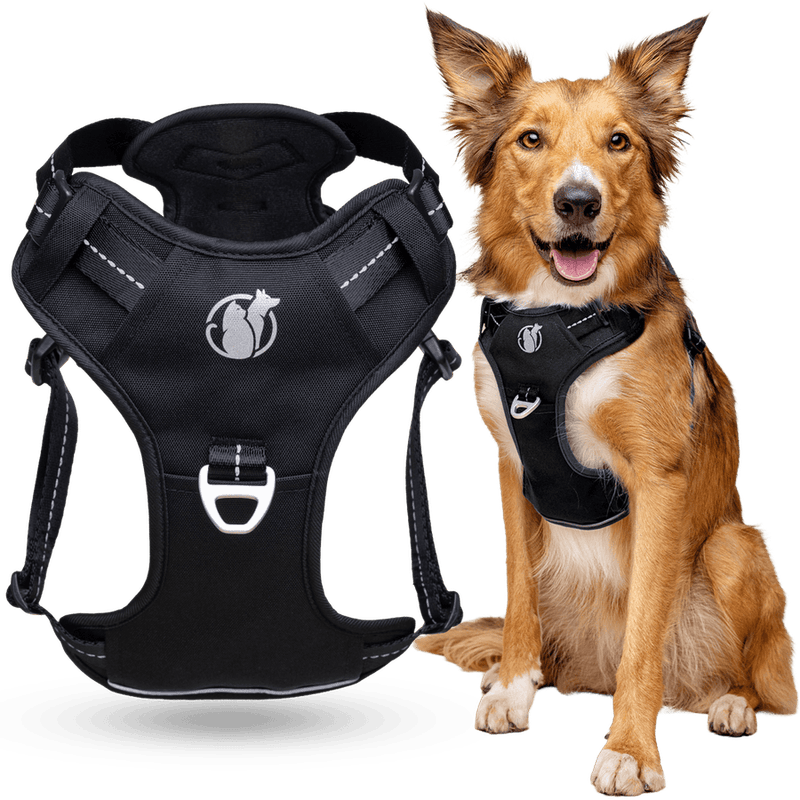
Stop Your Dog Pulling On Their Leash
The Steady+Style No Pull Harness uses front and back clip points to redirect pulling, so you get immediate, gentler control and can actually enjoy the walk again.
Shop Now 👉Better Walk Guarantee • 90-Day PawSafe® Promise
Step-In Harnesses vs Over-the-Head
This is about how you put the harness on, not how it functions during walks.

Step-In Harnesses:
- Place on ground, dog steps into two loops
- Pull up and buckle at the back
- No putting anything over your dog’s face or ears
Best for:
- Dogs that hate things over their head
- Head-shy or anxious dogs
- Dogs with ear sensitivities
Watch out: Step-in harnesses can be easier for some dogs to back out of, especially those with narrow heads. If your dog is an escape artist, this may not be the right choice.
Over-the-Head Harnesses:
- Slip over head like a collar
- Buckle around body below the chest
Best for:
- Escape-prone dogs
- Dogs who accept things over their head
- Security-conscious pet parents
Tip: For nervous dogs, condition slowly with treats. Let them put their nose through the opening voluntarily before sliding it over.
Strap Harnesses vs Vest Harnesses
Strap Harness:
- Lightweight webbing straps (usually nylon)
- Better for large, short-haired dogs
- More control, less bulk
- Dries quickly after water or rain
Vest Harness:
- More chest coverage with padded panel
- Better for small dogs, long-haired breeds
- Extra comfort, reduces chafing
- May be warmer in hot weather
For small breeds, vest harnesses distribute pressure more comfortably without overwhelming their frame with heavy buckles.
Special Purpose Harness Types
Some harnesses are designed for specific situations beyond daily walking.
No-Pull Harnesses
No-pull harnesses are front-clip harnesses specifically marketed for reducing pulling. The term describes function, not a separate category.
How they work: Front attachment + redirection = pulling becomes unproductive. Your dog’s own forward energy turns them back toward you.
What they don’t do: No-pull harnesses don’t teach your dog not to pull. Training does. The harness makes pulling ineffective while you train loose-leash walking. As veterinary behaviorists note, these are “management tools” that change outcomes today, while training changes behavior over time.
Key features to look for:
- Front D-ring (metal, not fabric loop)
- Padded construction for comfort
- Multiple adjustment points for secure fit
Sport and Activity Harnesses
Different activities call for different designs:
Running harnesses: Lightweight, breathable, Y-shaped for unrestricted movement. Some have handles for quick control.
Hiking harnesses: Sturdier construction, often with a lift handle for helping your dog over obstacles. Look for reflective elements for trail visibility.
Pulling sport harnesses: Designed FOR pulling (canicross, bikejoring, sledding). These maximize pulling efficiency - the opposite of walking harnesses.
Key point: Activity harnesses prioritize movement over control. If you’re hiking with a puller, you still want a front-clip option.
Car Travel Harnesses
Some harnesses double as vehicle restraints, but there’s an important distinction: a walking harness with a D-ring compatible with a seatbelt attachment is different from a purpose-built crash-tested harness.
If you need vehicle safety:
- Look for a sturdy D-ring that can connect to a dog seatbelt
- Ensure the harness fits securely without loose straps
- Always attach the seatbelt to the harness, never a collar
Both our Steady+Style No-Pull Harness and No-Pull Harness feature seatbelt-compatible D-rings for this purpose.
How to Choose the Right Harness Type for Your Dog
With all these options, how do you actually decide? Match harness type to three factors: behavior, body type, and activity.
Make Every Walk Feel Under Control
Adjustable comfort design helps reduce leash tension fast so walks become calm, consistent, and more enjoyable for both of you.
Shop Now 👉Better Walk Guarantee • 90-Day PawSafe® Promise
Match Harness to Behavior
| Your Dog’s Behavior | Recommended Type |
|---|---|
| Pulls constantly | Front-clip or no-pull |
| Calm walker | Back-clip for comfort |
| Pulls sometimes | Dual-clip for flexibility |
| Escapes harnesses | Over-the-head with tummy strap |
| Lunges at triggers | Front-clip for redirection |
Pulling is the most common issue - that 82.7% statistic isn’t an accident. If pulling is your challenge, start with front-clip.
Match Harness to Body Type

Different builds create different fitting challenges:
| Body Type | Best Harness Style | Avoid |
|---|---|---|
| Barrel-chested (Bulldogs, Pugs, Boston Terriers) | Adjustable girth, wide chest plate | Narrow straps |
| Deep-chested (Greyhounds, Whippets) | Over-the-head, tummy strap | Step-in only |
| Long-bodied (Dachshunds, Corgis) | Y-harness with tummy strap | Harnesses that ride up |
| Small breeds (Chihuahuas, Yorkies) | Padded vest, lightweight | Heavy buckles |
| Large/strong breeds (Labs, German Shepherds) | Sturdy construction, metal hardware | Plastic-only clips |
Why body type matters:
For brachycephalic (flat-faced) dogs, a 2025 study found that collars increased intraocular pressure during exercise, even when stationary. Harnesses did not. VCA Animal Hospitals advises harness use for dogs at risk of tracheal collapse.
For deep-chested dogs, the Greyhound Trust advises using harness rather than collar on long lines - these dogs accelerate so quickly that sudden stops concentrate dangerous forces on the neck.
For small breeds, tracheal collapse occurs almost exclusively in small dogs like Yorkies, Pomeranians, and Chihuahuas. Harnesses reduce throat pressure that can worsen this condition.
Match Harness to Activity
| Activity | Recommended Type |
|---|---|
| Daily walks | Dual-clip (versatility) |
| Training sessions | Front-clip (control) |
| Running/hiking | Y-harness (mobility) |
| Car travel | Any with seatbelt D-ring |
| Dog park play | Remove harness (safety) |
Harness Fitting Basics
The best harness type in the world won’t work if it doesn’t fit. Here’s what to verify:

Measure chest girth: Wrap a tape measure around the widest part of your dog’s ribcage, just behind the front legs. This is your primary measurement.
The two-finger rule: You should fit exactly two fingers under every strap. More than two = escape risk; less than two = discomfort and chafing.
Check positioning:
- Y-shape straps should sit on sternum, not throat
- No straps crossing top of shoulders
- Armpits clear with no rubbing
- Harness doesn’t shift when dog moves
Common fit failures:
- Armpit rubbing/chafing - strap placement too close or harness too loose
- Harness twisting under tension - front clips can rotate if geometry is wrong
- Restricted stride - both Y and H harnesses can decrease shoulder extension if poorly fitted
- Coughing - even harnesses shouldn’t worsen breathing; see a vet if this occurs
Pro Tip: Fit the harness during a calm moment, not when your dog is wiggly and excited for walk time. Get adjustments right when things are calm, then it’s ready when you need it.
Frequently Asked Questions
What is the best type of harness for a dog that pulls?
Front-clip or no-pull harness. The front attachment creates a pivot point - when your dog pulls forward, they’re redirected toward you instead of gaining leverage. This makes pulling unproductive without causing discomfort. Research shows front-clip harnesses produce statistically significant reductions in pulling impulse compared to collar baselines. Combine with consistent training for best results.
Is a Y-harness or H-harness better?
Y-harnesses allow fuller shoulder movement and are better for active dogs. H-harnesses suit dogs with narrow chest spacing who find Y-harness straps uncomfortable between their legs. Neither is universally “better” - it depends on your dog’s build. Both types decrease shoulder extension compared to no harness at all, so fit matters more than label.
Enjoy Calm Walks Starting Today
Dual-attachment harness distributes pressure and helps turn tug-of-war outings into relaxed, bonding strolls from the first use.
Shop Now 👉Better Walk Guarantee • 90-Day PawSafe® Promise
What’s the difference between a step-in and over-the-head harness?
Step-in harnesses have your dog step into loops that pull up and clip at the back. Over-the-head harnesses slip over the head and clip around the body. Step-ins avoid the face; over-the-head styles are more secure against escape. Choose step-in for head-shy dogs; choose over-the-head for escape artists.
Do no-pull harnesses actually work?
Yes, when properly fitted. They redirect pulling momentum rather than allowing it, making pulling unproductive. Studies show front-clip harnesses produce significant reductions in pulling force compared to collars. However, harnesses don’t teach behavior - training does. The harness makes training possible by giving you control while your dog learns.
Which harness type is best for small dogs?
Vest-style or padded harnesses work well for small dogs. They distribute pressure comfortably and don’t overwhelm small frames with heavy buckles. Front-clip is still recommended if your small dog pulls. Also important: small breeds are at higher risk for tracheal collapse, making harnesses preferable to collars for leash attachment.
Can I use the same harness for walking and car travel?
Yes, if it has a sturdy D-ring that can attach to a seatbelt. Many everyday walking harnesses (including PawSafe’s Steady+Style) are seatbelt-compatible. Always attach the seatbelt to the harness, never the collar. For vehicle safety, pair your harness with a quality dog seatbelt.
What harness type should I avoid for brachycephalic (flat-faced) dogs?
Avoid anything putting pressure on the throat or neck area. Collars are the main concern - research shows they increase eye pressure during exercise even when dogs are stationary. Front-clip harnesses that sit on the chest (not throat) work well. Y-shaped designs keep straps off the airway entirely. The American Veterinary Society of Animal Behavior recommends body harnesses with front attachments for flat-faced dogs.
How many types of dog harnesses are there?
There are 8-10 main categories depending on classification: back-clip, front-clip, dual-clip, step-in, over-the-head, Y-harness, H-harness, no-pull, vest/padded, and specialty (sport, car). Many harnesses combine multiple features - for example, a dual-clip Y-harness that’s padded. Function matters more than counting categories.
Find the Right Harness for Your Dog
Choosing the right dog harness type doesn’t have to be complicated. Here’s what matters:
- Clip position is the most important decision: Front-clip for pullers, back-clip for calm walkers, dual-clip for versatility
- Y-shaped designs allow more shoulder movement than horizontal chest straps - but fit matters more than label
- Match harness to your dog’s behavior, body type, and activities - not just what looks good
- Proper fit makes everything work: Two-finger rule under every strap, no rubbing in armpits, no shifting during movement
Our Steady+Style No-Pull Harness combines the features pet parents ask for most: front-clip for pulling control, dual-clip versatility, Y-shaped design for movement, padded comfort, and seatbelt compatibility. It’s the harness type that covers daily walks, training, and car travel in one piece of equipment. For detailed testing on specific models, see our dog harness reviews.
Ready to stop the pulling and start enjoying walks? See why 300,000+ pet parents trust PawSafe - explore our full dog harness collection.
Every walk is easier when your equipment matches your dog.