


A no choke harness is a body harness that carries leash pressure across a dog’s chest and rib cage instead of the throat, keeping force off the trachea, larynx, and neck. It works through a low neck opening and a front or chest-level load point that sits below the windpipe. Key features include multiple adjustment points, an escape-resistant fit, and quality hardware. It matters most for small and flat-faced breeds prone to coughing, gagging, or a collapsing trachea.

That cough-and-gag sound at the end of the leash is hard to unhear. Your dog lunges toward a squirrel, the collar catches their throat, and suddenly they’re hacking instead of walking. For small dogs especially, that daily pressure on the neck isn’t just uncomfortable - it can be genuinely risky.
Search for a “no choke harness for dogs” and you’ll drown in products all promising the same thing, plus a fair bit of confusion about what “no choke” even means. Some of it isn’t the same as “no pull,” even though the two phrases get used interchangeably.
This guide clears it up. You’ll learn exactly what makes a harness choke-free, the veterinary science behind why neck pressure matters, how to choose one (with a section just for small dogs), and honest picks across brands. We’ve helped 300,000+ pet parents find safer walking gear, our advice leans on veterinary sources, and we test harnesses on our own dogs.
Table of Contents
- What Is a No Choke Harness?
- No Choke vs No Pull: What's the Difference?
- Why Neck Pressure Is Worth Taking Seriously
- Features That Make a Harness Truly Choke-Free
- No Choke Harnesses Compared
- How to Fit a No Choke Harness So It Can't Choke or Escape
- Best No Choke Harness for Small Dogs
- Do No Choke Harnesses Actually Work?
- Frequently Asked Questions
- The Bottom Line
What Is a No Choke Harness?
A no choke harness is a body harness built and fitted so that leash tension lands on your dog’s chest and rib cage - the sturdy parts - rather than the soft throat. Instead of a strap tightening around the neck the way a collar does, the load sits below the windpipe and spreads across a wider surface.
The contrast with a collar is the whole point. A collar puts every ounce of pulling force onto a narrow band around the neck, right over the trachea and larynx. A well-designed choke free harness for dogs moves that force away from those structures entirely. For a deeper look at that trade-off, see our guide on dog harness vs collar.
Here’s the honest part: “no choke” and “choke-free” are marketing descriptions, not regulated certifications. There’s no independent lab stamp that qualifies an everyday walking harness as choke-free. (ASTM did publish a crash-test standard for car-restraint harnesses in 2025, but a matching walking-harness safety standard is still a work in progress.) What actually makes a harness choke-free is its design and its fit on your specific dog - not the words printed on the packaging.
No Choke vs No Pull: What’s the Difference?
This trips up almost everyone, so let’s separate the two jobs clearly.
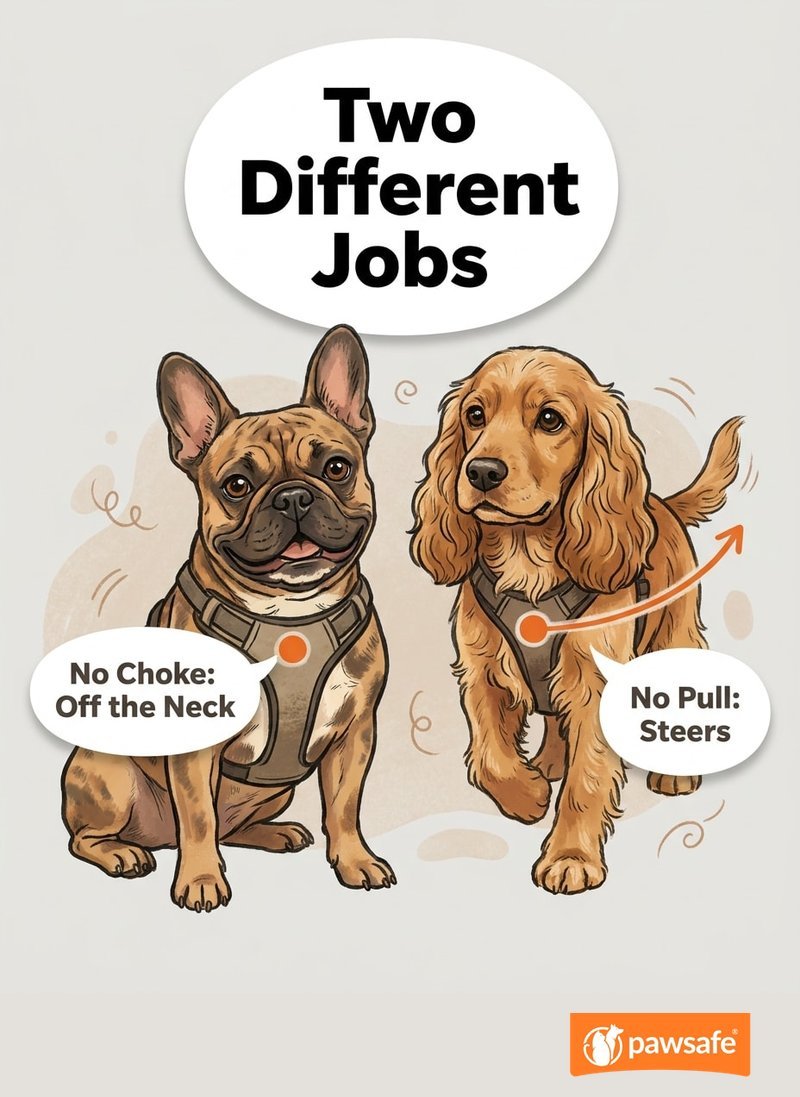
- No choke describes where the force goes. A choke-free harness keeps tension off the neck. Any well-fitted body harness that stays below the throat can do this - including a simple back-clip one.
- No pull describes steering. A no-pull harness has a front (chest) leash attachment that redirects a lunging dog back toward you. It gives you leverage; it doesn’t make pulling impossible.
The catch: many “choke-free” step-in harnesses attach only at the back. They protect the neck beautifully, but they do nothing to discourage pulling. In fact, veterinary research has found that dogs can pull harder in a back-clip harness than in a collar, because the harness lets them lean into their chest and shoulders - their strongest muscles. The force just gets distributed safely across the torso instead of the neck.
So if you’re searching for a “no pull no choke dog harness,” you’re really after a harness that does both: keeps pressure off the throat and has a front clip to redirect pulling. That combination is a front-clip or dual-clip body harness.
Why Neck Pressure Is Worth Taking Seriously
You don’t need to fear every collar to understand why a choke free harness for dogs is the safer walking choice. The evidence is clearest in a few specific areas.
Collars concentrate force on the neck. A 2020 study measured pressure from seven collar types on a canine-neck model and recorded peaks ranging from 83 to 832 kilopascals depending on the pull. The researchers concluded that no collar they tested delivered pressure low enough to rule out injury risk. Padding and width didn’t reliably lower the peak, either - construction and load direction mattered more.
Collar tension can spike eye pressure. In a study of sled dogs, pulling against a collar raised intraocular pressure by about 52%, while pulling against a harness produced only a small, non-significant change. A 2025 study in flat-faced and long-nosed dogs found the same pattern. The likely reason: neck compression impedes blood draining from the head. That’s a real concern for dogs with glaucoma or thin corneas.
Neck pressure aggravates a compromised airway. This is the big one for small dogs. In dogs with tracheal collapse, even mild external pressure on the neck can dramatically narrow an already weakened windpipe and set off coughing. Cornell’s Riney Canine Health Center notes that pressure on the neck can worsen coughing and recommends switching from a collar to a harness.
A fair note on the limits of the evidence: measured pressure is not the same as proven disease. There’s little direct research showing that ordinary leash pulling on a collar causes thyroid or cervical-spine problems in otherwise healthy dogs. What the research does support is caution - collars put concentrated force over vulnerable structures, and a harness moves most of it away.
Dogs Most at Risk
Some dogs have far less margin for error, and a no choke harness matters most for them:
- Toy and small breeds prone to tracheal collapse - Yorkshire Terriers, Pomeranians, Toy Poodles, Chihuahuas, Shih Tzus, and Maltese are frequently affected.
- Flat-faced (brachycephalic) breeds - French Bulldogs, Pugs, and Bulldogs already work harder to breathe; anything pressing at the base of the neck compounds it.
- Slim-necked escape artists - Greyhounds, Whippets, and other deep-chested dogs with narrow heads.
- Any dog that coughs, gags, or honks on the leash - that’s a signal, not a quirk.
When to see a vet: A harness can reduce external neck pressure, but recurring coughing, a harsh “goose-honking” cough, gagging, noisy breathing, or exercise intolerance can point to an airway, heart, or respiratory condition. Book a vet visit for persistent symptoms, and seek urgent care for blue or gray gums, fainting, or real difficulty breathing. A cough is not something to self-diagnose or fix with equipment alone.

Features That Make a Harness Truly Choke-Free
Not every harness labeled “no choke” earns it. Here’s what actually keeps force off the neck.
- A low neck opening. The top edge should sit below the soft throat and larynx, on the breastbone - not across the windpipe. A deep V, Y, or X shape at the front usually creates that clearance.
- Chest and rib-cage loading. Tension should transfer to the sternum and broad chest, not a single thin strap digging into the base of the neck.
- Position that holds under tension. When your dog pulls, turns, or backs up, the front should stay put and the throat should stay visibly clear. If the harness slides up or rotates toward the leash, it’s the wrong fit.
- Free shoulders and clear armpits. Straps should clear the shoulder joint, and the girth strap should sit on the rib cage behind the front legs - not rub the armpits. (Gait studies show fit and strap position matter more than whether a harness is branded “Y-shaped.”)
- Multiple adjustment points and an escape-resistant fit. Several adjusters let you dial in a secure fit; a loose harness both chokes and escapes.
- Quality hardware. Look for closed or welded D-rings that won’t spread under load, reinforced stitching at attachment points, and corrosion-resistant metal.
- A front clip if your dog also pulls. That’s what turns a choke-free harness into a no pull no choke harness.

Stop Your Dog Pulling On Their Leash
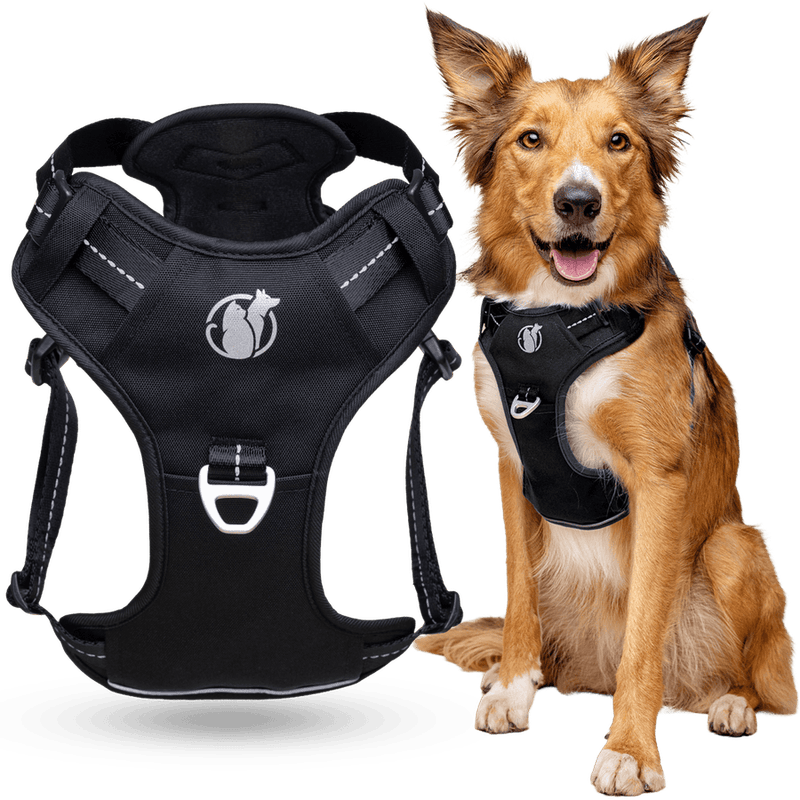
The Steady+Style No Pull Harness uses front and back clip points to redirect pulling, so you get immediate, gentler control and can actually enjoy the walk again.
Shop Now 👉Better Walk Guarantee • 90-Day PawSafe® Promise
No Choke Harnesses Compared
No single harness is right for every dog. Here’s an honest look at popular choke-free options and where each fits, based on how they’re designed and what testing and veterinary sources tell us.
PawSafe Steady+Style No-Pull Harness
The Steady+Style No-Pull Harness is our pick for dogs that both cough on a collar and pull. Its front (chest) D-ring sits at the sternum, so leash force loads the chest, not the throat - and because it’s a front clip, it also redirects pulling instead of just protecting the neck. That’s the no pull no choke combination.
Why it works:
- Front chest clip keeps pressure off the neck and redirects lunging
- Rear D-ring for relaxed walks once training progresses
- Padded chest plate spreads force over a wider area
- Adjustable straps for a secure, escape-resistant fit
- Reflective stitching and a padded grab handle for control
- Seatbelt-compatible (use the back clip in the car; pair with the PawSafe Dog Seatbelt)
Specs: Sizes XS (10-18 lbs) through XL (70-132 lbs); $63.96; colors including Classic Black and Ever Green.
Best for: Small-to-large dogs that need both neck protection and pulling control.
Gooby Comfort X
A well-known choke-free harness built around a deep V-neck, X-frame design that sits below the trachea, marketed specifically for dogs with tracheal collapse. Breathable mesh, light hardware, around $24.
Consider: It’s a back-clip only harness - excellent at neck protection, but it won’t redirect a puller. Best for a polite small dog that coughs in a collar. Check that the V stays low on a very tiny neck.
American River Choke-Free
A step-in mesh harness that loads the chest rather than the neck, with a wide size range (roughly 2-90 lbs) and reflective trim. Around $20-24.
Consider: Also back-clip, despite “no-pull” wording in some listings. The manufacturer cites a high break-strength test, but treat any single breaking-strength number as a marketing figure unless the exact size and method are documented.
PetSafe Easy Walk
A front-clip harness with a martingale chest loop that tightens gently to discourage pulling. Worn low over the breastbone, so it avoids a neck collar.
Consider: It’s primarily a no-pull design, and it’s a horizontal chest strap rather than a Y front. If it’s adjusted wrong, the chest strap can ride up or the belly strap can rub behind the legs.
PetSafe 3-in-1, Ruffwear Front Range, and 2 Hounds Freedom
These are dual-clip harnesses (front and back attachment), so they can do both jobs - neck-sparing torso loading plus front-clip steering. The Ruffwear and 2 Hounds options are well-padded for active or strong dogs; the PetSafe 3-in-1 is budget-friendly but can be bulky on very small dogs.
For hands-on testing notes across designs, see our dog harness reviews.
Make Every Walk Feel Under Control
Adjustable comfort design helps reduce leash tension fast so walks become calm, consistent, and more enjoyable for both of you.
Shop Now 👉Better Walk Guarantee • 90-Day PawSafe® Promise
How to Fit a No Choke Harness So It Can’t Choke or Escape
A harness only protects the neck if it fits. This matters double for small dogs, who have very little space between the jaw, throat, sternum, and front legs.
Measure first. Use a soft tape to measure chest girth at the widest point, just behind the front legs. Chest measurement matters more than weight - check the brand’s size chart.
Use the two-finger rule (as a starting point). You should be able to slide about two fingers under each strap. More than that and the harness can rotate or your dog can back out; less and it may restrict breathing or chafe.
Then watch your dog move. With the harness on, check that:
- The neck opening rests near the top of the sternum, not across the throat
- The girth strap sits on the rib cage, clear of the armpits
- Nothing crosses the top of the shoulders or blocks leg movement
- Under gentle leash tension, the front stays below the throat
- When your dog backs up, the neck loop won’t slip over their skull
Escape-proofing. Slim-headed dogs (and panicky reversers) can wriggle out of a standard two-loop harness. A third strap around the waist adds security, and a backup connector to a collar helps during the switch to new gear - though for a dog with airway trouble, the collar should never become the main load point. If your dog is a committed reverser, our escape proof dog harness guide breaks down the three-strap designs that hold a dog in without adding throat pressure.
After a short test walk, check for flattened fur, redness, or damp rubbing, and watch whether your dog moves freely or seems reluctant.

Best No Choke Harness for Small Dogs
Small and toy breeds are the reason most people search for a no choke harness for small dogs in the first place - and they’re the trickiest to fit. A neck opening that’s slightly too high sits right on the throat; a girth strap slightly too far forward digs into the armpit. And don’t assume small means gentle: in one 2025 study, dogs under about 29 lbs generated peak pulling forces averaging 122% of their body weight - proportionally more than big dogs.
For a Pomeranian, Chihuahua, Yorkie, or similar dog, prioritize:
- A front opening that stays below the throat when the leash is taut
- Lightweight hardware proportional to the dog
- Several adjustment points, not one fixed neck loop
- A soft, reasonably broad load-bearing surface
- A girth strap that sits behind the front legs
- Closures that won’t pop open against furniture
- A front clip if your small dog also pulls
One honest caveat from real owners: some popular small-dog harnesses still ride up and let a dog cough. If your dog keeps gagging in a well-fitted harness, the cause may be medical rather than the equipment - that’s a vet conversation.
Do No Choke Harnesses Actually Work?
Yes - with two honest qualifications.
First, a choke-free harness reliably moves force off the neck when it fits and stays below the throat. That’s exactly why Cornell, the American College of Veterinary Surgeons, and VCA recommend a body harness for dogs with tracheal collapse or flat-faced airway issues. It reduces a trigger; it doesn’t cure the underlying condition.
Second, a harness manages where force lands - it doesn’t teach your dog how to walk. Pair it with reward-based loose-leash training: reward your dog for walking near you on a slack leash, stop or change direction when the leash tightens, and resume once there’s slack. The American Veterinary Society of Animal Behavior recommends reward-based methods and advises against choke, prong, and shock collars, which apply pain around the neck - the opposite of what a no choke harness is for.
One rule that ties it all together: never clip a leash to a collar on a dog that pulls. Keep the collar for ID tags, and put the pulling force on a well-fitted harness. For more on managing pulling humanely, VCA has practical guidance.
Frequently Asked Questions
What is a no choke harness?
A no choke harness is a body harness fitted so leash tension is carried across your dog’s chest and rib cage instead of the throat and trachea. “No choke” is a marketing description, not a regulated certification, so the fit under real leash tension matters more than the word on the label. The neck opening should stay below the windpipe when the leash goes taut.
Do no choke harnesses really work?
Yes, when they stay below the throat and fit securely. Veterinary authorities recommend body harnesses for dogs with tracheal collapse and flat-faced airway problems because they move force off the neck. They do not cure airway disease, guarantee zero pressure, or automatically stop pulling - a harness manages where force lands, and training changes behavior.
Enjoy Calm Walks Starting Today
Dual-attachment harness distributes pressure and helps turn tug-of-war outings into relaxed, bonding strolls from the first use.
Shop Now 👉Better Walk Guarantee • 90-Day PawSafe® Promise
What is the best no choke harness for small dogs?
There is no single best model. For Pomeranians, Chihuahuas, and Yorkies, prioritize a front opening that stays below the throat under tension, lightweight hardware, several adjustment points, a girth strap clear of the armpits, and secure resistance to backing out. Add a front clip if your small dog also pulls.
Is a no choke harness the same as a no pull harness?
No. “No choke” describes where force is carried (the chest, not the neck). “No pull” describes steering - usually a front clip that redirects a lunging dog. Many choke-free step-in harnesses attach only at the back and do nothing to reduce pulling. A well-fitted front-clip or dual-clip harness can do both jobs.
Can a dog still choke or escape in a harness?
Yes. A neck opening that rides up onto the throat, a thin front strap, or a harness loose enough to rotate can all put pressure where you don’t want it. Slim-headed dogs can also back out of a two-loop harness. Check fit under gentle tension and consider a third waist strap for escape artists.
Is a harness or collar better for a dog that chokes?
A harness, for walking. Collars concentrate leash force over the neck, and research shows collar pressure can temporarily raise eye pressure and worsen coughing in dogs with tracheal collapse. Keep a lightweight collar for ID tags, but attach the leash to a well-fitted harness.
How tight should a no choke harness be?
Snug but not restrictive. You should be able to slide about two fingers under each strap - enough that it won’t rotate or slip, but not so loose a leg can pass through an opening. Always watch your dog move, turn, and back up to confirm the neck opening stays below the throat.
The Bottom Line
A good no choke harness for dogs is simple in principle: it keeps leash pressure on the chest, where your dog is strong, and off the neck, where they’re vulnerable. That protection matters most for the small and flat-faced breeds who search-drove you here in the first place.
Keep these takeaways in mind:
- Chest, not neck - that’s what “no choke” really means
- No choke isn’t automatically no pull - if your dog pulls, you want a front clip too
- Fit is everything - the neck opening must stay below the throat under tension
- Small dogs need it most - and can still out-pull their size
- Gear manages force; training changes behavior - use both
Our Steady+Style No-Pull Harness was built for exactly this - a front clip that loads the chest and redirects pulling, padded for comfort and adjustable for a secure fit. Browse the full dog harness collection to find the right choke-free fit for your dog, whether they’re a two-pound puller or a gentle giant. Because every walk should be about the walk - not the cough at the end of the leash.