


A dog harness distributes pressure across the chest and shoulders, while a collar concentrates force on the neck. Research shows collar pressure during pulling can reach 83-832 kilopascals, far exceeding the 4.3 kPa threshold that causes tissue damage in humans. Harnesses are safer for walking, especially for dogs that pull, brachycephalic breeds, or those with neck sensitivities. Collars remain essential for carrying ID tags. Most veterinarians and trainers recommend using both: a collar for identification and a harness for walks.
Every pet parent has been there - standing in the pet store aisle, staring at rows of collars and harnesses, wondering which one is actually better for their dog.
The dog collar vs harness debate has real stakes. Some trainers swear by collars for control, while veterinarians increasingly warn about neck injuries. Meanwhile, your dog is probably home right now practicing their pulling technique for your next walk.
This guide cuts through the confusion with research-backed answers. You’ll learn exactly when to use a collar, when a harness is safer, which option works best for your dog’s breed and behavior, and why most experts say you actually need both.
We’ve analyzed peer-reviewed veterinary studies, consulted published research from Nottingham Trent University and other institutions, and drawn from our experience helping 300,000+ pet parents find safer walking solutions.
Table of Contents
- The Quick Answer: Dog Collar vs Harness
- Why Harnesses Are Safer for Walking
- When Collars Still Make Sense
- Myth Busted: Do Harnesses Cause Pulling?
- Which Is Best for Your Dog? Breed and Situation Guide
- How to Choose a Safe Harness
- The Best Approach: Use Both
- Frequently Asked Questions
- Making the Right Choice for Your Dog
The Quick Answer: Dog Collar vs Harness
Before diving into the research, here’s a practical decision framework for the harness vs collar for dogs question.
Use a collar when:
- Your dog needs to carry ID tags (always recommended)
- Quick trips to the backyard
- Your dog walks calmly without any pulling
- Everyday identification around the house
Use a harness when:
- Walking, hiking, or running with your dog
- Your dog pulls on the leash (70-83% of dogs do)
- Your dog has respiratory issues or neck sensitivity
- Training loose-leash walking
- Car travel with a seatbelt attachment
Use both when:
- You want the safest, most versatile setup (this is what experts recommend)
| Factor | Collar | Harness |
|---|---|---|
| Best for | ID tags, calm walkers | Walking, pullers, training |
| Pressure point | Neck and throat | Chest and shoulders |
| Escape risk | Higher | Lower |
| Ease of use | Quick on/off | Takes slightly longer |
| Safety for pullers | Poor | Excellent |
Why Harnesses Are Safer for Walking
The science on this is clear - and more alarming than most pet parents realize.
The Science of Neck Pressure
A 2020 study by Dr. Ann Carter and colleagues at Nottingham Trent University measured exactly what happens when dogs pull against collars. The results were striking.
The researchers tested seven different collar types, including flat collars, rolled leather collars, and slip leads. They applied forces matching normal pulling (40 Newtons), strong pulling (70 Newtons), and jerk corrections (140 Newtons).
The collar pressures measured ranged from 83 to 832 kilopascals. To put that in perspective, research shows tissue damage in humans begins at just 4.3 kPa. A tight necktie produces about 5 kPa of pressure.
The study’s conclusion was unambiguous: “All types of dog collar have the potential to cause harm when the dog pulls on the lead.” Even padded or wide collars failed to reduce this risk to safe levels.
What’s at Risk in Your Dog’s Neck
Your dog’s neck contains delicate structures that don’t handle compression well:
Trachea: The windpipe can collapse under repeated pressure, especially in small breeds. A retrospective study of 110 cases found tracheal collapse occurs almost exclusively in small breeds like Yorkshire Terriers, Pomeranians, Chihuahuas, and Pugs.
Thyroid gland: Carter et al. noted that collar pressure on the throat “could potentially place pressure on and damage the thyroid gland” - similar to seatbelt trauma in humans.
Blood vessels: Constriction of arteries and veins supplying the brain can occur during pulling episodes.
Eyes: A 2025 study found that simply wearing a collar significantly increased intraocular pressure in brachycephalic dogs, even at rest. High neck tension obstructs jugular drainage, directly raising pressure in the eyes. Well-fitted harnesses did not cause this effect.
Spine: Cervical vertebrae can sustain damage in severe cases, particularly with jerk corrections.
How Harnesses Distribute Force
A harness fundamentally changes the physics of leash tension. Instead of concentrating all force on the vulnerable neck, a harness spreads pressure across the chest and shoulders - areas designed to handle load.
The front chest plate takes the brunt of pulling force, while back straps distribute remaining tension across the torso. This means your dog can pull (while you work on training) without risking the injuries associated with collar pressure.

If your dog tends to pull, a front-clip harness is often the best choice. Check out our guide to the best harness for dogs that pull for specific recommendations.
When Collars Still Make Sense
This isn’t an anti-collar argument. Collars serve legitimate purposes - they’re just not ideal for leash attachment.
The ID Tag Advantage
Collars provide the most visible place for identification. If your dog ever gets loose, a collar with tags offers:
- Immediate visual confirmation your dog has a home
- Contact information readable by anyone who finds them
- Proof of rabies vaccination (required in many areas)
- Backup to microchip identification
In many jurisdictions, dogs are legally required to wear ID tags. A collar is the simplest way to meet this requirement.
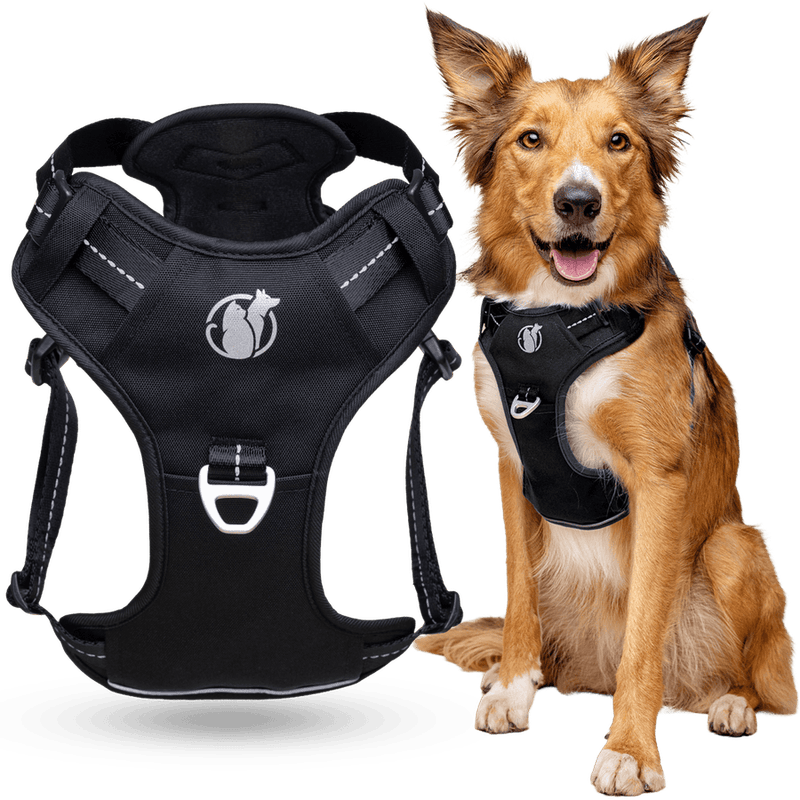
Stop Your Dog Pulling On Their Leash
The Steady+Style No Pull Harness uses front and back clip points to redirect pulling, so you get immediate, gentler control and can actually enjoy the walk again.
Shop Now 👉Better Walk Guarantee • 90-Day PawSafe® Promise
The Convenience Factor
Collars are undeniably easy:
- Quick to slip on for backyard potty breaks
- Comfortable enough for dogs to wear all day
- Lighter and less bulky than harnesses
- Simple to attach and remove
For quick trips outside where your dog won’t be on a leash, a collar makes sense.
Well-Behaved Walkers
If your dog genuinely doesn’t pull - not “usually doesn’t pull” or “only pulls sometimes” - collar walking may be acceptable. However, consider that even well-trained dogs can lunge unexpectedly at squirrels, other dogs, or startling sounds.
The safest approach is still attaching the leash to a harness, even for calm walkers. Browse our full dog harness collection to find options that work for any walking style.
Myth Busted: Do Harnesses Cause Pulling?
You’ve probably heard this one: “Harnesses make dogs pull because they trigger an opposition reflex, like sled dogs.”
It sounds logical. But peer-reviewed research tells a different story.
The Research
A 2021 study by Shih et al. tested 52 dogs, measuring leash tension when dogs were lured by treats while wearing either a collar or a back-clip harness.
The result? Dogs actually pulled harder and longer wearing the harness. Mean leash force was significantly higher with the harness, and both average and peak tension were greater.
A 2025 study by Bailey et al. found similar results: dogs in padded back-clip harnesses generated higher pulling forces (mean ~60.5 N, peak ~198.8 N) compared to the same dogs in collars (mean ~37.8 N, peak ~162.8 N).
What This Actually Means
These studies don’t support the “harnesses cause pulling” myth. What they show is that harnesses don’t prevent pulling - they simply shift the force from the neck to the chest.
As Shih et al. stated clearly: “There is no scientific evidence” supporting the idea that harnesses by themselves reduce pulling.
Sled dogs pull because they’re trained to pull, not because of what they’re wearing. Your dog’s pulling behavior is about training, not equipment.
The Bottom Line
- Dogs that want to pull will pull regardless of equipment
- The difference: harnesses don’t injure them while they do
- Training changes behavior, not equipment type
- Equipment keeps your dog safe while you train
The leash is a safety tool, not a steering mechanism. Training teaches the behavior; equipment keeps your dog safe while learning.
Which Is Best for Your Dog? Breed and Situation Guide
The dog harness vs collar decision often depends on your specific dog. Here’s a breakdown by breed type and situation.
Make Every Walk Feel Under Control
Adjustable comfort design helps reduce leash tension fast so walks become calm, consistent, and more enjoyable for both of you.
Shop Now 👉Better Walk Guarantee • 90-Day PawSafe® Promise
Dogs That Should Always Use a Harness
Pullers: Any dog that pulls on the leash needs a harness. With 70-83% of dogs pulling on walks (according to owner surveys), this includes most dogs. A harness protects the neck while you work on loose-leash training.
Brachycephalic breeds (flat-faced dogs):
- French Bulldogs, Pugs, Bulldogs, Boston Terriers, Shih Tzus
- These breeds already have compromised airways (called BOAS - Brachycephalic Obstructive Airway Syndrome)
- Any collar pressure makes breathing harder
- The 2025 IOP study found collar use increased eye pressure in these breeds even at rest
- Veterinary sources explicitly advise against collar use for flat-faced dogs
Small breeds prone to tracheal collapse:
- Chihuahuas, Yorkshire Terriers, Pomeranians, Toy Poodles, Maltese
- Delicate tracheas are easily damaged by collar pressure
- Research shows tracheal collapse occurs almost exclusively in these breeds
- Veterinarians strongly recommend harness use to spare the windpipe
Dogs with neck or spine issues:
- Any dog with IVDD (intervertebral disc disease)
- Dachshunds, Corgis, Basset Hounds at higher risk
- A chest harness distributes force over the torso instead of concentrating stress on vertebrae
Escape artists:
- Dogs with narrow heads that slip collars easily
- Greyhounds, Whippets, Italian Greyhounds
- These breeds need a martingale collar (for ID) plus a properly fitted harness (for leash)

Reactive dogs: For dogs that lunge or bark at triggers, a front-clip harness combined with training provides the best control. See our guide to the best harness for reactive dogs for specific recommendations.
Activity-Based Recommendations
| Activity | Recommended Gear | Notes |
|---|---|---|
| Daily walks | Harness + Collar for ID | Front-clip for pullers |
| Hiking | Harness + Collar | Handle useful for scrambles |
| Running | Harness + Collar | Chest distribution prevents strain |
| Car travel | Harness + Seatbelt | Never attach seatbelt to collar |
| Dog park | Collar only | Remove harness for safe play |
| Backyard | Collar only | Quick, easy for potty breaks |
| Training class | Harness | Safer for corrections and control |
How to Choose a Safe Harness
Not all harnesses are created equal. Design and fit significantly affect both safety and comfort.
Types of Harnesses
Understanding dog harness types helps you choose the right one:
Back-clip harnesses: The leash attaches at the back, between the shoulder blades. Easy to use and comfortable, but gives dogs more leverage to pull. Best for small dogs that don’t pull or well-trained dogs.
Front-clip harnesses: The leash attaches at the chest. When the dog pulls, the design turns them back toward you, providing immediate feedback without neck pressure. A 2025 scientific review found non-tightening front-clip harnesses “strike the best balance for pullers, offering control while minimizing discomfort.”
Dual-clip harnesses: Feature both front and back attachment points. Use the front clip for training and pullers, switch to back clip once loose-leash walking is established. Most versatile option.
Head halters: Maximum control for large, strong pullers. Fits around the muzzle and behind the ears. Requires careful introduction and proper fit.

What to Look For
Y-shaped design: The front strap forms a Y on the chest, sitting on the sternum rather than across the shoulders. This keeps shoulder joints free for natural movement. Research shows Y-shaped harnesses cause less restriction than designs that cross the shoulders.
Padded chest plate: Distributes pressure comfortably across a wider area.
Adjustable straps: Custom fit prevents rubbing, chafing, and escape. Multiple adjustment points are better than fixed sizing.
Reflective elements: Essential for early morning or evening walks when visibility matters.
Seatbelt-compatible D-ring: If you drive with your dog, ensure the harness can attach to a car seatbelt safely.
Getting the Right Fit
Proper fit is crucial. A poorly fitted harness can restrict movement or cause chafing.
The two-finger rule: You should be able to slide two fingers under every strap. This ensures the harness is:
- Tight enough to prevent slipping or escape
- Loose enough to avoid rubbing or restricting breathing
Fit checklist:
- Dog steps into harness easily without struggle
- Front chest strap sits in the middle of the sternum (breastbone)
- Neck area is loose - the harness should not tighten around the throat
- No straps cutting across the top of the shoulders
- Armpits are clear with no rubbing
- The harness doesn’t slide backward when the dog moves
Watch for rubbing in the armpit area after walks. Red marks or missing fur indicate the fit needs adjustment.

For detailed reviews and comparisons, check our dog harness reviews.
The Best Approach: Use Both
The expert consensus is clear: use a collar AND a harness, each for its intended purpose.
Collar (worn always):
- Carries ID tags and rabies vaccination tag
- Provides visible identification if your dog gets loose
- Serves as backup to microchip
- Lightweight and comfortable for all-day wear
- Meets legal requirements for ID in most areas
Harness (for walks and travel):
- Attach the leash to the harness, never the collar
- Protects the neck during any pulling
- Provides safer control in all walking situations
- Essential for car travel with a seatbelt attachment
Why this combination works:
- The collar handles identification
- The harness handles safety
- You get the benefits of both without the risks of either
- This is what veterinarians and certified trainers recommend
Dr. Carter’s research explicitly advises: “Collars should be used to display ID tags and dogs should be walked on a harness or loose lead that avoids any pressure on the neck.”
Pro Tip: Keep your harness by the door with the leash. It becomes automatic - harness on, then walk - rather than an extra step you might skip.

Enjoy Calm Walks Starting Today
Dual-attachment harness distributes pressure and helps turn tug-of-war outings into relaxed, bonding strolls from the first use.
Shop Now 👉Better Walk Guarantee • 90-Day PawSafe® Promise
Frequently Asked Questions
Is a harness or collar better for a puppy?
Start puppies with a harness for walks. Their necks are still developing, and pulling is completely normal as they learn leash manners. Use a collar for ID tags (puppies can slip out of things and get lost), but attach the leash to the harness. This protects their delicate trachea while you train loose-leash walking.
Can a harness hurt my dog’s shoulders?
A properly fitted harness doesn’t restrict movement or harm shoulders. The key is choosing a Y-shaped design that keeps shoulder joints free and fitting it correctly. Research shows any harness affects gait somewhat, but well-designed harnesses minimize this. You should be able to fit two fingers between the harness and your dog’s body at every strap.
Why does my dog still pull in a harness?
Harnesses don’t automatically stop pulling - they just make pulling safer for your dog. Research confirms this: studies show dogs actually pull slightly more in back-clip harnesses than in collars. The difference is that harnesses don’t injure them while they do. Training changes pulling behavior, not equipment. Use a front-clip harness to redirect pulling motion, and work on loose-leash training with positive reinforcement.
Are slip collars or choke chains safe?
Veterinarians and force-free trainers recommend against slip collars, choke chains, and prong collars. These apply intense pressure to the neck during corrections, risking tracheal damage, thyroid issues, and psychological stress. Dogs handled roughly with these tools have shown thyroid and tracheal lesions. Front-clip harnesses achieve better control without the injury risk.
Should I take my dog’s harness off at home?
Yes, remove the harness when you’re not actively walking or training. This prevents rubbing, allows their coat to breathe, and reduces wear on the harness. Keep the collar with ID tags on at all times when your dog might get outside - including supervised backyard time. A breakaway collar is a safe option for indoor wear.
Can I use a harness with a retractable leash?
While physically possible, retractable leashes aren’t recommended with any attachment. They actually teach dogs to pull (the leash only extends when they do), and the thin cord can cause injuries to both dogs and humans. A standard 5-6 foot leash gives you better control, safety, and consistency in training.
Making the Right Choice for Your Dog
The dog collar vs harness debate isn’t really about choosing sides. It’s about using the right tool for each situation.
Here’s what the research tells us:
- Harnesses are safer for walking - they distribute pressure across the chest instead of concentrating dangerous forces on the neck
- Collar pressure during pulling can reach 83-832 kPa, far above tissue damage thresholds
- Collars remain essential for carrying ID tags
- The best approach is using both: collar for identification, harness for walks
Your dog’s safety comes down to simple choices. A comfortable collar keeps their ID visible. A quality harness makes every walk safer. Together, they give you the best of both worlds.
Walk time should be the highlight of your dog’s day - a chance to explore, bond, and exercise together. With the right equipment, it can be exactly that, without the worry of neck injuries or the frustration of constant pulling.
Ready to find the perfect setup for your pup? Browse our dog harness collection to find harnesses designed for safety, comfort, and better walks for both of you.