


Dog gum disease, or periodontal disease, is graded in stages by how much of a tooth’s support has been lost. It begins as Stage 1 gingivitis - inflamed gums with no bone loss - and, if plaque isn’t controlled, advances through early, moderate, and severe periodontitis as attachment and bone are destroyed. Only Stage 1 gingivitis is reversible; later stages cause permanent damage. A veterinarian confirms the stage using periodontal probing and dental X-rays under anesthesia, because how the mouth looks from the outside cannot reveal it.

That whiff of bad breath when your dog yawns in your face is easy to laugh off. But it’s often the first clue to the most common health problem vets see in dogs: gum disease. Left alone, it’s also the leading cause of dogs losing their teeth.
Here’s the part that matters most, and the reason understanding the dog gum disease stages is worth ten minutes of your time. In its earliest stage, gum disease can be turned around completely. A little later, it can’t - the damage becomes permanent, and the goal shifts from reversing it to stopping it getting worse. Where your dog sits on that scale changes everything about what happens next.
This guide walks through each stage of gum disease in dogs - what’s happening beneath the gumline, the symptoms to watch for, which stages are reversible, and how vets diagnose and treat it. It’s built on veterinary sources, and it’s clear about the limits: only your vet can stage and treat your dog’s mouth. Think of this as the map that helps you act early.
Table of Contents
What Is Gum Disease in Dogs?
Gum disease in dogs - the everyday name for periodontal disease - is infection and inflammation of the tissues that surround and support each tooth: the gums, the periodontal ligament, and the bone of the jaw. It starts with plaque, a sticky film of bacteria that builds up on teeth at and below the gumline. The bacteria damage the tissue directly, and the dog’s own inflammatory response adds to the destruction of the tooth’s support.
Vets split it into two forms, and the difference is the whole story:
- Gingivitis - inflammation limited to the gums, with the tooth’s attachment and bone still intact.
- Periodontitis - the destructive phase, where the ligament and bone anchoring the tooth are being lost.
Periodontal disease is extremely common. Veterinary organizations often report that most dogs show some evidence by age three, with some estimates reaching around 80 to 90 percent - though the exact figure varies by age, breed, and whether the exam includes probing and X-rays. According to the Merck Veterinary Manual, untreated loss of that support is a major reason dogs lose teeth.
Some dogs are more prone than others. Small and toy breeds, older dogs, dogs with crowded or misaligned teeth, and dogs with a genetic or anatomic predisposition tend to be diagnosed more often. Building good habits early is the foundation of a lasting dog dental care routine - and it’s far easier than treating disease later.
The Stages of Dog Gum Disease (Stage 0 to 4)
Veterinary dentists grade periodontal disease on a scale the American Veterinary Dental College calls PD0 through PD4. One important nuance: the stage applies to a single tooth, not the whole mouth. Your dog can have a healthy incisor, a Stage 2 premolar, and a Stage 4 molar all at the same time. The stage is set by how much of each tooth’s supporting attachment has been lost - not by how much tartar you can see.

Here’s how the stages break down.
| Stage | What’s happening | Reversible? | General veterinary approach |
|---|---|---|---|
| Stage 0 - Healthy | No gum inflammation or attachment loss | Not applicable | Home plaque control and routine oral exams |
| Stage 1 - Gingivitis | Gum inflammation only; no bone loss | Yes, often reversible | Professional cleaning plus daily home care |
| Stage 2 - Early periodontitis | Less than 25% attachment loss | No | Cleaning plus targeted periodontal treatment |
| Stage 3 - Moderate periodontitis | 25 to 50% attachment loss | No | Advanced therapy or extraction, case by case |
| Stage 4 - Advanced periodontitis | More than 50% attachment loss | No | Extraction is often necessary |
Stage 1 (gingivitis) is where the gums are red, puffy, and quick to bleed, and bad breath often shows up. Crucially, no support has been lost yet - which is why this stage can still be reversed.
Stage 2 (early periodontitis) is the turning point. Less than a quarter of the tooth’s attachment is gone, but the moment bone loss begins, the clock stops rewinding. It won’t look dramatic from the outside, which is exactly why it’s so often missed.
Stage 3 (moderate periodontitis) brings deeper pockets, receding gums, exposed roots, and sometimes loose or painful teeth. Stage 4 (advanced periodontitis) means more than half the support is gone, with severe recession, mobile teeth, infection, and real pain.
Those percentages describe supporting attachment lost relative to the root - measured by your vet, not judged by eye. And that’s the catch: appearance is not a dependable stage test. A tooth can look clean above the gumline while disease advances below it. This is why accurate staging always happens under anesthesia, which we’ll get to.
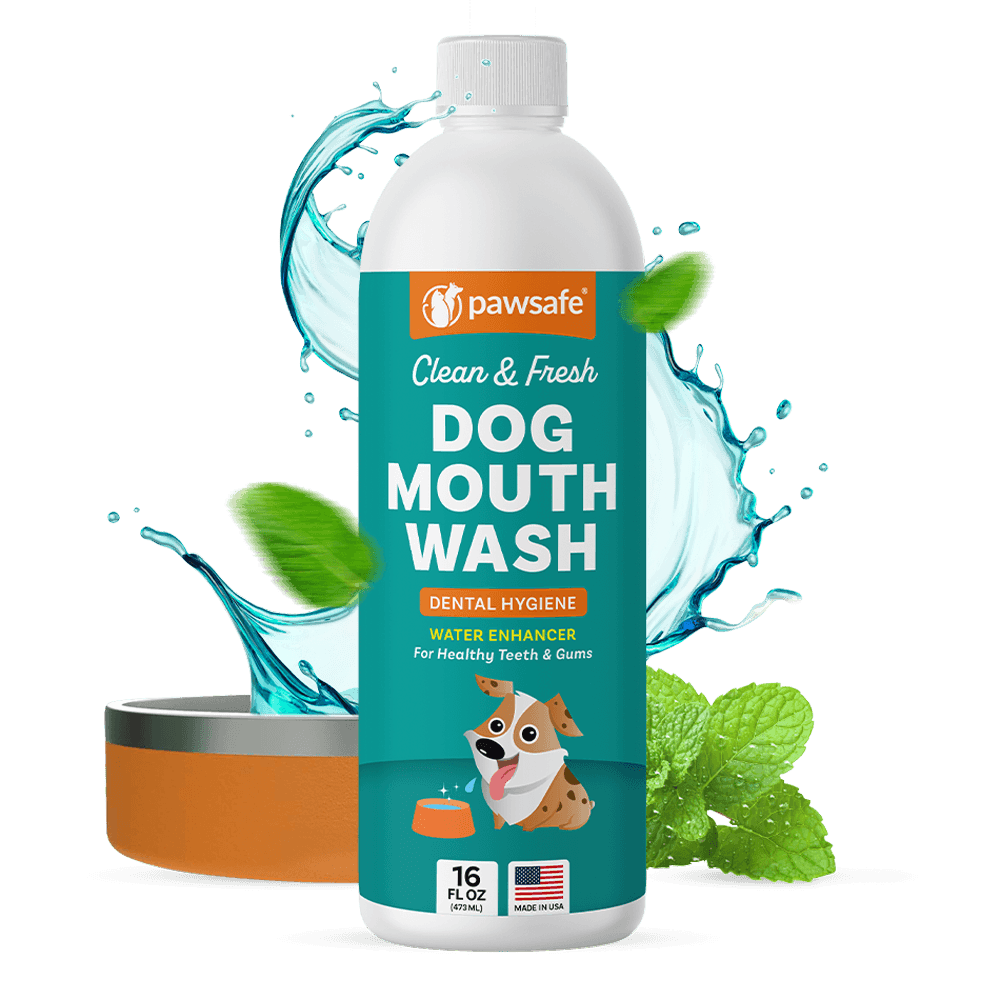
Fresh Breath The Easy Way
Just add to the water bowl to support cleaner mouths and noticeably fresher breath without daily brushing struggles.
Shop Now 👉Fresh Breath Guarantee • 90-Day PawSafe® Promise
Symptoms of Gum Disease in Dogs
Knowing the dog gum disease symptoms to watch for is how you catch it while you can still do the most about it. Signs range from the barely noticeable to the impossible to ignore.
Early or easily missed signs:
- Persistent bad breath (often the very first clue)
- Yellow or brown tartar along the gumline
- Red, swollen gums
- Bleeding when chewing, or blood on a toy
- Mild sensitivity when you touch the muzzle
- No outward signs at all
Signs of progressing disease or oral pain:
- Drooling, sometimes tinged with blood
- Pawing or rubbing at the mouth
- Chewing on one side, or dropping food
- Eating more slowly or refusing hard food and chews
- Reduced appetite
- Receding gums or visible tooth roots
- Loose, discolored, or missing teeth
- Irritability, withdrawal, or other behavior changes
Advanced or urgent signs:
- Facial or jaw swelling
- A draining sore below the eye or under the jaw
- Nasal discharge, sometimes bloody
- Refusal or inability to eat
One thing worth sitting with: dogs are experts at hiding oral pain. As Cornell’s veterinary team notes, animals “usually conceal their discomfort,” so a dog that’s still eating isn’t necessarily a dog that’s comfortable. Bad breath is frequently the earliest flag - our guide on how to get rid of bad dog breath covers what that smell can mean and when it points to something more.
Can Dog Gum Disease Be Cured or Reversed?
This is the question that sends most people searching, and it deserves an honest, unglossed answer.
Stage 1 gingivitis can often be reversed. Because the inflammation hasn’t yet destroyed any of the tooth’s support, a professional cleaning above and below the gumline - followed by consistent daily home care - can return the gums to health. The American Animal Hospital Association puts it plainly: gingivitis is reversible and preventable.

Periodontitis - Stages 2 through 4 - is not curable. Once attachment and bone are lost, that tissue does not routinely grow back. This is the single most important thing to take from this article. Treatment at these stages isn’t about reversal; it’s about control: stopping further loss, relieving pain, saving the teeth that can be saved, and removing the ones that can’t.
So when you see “how to cure dog gum disease” online, treat it with care. Gingivitis can be reversed before support is lost; periodontitis can be managed and stabilized, but not cured. That gap between “reversible” and “permanent” is the entire reason catching it early is worth so much - and why “wait and see” is the costly choice.
Daily Water Additive For Oral Freshness
Helps maintain better breath and oral hygiene as your dog drinks, keeping cuddle moments pleasant.
Shop Now 👉Fresh Breath Guarantee • 90-Day PawSafe® Promise
How Vets Diagnose and Treat Gum Disease
Here’s why you can’t reliably stage or treat dog gum disease at home, no matter how good a look you get. Most periodontal disease lives below the gumline, invisible to the naked eye. Real diagnosis takes tools you don’t have on the kitchen floor.

A complete assessment - often called a COHAT, a Comprehensive Oral Health Assessment and Treatment - generally includes:
- A conscious exam to screen the face, breath, gums, and bite and plan the visit.
- General anesthesia with monitoring, so every tooth and the areas below the gumline can be examined safely and without pain.
- Full-mouth dental X-rays, which reveal roots, bone loss, and hidden disease. The AAHA reports that in one study, 28 percent of dog teeth that looked normal had important findings on X-ray.
- Tooth-by-tooth probing and charting to measure pockets, recession, and mobility.
Only then can a vet assign a stage and build a plan - and it often differs from the awake estimate. Treatment is matched to each tooth: professional cleaning above and below the gumline for earlier disease, targeted periodontal therapy, and for teeth too damaged to maintain comfortably, extraction. A lot of that visible tartar is what drives the process forward, which is the link between everyday buildup and disease - our guide to dog tartar stages traces how plaque hardens into the calculus that fuels gum disease.
A quick word on anesthesia-free “dental cleaning.” It may scrape off visible tartar, but it can’t take X-rays, probe below the gumline, or treat what it finds - and both the AAHA and veterinary dental specialists consider it cosmetic rather than medical. The stuff that matters is happening where a scaler and a conscious dog can’t reach.
One firm boundary: medications, pain control, anesthesia decisions, periodontal surgery, and extractions are all your veterinarian’s call. This guide won’t give you doses or at-home procedures, because those aren’t home-care territory - and getting them wrong hurts your dog.
How to Prevent Gum Disease
The good news is that prevention is mostly daily habit, and it’s where you have the most power - protecting that healthy Stage 0 mouth for as long as possible.
- Brush daily. This is the single most effective thing you can do at home. Use a soft brush and toothpaste made for dogs, and aim for every day - brushing removes soft plaque before it hardens into tartar. Never use human toothpaste. The FDA warns to “only use pet toothpaste for pets, never human toothpaste,” because human products can contain xylitol, which is toxic to dogs.
- See your vet for regular oral exams. Your vet checks the mouth at least yearly and decides how often your individual dog needs a professional cleaning - it isn’t the same for every dog.
- Choose evidence-backed adjuncts. Dental diets, chews, wipes, and water additives can support brushing; for a product sold on a plaque- or tartar-control claim, the VOHC (Veterinary Oral Health Council) seal is a useful independent check. A daily dental dog mouthwash water additive can be one convenient part of an at-home routine, alongside brushing and regular veterinary care - not a replacement for either, and not a treatment for disease.
- Skip the tooth-crackers. Bones, antlers, hooves, and very hard nylon chews can fracture teeth. Pick an appropriately sized chew, supervise it, and ask your vet what suits your dog.
Prevention works by controlling plaque before it ever damages support. It can’t remove established tartar or undo bone loss - that’s what professional care is for - but it’s what keeps most dogs out of the later stages.
Turn Plain Water Into Breath Support
A simple routine that supports a cleaner mouth and fresher kisses over time—no messy brushing required.
Shop Now 👉Fresh Breath Guarantee • 90-Day PawSafe® Promise
When to See a Vet
Book a veterinary exam if you notice any of these - and remember, the earlier the stage, the more that can be done:
- Persistent bad breath
- Red, swollen, receding, or bleeding gums
- Visible tartar buildup
- Drooling, or pawing at the mouth
- Broken, loose, discolored, or missing teeth
- Eating on one side, dropping food, or refusing hard food
- Reduced appetite
Seek same-day or emergency care for inability to eat or drink, heavy or uncontrolled mouth bleeding, marked or fast-growing facial swelling, severe pain, or any suspected swallowing of a xylitol-containing product like human toothpaste or gum.
Some dogs deserve a closer eye and earlier attention: small and toy breeds, dogs with crowded teeth or malocclusions, some flat-faced breeds, seniors, and any dog with a history of dental disease. If your dog is in one of those groups, talk to your vet about the right check-up schedule rather than waiting for symptoms to appear.
The Bottom Line on Dog Gum Disease Stages
Understanding the dog gum disease stages comes down to a few things that genuinely change outcomes:
- The stages run 0 to 4, from a healthy mouth (Stage 0) through gingivitis (Stage 1) to advanced periodontitis (Stage 4), and each tooth is graded on its own.
- Only Stage 1 is reversible. Once bone and attachment are lost in Stages 2 to 4, the damage is permanent - treatment then controls the disease rather than curing it.
- You can’t stage it by looking. Real diagnosis needs probing and dental X-rays under anesthesia, because most of the disease hides below the gumline.
- Prevention is daily and doable. Brushing, vet checks, professional cleanings, and sensible adjuncts keep most dogs in the early, manageable range.
Catch it at Stage 1 and you can turn it around; catch it later and you’re limiting the damage. That’s the whole case for paying attention to your dog’s mouth now rather than later. For more on keeping those teeth healthy for life, explore our dog dental care guides - and when in doubt about your dog’s gums, your vet is the person who can actually stage and treat what’s going on.