

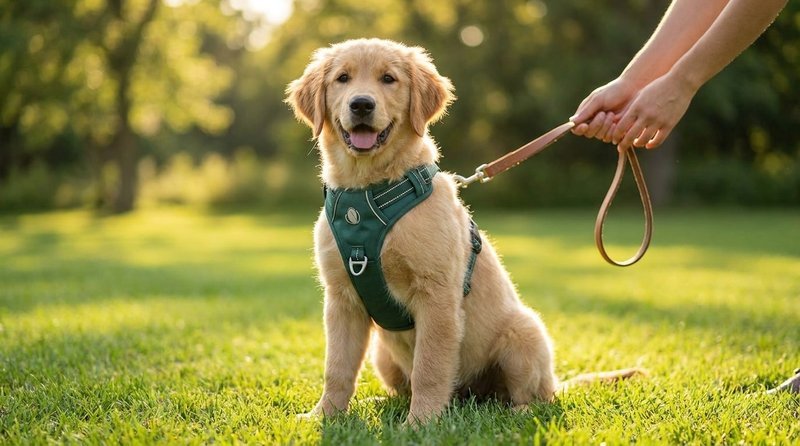
The best harness for a golden retriever puppy is an adjustable, front-clip Y-harness that fits the puppy’s current chest girth, not a size bought to grow into. A front attachment redirects a strong puppy’s pulling away from the neck, while several adjustment points extend each size as the puppy grows. Golden puppies grow fast, so measure the widest part of the rib cage, follow the exact brand’s chart, and expect to size up several times in the first year.
Your golden retriever puppy will outgrow their first harness long before they outgrow the zoomies. That’s the reality every new golden parent runs into: these puppies balloon from around 15 pounds at eight weeks to over 50 pounds by eight months, and a harness that fit perfectly in October is a tight, chafing mess by December.
So the “best” harness for a golden retriever puppy isn’t the priciest one or the one a random list crowned number one. It’s the one that fits your puppy’s body right now, adjusts as they grow, and keeps a strong, bouncy sporting dog comfortable and under control. Get that wrong and you’ll fight slipping straps, matted coat, and a puppy who hates gear.
This guide covers what actually matters for a golden puppy, how to size and fit one (measuring beats guessing every time), the real contenders compared fairly, and where the PawSafe harness honestly fits. We’ve helped 300,000+ pet parents walk their dogs, and we test gear on our own dogs - so we’ll be straight about the trade-offs too.
Table of Contents
- What to Look for in a Harness for a Golden Retriever Puppy
- What Size Harness for a Golden Retriever Puppy?
- How to Measure and Fit Your Puppy's Harness
- Golden Coat and Skin Considerations
- Best Harnesses for a Golden Retriever Puppy
- Is a No-Pull Harness Good for a Golden Retriever?
- Where the PawSafe Steady+Style Fits
- Best Harness for a Goldendoodle Puppy
- When Can a Golden Retriever Puppy Start Wearing a Harness?
- Frequently Asked Questions
- The Bottom Line on the Best Harness for a Golden Retriever Puppy
What to Look for in a Harness for a Golden Retriever Puppy
Golden puppies have three traits that shape the right choice: they grow fast, they pull hard, and they carry a thick double coat. A good harness answers all three.
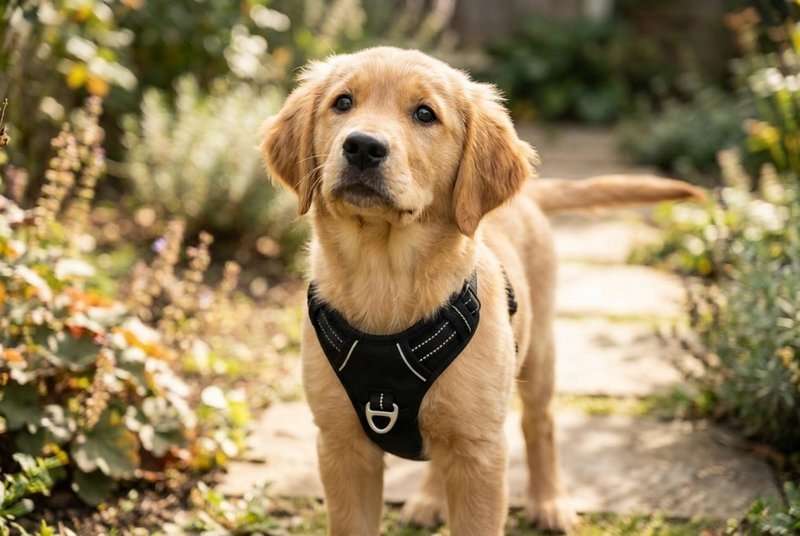
Here’s what to prioritize:
- Plenty of adjustment. Multiple independent adjustment points (neck, chest, girth) stretch how long each size lasts on a growing puppy. This is the single most useful feature for a golden.
- A front-clip option. A front attachment redirects a strong puppy’s pulling away from the neck. Goldens are sporting dogs bred to work, so a no-pull front clip makes early walks far more manageable.
- A Y-shape off the throat. Straps that sit on the chest and stay clear of the windpipe are more comfortable for a puppy leaning into the leash.
- Smooth, breathable materials. A thick coat mats and chafes under rough webbing. Look for bound strap edges, elbow clearance, and a lining that dries quickly - more padding isn’t automatically better if it traps moisture and coat.
- Durable hardware and a handle. Sturdy buckles and a padded top handle give you instant control during a puppy meltdown or a road crossing.
- Reflective detailing for early-morning and evening walks.
You don’t need a $60 mountaineering harness for neighborhood walks your puppy will outgrow in six weeks. You need a well-fitted, adjustable one - and the discipline to re-check the fit.
What Size Harness for a Golden Retriever Puppy?
Here’s the honest answer most sizing guides dodge: there is no reliable breed chart that tells you a golden puppy’s chest size by age. Golden puppies vary too much in build, and weight alone doesn’t predict girth. So the rule is simple - measure your puppy, then use the exact harness’s chart.
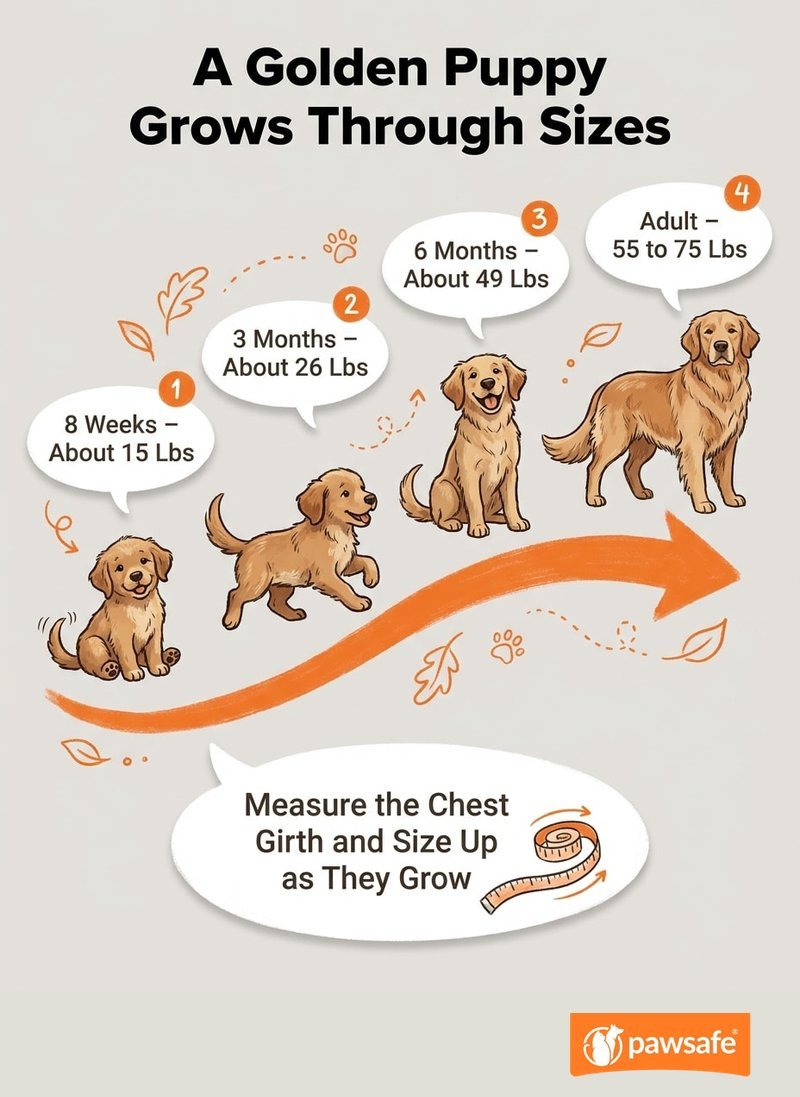
Weight is still useful for anticipating growth. Using breed-guide estimates (which carry roughly 10% variation either way), a golden puppy grows roughly like this:
| Age | Approx. weight | What it means for sizing |
|---|---|---|
| 8 weeks | ~14-15 lbs | First harness - extra-small/small range |
| 3 months | ~25-26 lbs | Usually a size up already |
| 4-5 months | ~35-44 lbs | Chest and shoulders broaden fast |
| 6-8 months | ~47-56 lbs | Approaching a large size |
| Adult (AKC standard) | Males 65-75 lbs, females 55-65 lbs | Settled adult size around 18 months |
The takeaway: a golden puppy realistically moves through three or four harness sizes in the first year. That’s not a failure - it’s the breed. Budget for it, and favor a harness line that spans the full size range so you can re-buy the same familiar design instead of relearning the fit each time. For the full breed-by-breed breakdown, see our dog harness size chart by breed.
How to Measure and Fit Your Puppy’s Harness
Measuring takes two minutes and saves a lot of returns.
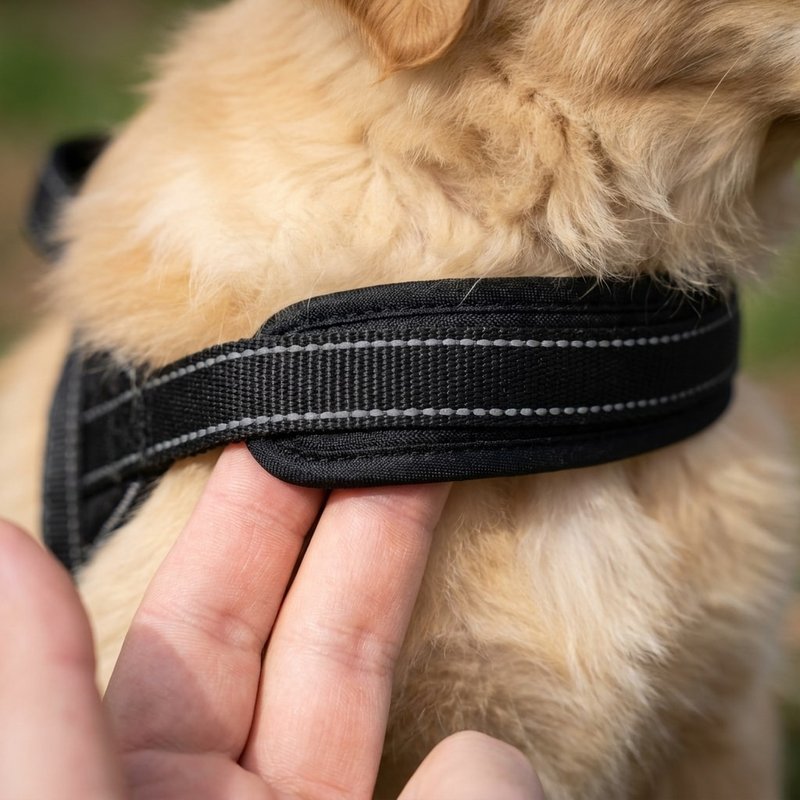
- Measure chest girth. With your puppy standing, wrap a soft tape around the widest part of the rib cage, just behind the front legs. This is your primary number.
- Measure the base of the neck if the harness chart asks for it.
- Match the exact brand’s chart. Sizing isn’t standardized - one brand’s medium is another’s large. Don’t buy a much bigger harness “to grow into”; a loose harness lets a puppy back out.
- Check the two-finger rule. You should slide about two fingers under each strap - snug, not tight.
- Do a reverse check. With gentle backward pressure, your puppy shouldn’t be able to slip out. Straps should stay off the throat and behind the elbows, not in the armpits.
- Watch them move, then take the harness off and check the skin and coat after the first few walks.
Re-measure weekly during growth spurts and after grooming, and size up the moment the adjustments run out or the harness starts rubbing.
Golden Coat and Skin Considerations
Goldens have a thick, water-repellent double coat with heavy feathering on the chest and legs - exactly where harness straps sit. That coat mats easily, and mats pull painfully on the skin and can hide irritation.
To protect it:
- Choose smooth-edged straps and a low-profile design that won’t trap coat.
- Brush under the chest, behind the elbows, and beneath every strap regularly - the AKC recommends at least weekly brushing, daily during heavy shedding.
- After swimming (and goldens love water), take the harness off, rinse away grit, and dry both the coat and the harness before the next walk.
- Re-check the fit after grooming appointments, since a trimmed or blown coat changes the girth.
A rotating or damp harness dragging across one patch of coat is a recipe for a bald, sore spot. Fit and hygiene matter as much as the harness itself.
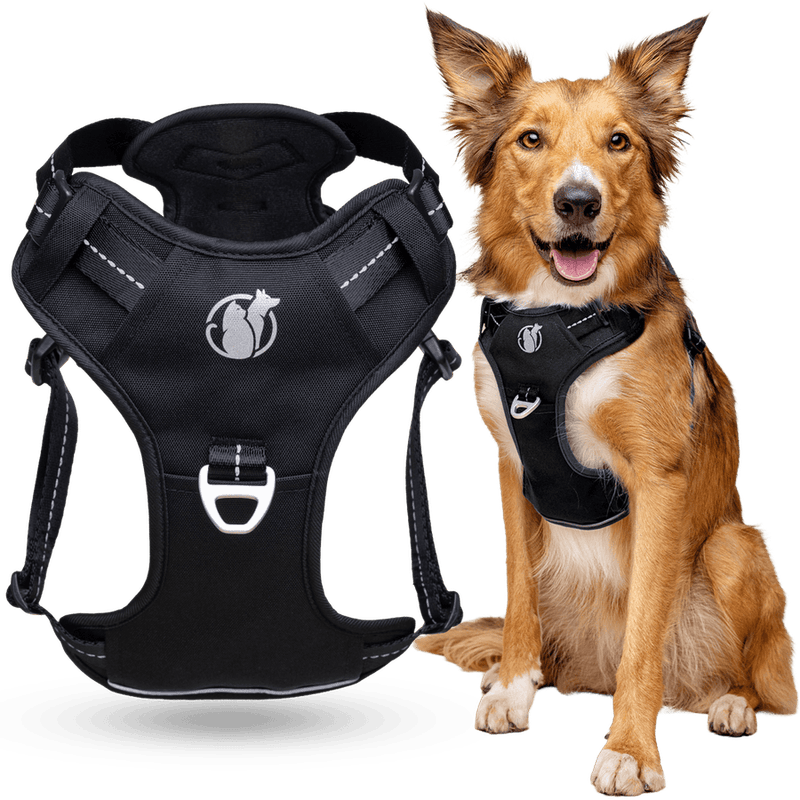
Stop Your Dog Pulling On Their Leash
The Steady+Style No Pull Harness uses front and back clip points to redirect pulling, so you get immediate, gentler control and can actually enjoy the walk again.
Shop Now 👉Better Walk Guarantee • 90-Day PawSafe® Promise
Best Harnesses for a Golden Retriever Puppy
There’s no single winner - the right pick depends on your puppy’s age, build, and your budget. Here are the genuine contenders and where each one fits, based on manufacturer specs and independent testing.

| Harness | Type | Best for | Worth knowing |
|---|---|---|---|
| Blue-9 Balance | Front + back, 6 adjustment points | Most adjustable first harness for a fast-growing pup | Minimal padding, so fit and leash manners matter |
| Ruffwear Front Range | Front + back, padded | A padded everyday harness while your pup is smaller | Testers found it runs short in the back on some medium/large dogs, rubbing the armpits |
| 2 Hounds Freedom No-Pull | Front + tightening back loop | Short, training-focused walks | The back loop tightens under load; watch armpit placement - it’s a training tool, not all-day gear |
| Kurgo Journey Air | Front + back, padded, handle | A breathable, durable budget option | Can run short on long-bodied dogs; a handle isn’t a crash-test rating |
| PetSafe Easy Walk | Front-only, lightweight | Inexpensive front-steering for training sessions | Unpadded horizontal strap can rotate or rub; fit it carefully |
| PawSafe Steady+Style | Front + back, padded, handle | A strong puller who needs control and a size range that grows with them | Weight-banded (see honest notes below) |
Two things independent testers repeat: a harness that fits one dog can rub another of the same weight, so try before you commit - and buy from somewhere with an easy exchange policy, because a growing puppy makes returns inevitable.
Is a No-Pull Harness Good for a Golden Retriever?
Yes - with realistic expectations. Golden retrievers are strong, enthusiastic pullers, especially as puppies, and a no-pull harness for a golden retriever helps a lot. Veterinary guidance from VCA recommends a front-attachment harness as a useful starting tool for puppies that pull, because it keeps force off the neck.
A front-clip attachment redirects your puppy’s chest toward you when they hit the end of the leash, reducing the straight-ahead leverage a back clip gives them. A 2025 peer-reviewed review concluded that a well-fitted, non-tightening front-clip harness currently offers the best balance between reducing pulling and keeping a dog comfortable. That matches what trainers see on the ground.
But be clear on what it does and doesn’t do:
- It manages pulling; it doesn’t teach. No harness creates a loose-leash walker on its own. Reward the moments the leash is slack, stop or change direction when it tightens, and keep sessions short - our guide on how to stop a dog pulling on the leash walks through the method. Consistency over weeks is what sticks.
- Fit matters more than the label. Research shows even harnesses marketed as “non-restrictive” can change a dog’s gait, and the effect depends on fit and the individual dog. Make sure straps don’t twist, cross the shoulder joint, or rub the armpits.
- Skip the harsh shortcuts. A golden puppy doesn’t need a prong or a head halter to walk nicely. A comfortable front-clip harness plus patience does the job without risk.
Where the PawSafe Steady+Style Fits
We build a harness, so here’s the honest placement rather than a sales pitch. The Steady+Style No Pull Harness fits the golden-puppy job well once your pup is in its size range.
What makes it a genuine fit for a growing golden:
- A front-clip aluminum D-ring that redirects pulling - exactly what a strong, energetic golden puppy needs - plus a rear D-ring for relaxed walks once they’ve settled.
- A padded chest plate and adjustable straps for comfort over that thick coat, with a padded top handle for instant control during zoomies or at a crosswalk.
- Reflective stitching, a seatbelt-compatible rear D-ring for the car, and a hidden pocket sized for an Apple AirTag - useful peace of mind with a curious new puppy.
- A size range from XS (10-18 lbs) to XL (70-132 lbs), so you can re-buy the same design you already know how to fit as your golden grows, backed by our 90-day Better Walk Guarantee while you dial in the size.
And the honest limits: it’s weight-banded, not infinitely adjustable, so a fast-growing golden will move up through sizes - measure the chest girth and expect to size up. A very young puppy under about 10 pounds may start in a lightweight puppy harness before graduating into the XS. It’s a comfortable, controllable everyday harness, not a specialized escape or hiking rig.
Best Harness for a Goldendoodle Puppy
Goldendoodles follow the same playbook with one big caveat: size is a moving target. Goldendoodles range from petite (under 25 pounds) to standard (over 51 pounds) depending on their poodle parentage, and a breeder’s projected adult size is an educated guess at best. So the “best harness for a goldendoodle puppy” is never a size bought on a prediction - it’s whatever fits the current chest girth.
Two doodle-specific notes:
- Adjustability matters even more. With a less predictable growth curve, a harness with many adjustment points earns its keep.
- Mind the curly coat. Doodle coats are especially mat-prone. Keep straps smooth, brush under them, and check the skin often.
When Can a Golden Retriever Puppy Start Wearing a Harness?
You can introduce the harness the week your puppy comes home - indoors, paired with treats. Put it on the floor and reward interest, feed treats around the neck opening, then fasten it for a few seconds during meals or play, building up slowly so the harness always means good things.
Public, on-leash walks are a separate question. Puppies receive a core vaccination series that runs from about 6-8 weeks until at least 16 weeks, and your vet will tell you when it’s safe to walk on shared ground. In the meantime, you can build good habits with harness time indoors, leash practice at home, a clean private yard, and carefully managed puppy classes.
One more golden-specific point: they’re a large breed with soft, growing joints. Skip forced running, repetitive fetch with hard stops, and big jumps while they’re growing. Short sniff walks, training, and free play are plenty - and no properly fitted harness will harm a growing puppy.
Make Every Walk Feel Under Control
Adjustable comfort design helps reduce leash tension fast so walks become calm, consistent, and more enjoyable for both of you.
Shop Now 👉Better Walk Guarantee • 90-Day PawSafe® Promise
Frequently Asked Questions
What size harness does a golden retriever puppy need at 8 weeks?
Measure, don’t guess. There’s no reliable breed chest-girth chart by age, and every puppy is built differently. Measure the widest part of your puppy’s rib cage just behind the front legs, then match that number to the exact harness brand’s size chart. As a rough guide, an 8-week golden weighs around 14-15 pounds, but you should still size by the current girth measurement and re-check every couple of weeks.
Is a no-pull harness good for a golden retriever?
Yes, as a management tool. Golden retrievers are strong, energetic sporting dogs, and a front-clip no-pull harness redirects pulling away from the neck without choking. Research supports a well-fitted, non-tightening front-clip harness as a reasonable option for pullers. It won’t teach loose-leash walking on its own, though - pair it with reward-based training.
Should a golden retriever puppy wear a harness or a collar?
Both, for different jobs. Keep a flat collar on for ID tags, but attach the leash to a body harness for walks. A harness spreads leash forces across the chest and shoulders instead of concentrating a sudden lunge on the neck, which is safer for a strong puppy still learning leash skills.
Enjoy Calm Walks Starting Today
Dual-attachment harness distributes pressure and helps turn tug-of-war outings into relaxed, bonding strolls from the first use.
Shop Now 👉Better Walk Guarantee • 90-Day PawSafe® Promise
When can my golden retriever puppy start wearing a harness?
Right away, indoors. Introduce the harness with treats and short wear sessions the week you bring your puppy home. On-leash walks in public areas should wait until your vet clears it, usually after the puppy’s core vaccination series is underway - your veterinarian will advise based on local risk.
How often will I need to size up my golden puppy’s harness?
Often. Golden puppies grow fast - from roughly 15 pounds at 8 weeks to 50-plus pounds by 8 months - so plan to re-measure weekly during growth spurts and size up whenever the harness reaches its adjustment limit, starts rubbing, or changes their gait. Budgeting for two to four harnesses in the first year is realistic.
What’s the best harness for a goldendoodle puppy?
The same principles apply: an adjustable front-clip harness sized to the current chest girth. Goldendoodles vary hugely in adult size - from petite (under 25 pounds) to standard (over 51 pounds) - so never size by a breeder’s projected adult weight. Measure, and their curly coat means paying extra attention to matting and chafing under the straps.
How do I stop my golden retriever puppy pulling on the leash?
A front-clip harness reduces the leverage your puppy gets to pull straight ahead, which makes training easier - but the harness manages pulling, it doesn’t teach the lesson. Reward loose-leash moments, stop or change direction when the leash goes tight, and keep sessions short and positive. Consistency over weeks is what creates a calm walker.
The Bottom Line on the Best Harness for a Golden Retriever Puppy
Choosing the best harness for a golden retriever puppy comes down to a few honest truths:
- Fit beats brand. Measure the current chest girth and buy to that - never to a predicted adult size.
- Adjustable and front-clip win for a fast-growing, strong-pulling sporting breed.
- Plan for growth. Expect three or four sizes in year one, and choose a design in a size range you can re-buy.
- Mind the coat. Smooth straps, regular brushing under them, and a fit check after grooming keep the skin healthy.
Whether you land on a super-adjustable option like the Blue-9 Balance, a padded everyday harness, or our own Steady+Style once your pup grows into it, the goal is the same: a comfortable, secure harness that keeps your golden retriever puppy safe while you enjoy those first wobbly walks together. For hands-on write-ups of specific models, browse our dog harness reviews, or explore the full dog harness guides and collection.