

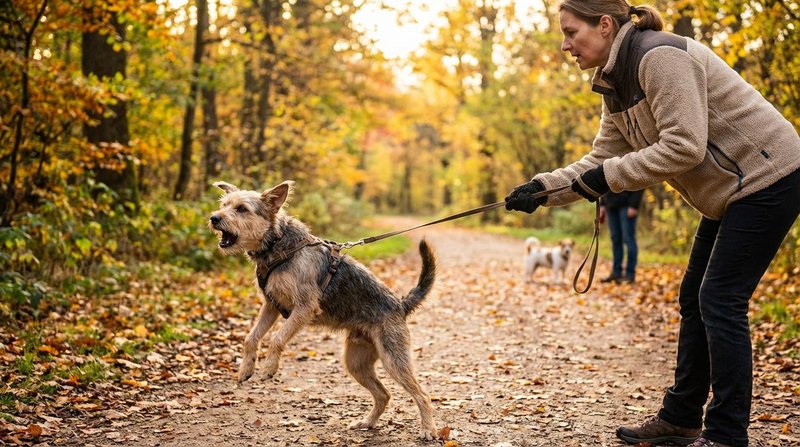
The best harness for reactive dogs features a front chest clip that redirects lunging momentum, escape-resistant design, and padded construction for comfort during high-stress reactions. Front-clip harnesses work better than back-clip for reactive dogs because they turn the dog toward you when they lunge, interrupting the reaction. Look for dual attachment points, adjustable straps for secure fit, and a Y-shaped design that allows full shoulder movement.
Walking a reactive dog feels like defusing a bomb while juggling. You’re constantly scanning for triggers, tensing the leash, and hoping you won’t get pulled off your feet when your dog spots another dog three blocks away.
The wrong harness makes everything worse. A back-clip harness gives your dog leverage to lunge harder. A collar puts dangerous pressure on their neck during reactions. And a poorly fitted harness? Your dog might slip out entirely when they’re in full reaction mode.
This guide covers exactly what features matter for reactive dogs (and why), our top harness recommendations, and how the right equipment supports your training efforts.
We’ve helped 300,000+ pet parents find safer walking solutions, and we understand the unique challenges reactive dog owners face. Your dog isn’t “bad” - they need the right tools and training.
Table of Contents
- Why Reactive Dogs Need Different Harnesses
- 5 Essential Features for Reactive Dog Harnesses
- Best Harnesses for Reactive Dogs: Our Recommendations
- How to Fit a Harness for Your Reactive Dog
- Complete Walking Kit for Reactive Dogs
- Training Tips That Work WITH Good Equipment
- Common Mistakes to Avoid
- Frequently Asked Questions
- Transform Your Reactive Dog's Walks
Why Reactive Dogs Need Different Harnesses
Reactive dogs don’t just pull - they lunge with sudden, intense force. This creates different equipment demands than regular pullers.
When a fearful dog sees a trigger, they can’t run away (the leash prevents flight), so they may fight instead - lunging, barking, and pulling as hard as they can. Frustrated dogs lunge forward to reach what they want, barking excitedly in the process. Either way, the forces involved are sudden and extreme.
The emotional toll on pet parents is real. You need equipment that inspires confidence, not anxiety. The right harness enables training; the wrong harness makes training impossible.
The Physics of a Reactive Episode
When a dog lunges, forces spike dramatically - this isn’t gradual pulling. Research from Nottingham Trent University found that collar pressure during strong pulling can reach 83-832 kilopascals. To put that in perspective, tissue damage in humans begins at just 4.3 kPa.
Reactive lunges generate even higher forces than regular pulling. The sudden acceleration creates peak pressures that can damage your dog’s trachea, thyroid, and cervical spine when concentrated on the neck.
A harness distributes this force across the chest and shoulders instead. These areas are designed to handle load - they’re the same muscles your dog uses to run and play. For the complete research breakdown, see our guide on dog harness vs collar.
Why Back-Clip Harnesses Fail Reactive Dogs
A back-clip harness attaches the leash between the shoulder blades. This gives your dog maximum leverage to pull forward - like strapping a sled to them.
When your reactive dog lunges, a back-clip harness:
- Lets them engage their full body weight and muscle power
- Provides no redirection mechanism
- Makes you fight their strongest muscles (chest and shoulders)
- Offers no feedback that interrupts the lunge
It’s like trying to steer a car from the back seat. You have almost no control over direction, and your dog can pull with everything they’ve got.

5 Essential Features for Reactive Dog Harnesses
After evaluating dozens of harnesses and consulting trainer recommendations, these are the features that matter most for reactive dogs.
1. Front Chest Clip (Non-Negotiable)
This is the single most important feature for reactive dogs.
When your dog lunges forward, a front-clip harness turns them back toward you. The leash attachment point acts as a pivot - forward momentum gets redirected sideways, interrupting the reaction cycle.
This happens through physics, not force. You’re not yanking your dog; the harness design naturally steers them when they pull. Professional trainers describe it as steering the body via the chest, making pulling unproductive.
The redirection also gives you a training opportunity. Each time your dog lunges and gets turned, they learn that lunging doesn’t get them closer to the trigger.
2. Sturdy Back Handle
You will need to grab your dog at some point. An off-leash dog approaches, a trigger appears suddenly, or your dog lunges harder than expected.
A stout back handle gives you instant physical control in emergencies. You can grab your dog, guide them away from the trigger, and physically prevent them from reaching whatever set them off.
Trainer reviews consistently list the back handle as essential for reactive dogs. Harnesses without handles leave you scrambling for the harness straps in a crisis.
3. Escape-Resistant Design
Reactive dogs thrash and twist during reactions. A scared or over-aroused dog may try to back out of a loose harness, and if they succeed, you’ve got a loose reactive dog.
Look for:
- Multiple adjustment points (4+ is ideal) for a custom fit
- Martingale-style chest loops that tighten gently under pull with built-in stoppers
- Tummy strap that prevents backing out
- Secure buckles that won’t pop open under stress
The two-finger rule applies: you should fit exactly two fingers under every strap. If you can grab a handful of fabric, it’s too loose. If you can barely slide one finger, it’s too tight.
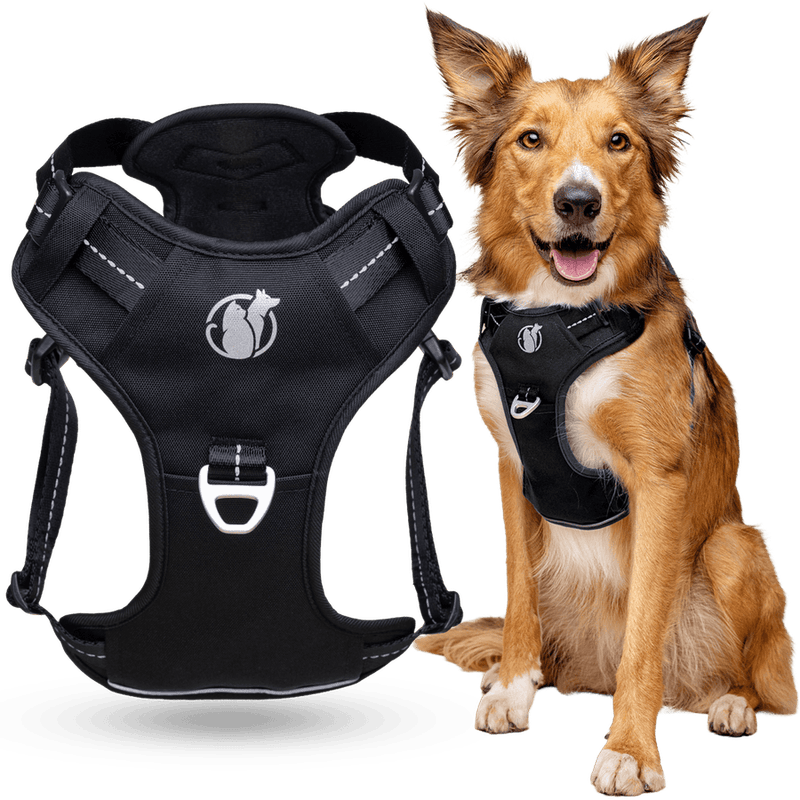
Stop Your Dog Pulling On Their Leash
The Steady+Style No Pull Harness uses front and back clip points to redirect pulling, so you get immediate, gentler control and can actually enjoy the walk again.
Shop Now 👉Better Walk Guarantee • 90-Day PawSafe® Promise
4. Padded Construction
Reactions create sudden pressure points. When your dog lunges, all their force transfers through the harness contact points. Padded straps and chest plates distribute this force over a wider area, preventing bruising and chafing.
Comfort matters for another reason: stressed dogs are more reactive. If the harness pinches, rubs, or restricts movement, that discomfort adds to your dog’s baseline stress level. They’ll hit their threshold faster and react more intensely.
Look for padded chest plates (foam or velvet-lined), soft nylon webbing, and smooth edges that won’t dig in during a lunge.
5. Y-Shaped Front Design
The harness front strap should form a Y on your dog’s chest, sitting on the sternum rather than crossing the shoulders.
This matters because:
- Shoulder joints stay free for natural movement
- No straps restrict your dog’s gait
- The design prevents the frustration that comes from restricted motion
- Dogs who react by spinning or twisting can move naturally
Harnesses that cross the shoulders can cause your dog to walk awkwardly, which increases physical stress and potentially worsens reactivity. For a detailed comparison of all harness styles, see our guide to dog harness types.

Best Harnesses for Reactive Dogs: Our Recommendations
We’ve evaluated harnesses based on the five essential features above to find the best reactive dog harness for your situation. For in-depth testing on each option, see our dog harness reviews. Here are our top picks.
Best Overall: PawSafe Steady+Style No-Pull Harness
Why it works for reactive dogs:
- Front chest clip redirects lunging momentum
- Padded chest plate distributes force comfortably
- Dual attachment points (front and back) for flexibility
- Seatbelt-compatible D-ring (many reactive dogs are anxious in cars too)
- Reflective stitching for visibility on early morning or evening walks
- Adjustable straps for secure, escape-resistant fit
Specs:
- Sizes: XS (10-18 lbs), S (18-30 lbs), M (30-50 lbs), L (50-70 lbs), XL (70-132 lbs)
- Price: $63.96
- Colors: Classic Black, Ever Green
Best for: Most reactive dogs; excellent balance of control, comfort, and value.
View Steady+Style No-Pull Harness →
Best for Large Reactive Dogs: Ruffwear Web Master
Why it works:
- Three points of adjustment for escape-proof fit
- Padded chest and belly panel for all-day comfort
- Wide, sturdy lift handle on back
- Designed for working dogs - built tough for extreme conditions
- Neck buckle so you don’t have to pull over the dog’s head (helpful for anxious dogs)
Considerations:
- Higher price point (~$80+)
- Front-clip is a web loop, not metal ring
- Bulkier and heavier than other options
- Can run warm on hot days
Best for: Large, strong reactive dogs (70+ lbs) who are escape artists or need maximum control.
Best Budget Option: PawSafe No-Pull Harness
Why it works:
- Dual leash attachment points (front and back)
- Quick-release buckles for easy on/off
- Breathable mesh lining prevents overheating
- Machine washable (reactive dogs can get sweaty)
- Seatbelt-compatible D-ring
Specs:
- Sizes: XS through XL (10-132 lbs)
- Price: $55.96
- Reviews: 1,200+
Best for: Budget-conscious pet parents; effective no-pull training without premium pricing.
View No-Pull Harness →
How to Fit a Harness for Your Reactive Dog
Proper fit is critical. A loose harness is an escape risk; a tight harness increases stress and can worsen reactivity.
Measuring Your Dog
Wrap a soft tape measure around your dog’s chest at the widest point - just behind the front legs, over the ribcage. This is your girth measurement.
Most harnesses size by chest girth and weight. If your dog falls between sizes, err slightly smaller and adjust up. A harness that’s too big is more dangerous than one that’s snug.
Make Every Walk Feel Under Control
Adjustable comfort design helps reduce leash tension fast so walks become calm, consistent, and more enjoyable for both of you.
Shop Now 👉Better Walk Guarantee • 90-Day PawSafe® Promise
The Fit Checklist
Before your first walk in a new harness, check:
- Front chest strap sits on sternum (breastbone), not up on throat
- Two fingers fit under every strap - not more, not fewer
- No straps crossing the top of shoulders
- Armpits are clear with no rubbing
- Harness doesn’t shift or ride up when dog moves
- Buckles are secured and positioned away from pressure points
- Belly strap sits 1-2 inches behind front legs
Warning Signs of Poor Fit
After walks, check for:
- Red marks or missing fur (indicates rubbing)
- Harness riding up toward neck
- Dog backing out or nearly escaping
- Straps leaving indentations in fur
Pro Tip: Practice putting the harness on when your dog is calm. A stressed dog is harder to fit, and you want them comfortable with the harness before encountering triggers.

Complete Walking Kit for Reactive Dogs
The harness is just one piece. Here’s the complete setup recommended by trainers.
Essential gear:
- Front-clip harness (primary control)
- Flat collar with ID tags (legal requirement in most areas - keep on at all times)
- 6-foot fixed leash (no retractable leashes - they teach pulling and offer no control)
- High-value treats (for counter-conditioning training)
- Treat pouch (hands-free access during walks)
Optional but helpful:
- Safety strap: Connects harness to collar as backup - if one fails, the other holds
- Martingale collar: For narrow-headed breeds that slip regular collars
- Muzzle: For dogs with bite history (consult a trainer for proper introduction)
What NOT to use:
- Retractable leashes (give your dog too much freedom, make control impossible during lunges)
- Choke chains or prong collars (increase stress and fear, can worsen reactivity)
- Collar-only for leash attachment (neck injury risk during lunges)
For car travel between walking spots, pair your harness with a dog seatbelt to keep everyone safe.
Training Tips That Work WITH Good Equipment
Equipment enables training - it doesn’t replace it. Here are techniques that complement your harness.
The “Watch Me” Foundation
Teach your dog to make eye contact on cue. This becomes your interrupter when triggers appear.
- Practice at home first, then gradually add distractions
- Use high-value treats (chicken, cheese) - boring treats won’t compete with triggers
- When you see a trigger, cue “watch me” BEFORE the reaction starts
- Reward any attention to you, then gradually increase duration
Trainers say this is foundational: “If you can get your dog to ignore other stimuli and look back at you, you can do anything.”
Emergency U-Turn
The moment you spot a trigger, turn 180 degrees and walk the other direction. Practice this so it becomes automatic.
- Say “let’s go!” in an upbeat voice
- Turn away from the trigger, not toward it
- Reward your dog for following
- Use this when triggers appear suddenly or you’ve misjudged distance
A front-clip harness makes turning easier - the redirection helps guide your dog around.

Threshold Management
Every dog has a “reaction distance” - the closest they can be to a trigger while staying calm. Training happens outside this threshold.
- If your dog reacts at 30 feet, train at 40+ feet
- Gradually decrease distance over time (weeks or months, not days)
- If your dog reacts, you’re too close - increase distance
- Good equipment gives you confidence to train at threshold without panic
Working with a professional: The best harness in the world won’t fix reactivity alone. Consider working with a certified force-free trainer (look for CPDT-KA or KPA-CTP credentials) for personalized guidance. Cornell University veterinary behaviorists emphasize that “behavior modification and counter-conditioning are the long-term answer” for reactive dogs.
Common Mistakes to Avoid
-
Using a back-clip harness for a reactive dog - Gives them leverage to lunge harder with zero redirection.
-
Fitting too loose “for comfort” - Creates escape risk and reduces control during reactions.
-
Attaching leash to collar - Neck injury risk during lunges; research shows pressure can reach dangerous levels during strong pulling.
-
Expecting harness to “fix” reactivity - Equipment enables training; it doesn’t replace it. A harness manages symptoms while you work on the underlying behavior.
-
Skipping the back handle - You will need to grab your dog at some point. Don’t find out you need a handle during an emergency.
-
Buying based on looks over function - A cute harness that doesn’t fit or lacks essential features is a dangerous harness.
Enjoy Calm Walks Starting Today
Dual-attachment harness distributes pressure and helps turn tug-of-war outings into relaxed, bonding strolls from the first use.
Shop Now 👉Better Walk Guarantee • 90-Day PawSafe® Promise
Frequently Asked Questions
What type of harness is best for a reactive dog?
Front-clip harnesses with escape-resistant design work best. The front attachment redirects lunging momentum, turning your dog toward you instead of letting them pull forward. Look for multiple adjustment points, padded construction, and ideally a back handle for emergency control.
Do harnesses make reactive dogs worse?
No. The myth that harnesses “cause pulling” isn’t supported by research. Studies show dogs actually pull slightly harder in harnesses than collars - but harnesses don’t cause the pulling, they just don’t prevent it. Harnesses don’t fix reactivity, but they don’t cause it either. They simply make reactions safer by distributing force across the chest instead of the neck.
Should reactive dogs wear a harness or collar?
Both, but attach the leash to the harness. The collar carries ID tags (required in most areas), while the harness provides safe control. Never attach the leash to a collar for a reactive dog - research shows collar pressure during pulling can reach dangerous levels, and reactive lunges create even higher forces.
How do I stop my reactive dog from lunging?
Equipment alone won’t stop lunging - training does. But the right harness makes training possible by giving you control and keeping your dog safe during the process. Work with a certified force-free trainer on desensitization and counter-conditioning techniques. The “watch me” cue, emergency U-turns, and threshold management all complement good equipment.
Can my reactive dog slip out of a harness?
A properly fitted harness is escape-resistant. Look for designs with a tummy strap, multiple adjustment points (4+), and martingale-style chest loops that tighten gently under pull. Use the two-finger rule: you should fit exactly two fingers under every strap. Practice fitting when your dog is calm - test the fit before encountering triggers.
What size harness does my reactive dog need?
Measure your dog’s chest at the widest point (behind the front legs) using a soft tape measure. Most harness brands provide sizing charts based on chest girth and weight. When your dog’s measurements fall between sizes, choose the smaller size and adjust up. A too-loose harness is more dangerous than a snug one.
Transform Your Reactive Dog’s Walks
Walking a reactive dog is hard. The constant vigilance, the embarrassment when your dog loses it, the fear that something will go wrong - we get it.
But the right equipment changes everything. Instead of dreading walks, you can approach them as training opportunities. Instead of white-knuckling the leash, you can feel confident in your control. Instead of avoiding the world, you can gradually help your dog learn that triggers aren’t so scary.
Here’s what to remember when choosing a reactive dog harness:
- Front-clip harness is essential - it redirects lunges safely
- Proper fit prevents escape and maximizes control
- Equipment enables training but doesn’t replace it
- Complete system: harness + collar + fixed leash + treats
Your reactive dog deserves walks that don’t stress both of you out. Our Steady+Style No-Pull Harness is designed with exactly these challenges in mind - front-clip control, padded comfort, and a fit that won’t let you down when it matters most. Browse our dog harness collection to find the right fit for your reactive dog.
Every walk is a chance to help your dog learn that the world isn’t so scary. The right harness makes that possible.