

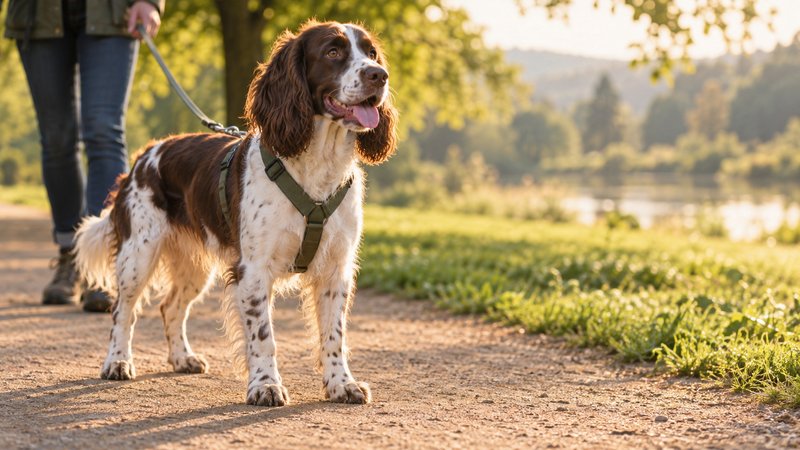
A Y-shaped dog harness has two neck straps that meet a central strap over the breastbone, forming a Y on the chest, with a girth strap around the rib cage behind the front legs. This routes leash pressure onto the sternum and keeps straps clear of the shoulder joints, so the front legs move freely. It suits most dogs when fitted correctly - the junction sitting on the chest bone, not the throat. A well-fitted Y-harness supports natural movement and comfortable walks.
“Get a Y-shaped harness.” If you’ve asked around about dog gear lately, you’ve heard it from trainers, vets, and every dog forum on the internet. The Y-shape has become the default recommendation for a harness that respects your dog’s body.
But what actually makes the Y-shape better? How is it different from an H-harness? And does simply buying something labeled “Y” guarantee your dog gets a good, shoulder-friendly fit? (Spoiler: it doesn’t.)
This is the complete, honest guide. You’ll learn exactly what a Y-shaped dog harness is, the anatomy behind why it’s recommended, how it stacks up against the H-harness, what a no-pull “Y-front” adds, and - most importantly - the four fit checks that decide whether the harness actually helps your dog or quietly works against them.
We’ve drawn on peer-reviewed canine biomechanics research and guidance from veterinary and welfare sources, plus what we’ve learned helping more than 300,000 pet parents find gear that fits.
Table of Contents
- What Is a Y-Shaped Harness?
- Why Vets and Trainers Recommend a Y-Shaped Harness
- Y-Shaped Harness vs H-Harness: The Real Differences
- What a Y-Front (No-Pull) Harness Adds
- Does Your Y-Harness Actually Fit? The 4 Checkpoints
- Which Dogs Suit a Y-Shaped Harness?
- How to Choose a Y-Shaped Harness
- Frequently Asked Questions
- Is a Y-Shaped Harness Right for Your Dog?
What Is a Y-Shaped Harness?
A Y-shaped harness is named for the shape it makes on the front of your dog’s chest. It has three working parts:
- Two neck straps that run down each side of the neck from the withers.
- A central junction where those straps meet, sitting over the front of the breastbone (the sternum). This forms the “Y.”
- A chest strap that continues back between the front legs to a girth strap that circles the rib cage behind the elbows.
The whole point of that geometry is where the straps don’t go: across the front of the shoulders or against the throat. Canine sports-medicine veterinarians describe the Y design as neck bands meeting a central chest band at the front of the sternum, so leash pressure loads onto the chest and rib cage rather than the neck.
You’ll sometimes see a Y harness for dogs called an “anatomical” or “open-shoulder” harness. It differs from a Norwegian or straight-front harness, which runs one horizontal band across the front of the chest - a band that can lie right over the moving shoulders. The distinction that matters is the actual strap path, not the name on the box.

Why Vets and Trainers Recommend a Y-Shaped Harness
The recommendation comes down to how a dog’s shoulder is built - and it’s different from ours.
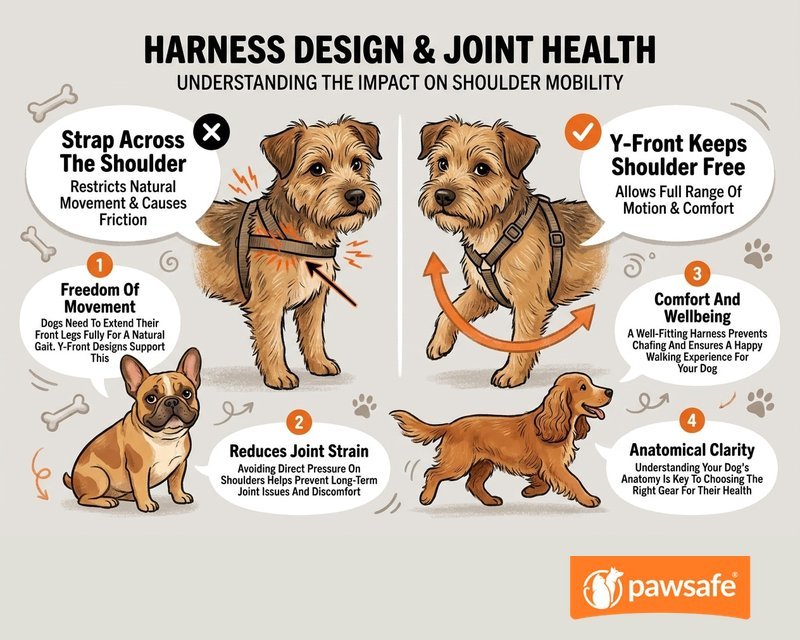
Your dog doesn’t have a working collarbone. Instead of a bony joint connecting the front leg to the body, the shoulder blade (scapula) is held against the rib cage by muscle, an arrangement called the scapular synsarcosis. That shoulder blade slides and rotates over the ribs with every stride. In fact, one veterinary review estimates scapular movement contributes at least 65% of a dog’s stride length.
Now picture a strap pulled tight across the front of that moving shoulder. It can press on the joint, rub against the sliding scapula, and shorten the dog’s reach - and dogs often shorten their own stride when they feel that pressure. A Y-front is designed to route the straps beside the neck and onto the sternum instead, leaving the shoulder joints free to do their job.
That’s why welfare organizations put it plainly. As Dogs Trust advises: “Some harnesses cross directly in front of the shoulders preventing natural movement, and you should avoid these.”
Here’s the honest part, though. A Y-shape is a sensible starting point - not a guarantee. In one influential 2019 study, the Y-shaped harness tested actually reduced shoulder extension more than the horizontal-strap harness (about 4.73° versus 2.16° at a walk). Larger studies since have found the effect depends heavily on the breed, the specific product, and the fit. The research consensus is careful: every harness can change gait a little, no design is automatically best, and a short-term change in stride is not proof of injury. As Tufts veterinary behaviorist Dr. Stephanie Borns-Weil sums up, “harnesses, provided they are well fitted, are much preferable to collars for dogs for leash walking.” The operative words are well fitted.
Y-Shaped Harness vs H-Harness: The Real Differences
This is the comparison everyone wants, so let’s be precise - because “Y-shaped harness vs H-harness” isn’t always a true either/or.
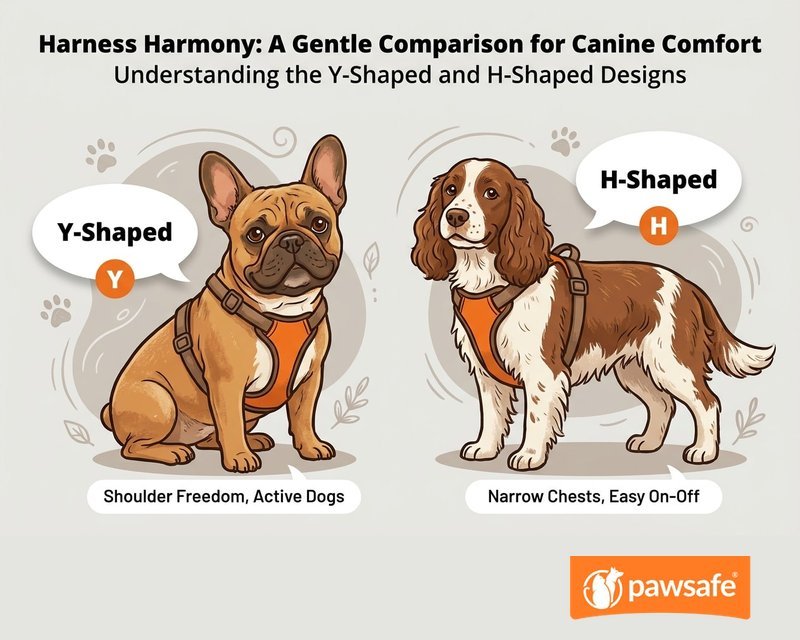
“Y” describes the front of the harness. “H” usually describes the side profile: a neck loop and a girth loop joined along the back and underneath. The catch is that an H-harness can also have an open Y-front. So the letters describe different things, and one doesn’t rule out the other.
With that in mind, here’s a fair comparison of how the typical versions behave:
| Factor | Y-front harness | H-harness |
|---|---|---|
| Shoulder clearance | Straps route beside the shoulder onto the sternum | Depends on the front connector - some are open, some cross the shoulder |
| Pressure | Loads the breastbone, neck straps, and girth | Two loops can spread load, but narrow webbing may concentrate it |
| Pullers | Back clip won’t discourage pulling; front/dual clip redirects | Same - clip position matters more than the shape |
| Deep chest | Great if the sternum and girth adjust independently | Multi-adjustable H versions handle long chests well |
| Narrow chest | A wide chest panel may rub or tip sideways | A snug H, or a double-H, can fit narrow dogs securely |
| Escape security | A plain two-loop Y is not escape-proof | A third belly strap (double-H) is harder to back out of |
| Putting it on | Often over-the-head; buckled versions exist | Over-the-head, buckled, or step-in |
The takeaway: there’s no universal winner. A Y-front tends to shine for shoulder freedom, active dogs, and deep-chested breeds; a well-adjusted H (especially a double-H) can be the smarter pick for narrow-chested sighthounds, escape artists, or head-shy dogs that need buckles instead of an over-the-head design. To see how these fit into the wider range of options, our guide to dog harness types breaks down every style. Whichever letter you choose, the rule is identical: the straps must clear the shoulders.
What a Y-Front (No-Pull) Harness Adds
A y front harness for dogs takes the Y-shape and adds a leash ring at the front, right at the sternum junction. When your dog pulls, the leash acts in front of their center of mass, so the harness turns their chest back toward you instead of letting them power straight ahead. That’s redirection - it makes pulling less effective in the moment.
Where the front ring sits matters enormously. It should be centered on the firm front of the breastbone, below the throat and high enough that it doesn’t hang between the legs. A ring set too low weakens the steering, drags the leash across a leg, and can twist the harness to one side.
Two things worth being honest about. First, a plain back-clip Y protects the neck but can actually let a dog pull with more force - one 2025 study measured a mean of 60.5 N of pulling force in a back-clip harness versus 37.8 N on a flat collar. So a back-clip harness should never be sold as “no-pull.” Second, even a front clip is a management aid, not a fix. A 2025 review found a non-tightening front-connection harness is the most reasonable equipment compromise for pullers - but only alongside reward-based loose-leash training. The Steady+Style no-pull dog harness uses exactly this approach: a padded Y-front chest plate with a front clip that redirects momentum, plus adjustable straps so the ring and junction sit where they should.
Does Your Y-Harness Actually Fit? The 4 Checkpoints
Here’s the truth the retailer pages skip: a poorly-fitted Y-harness can restrict the shoulder and chafe just as badly as the cross-shoulder design you were trying to avoid. Buying a “Y” is step one. Fitting it is what actually protects your dog. Check these four things.
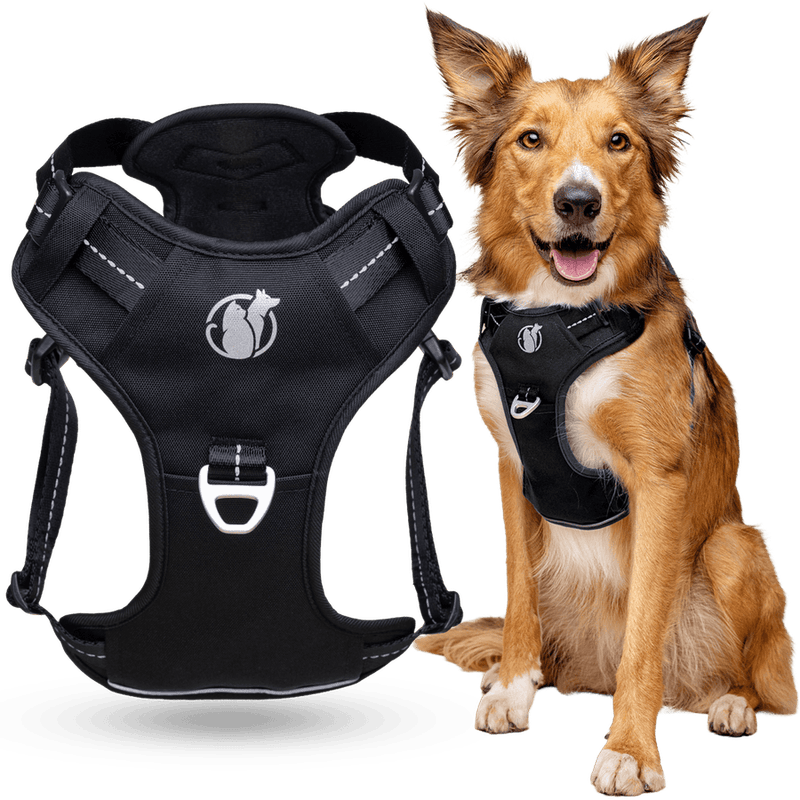
Stop Your Dog Pulling On Their Leash
The Steady+Style No Pull Harness uses front and back clip points to redirect pulling, so you get immediate, gentler control and can actually enjoy the walk again.
Shop Now 👉Better Walk Guarantee • 90-Day PawSafe® Promise
1. The shoulders are clear
The neck straps should run up the sides of the neck, inside the front of the shoulders, and stay there when your dog reaches forward. If a strap drifts out over the shoulder joint, the harness is too big, sits too low, or is the wrong shape for your dog - a printed Y won’t save it.
2. The junction sits on the chest bone
Feel for the firm front point of the breastbone. The Y should meet there - not up on the soft throat, and not sagging low between the legs. As trainer Lori Stevens puts it, the intersection of the Y “should land on the dog’s sternum, not their airway.” If it rides up when your dog lowers their head or the leash tightens, the front section is too short.
3. The armpits have room
The girth strap belongs behind the elbows but still on the rib cage - not tucked into the armpit, and not so far back it sits on the soft belly. A rough guide is room for two-ish fingers behind the front legs on a medium dog, more on a large one, but the real test is simple: the front legs should swing fully back without the strap rubbing.
4. The chest strap doesn’t rub between the legs
The central strap should lie flat on the sternum and be narrow enough that it never rubs the inside of the front legs as they move. A chest panel built for a broad dog will chafe a narrow one, so watch your dog walk from the front.
Pro Tip: After the first 10-15 minutes of a walk, run your hands over the armpits, inner legs, sternum, and throat. Flattened fur, red marks, or missing hair mean the fit needs adjusting. Then apply gentle leash tension from the front and back and do a backward-escape check - a harness that looks secure moving forward can slip over the head in reverse.

Which Dogs Suit a Y-Shaped Harness?
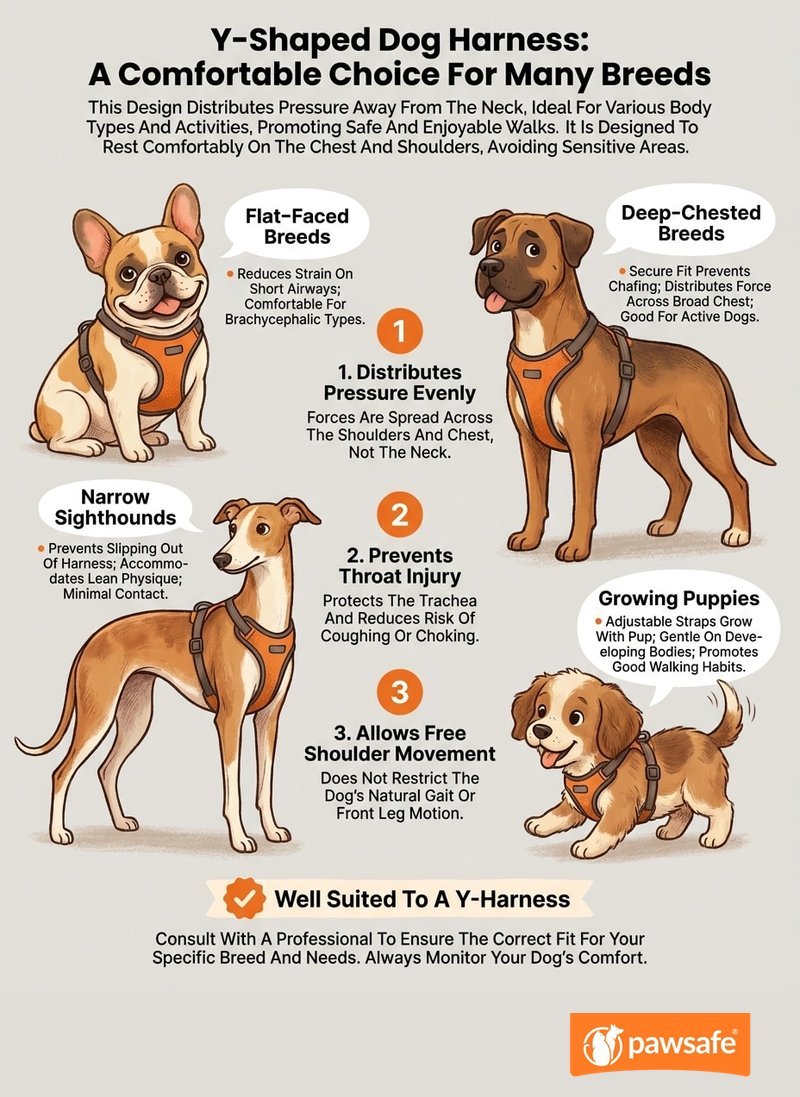
Most dogs do well in a well-fitted Y-front, but body shape and life stage change what to look for. Explore options for each in our dog harness collection and guides.
| Dog type | Y-harness guidance |
|---|---|
| Flat-faced (brachycephalic) | Strongly favored - keeps pressure off an already-compromised airway; keep the junction well below the throat |
| Deep-chested breeds | Great fit if the sternum and girth adjust independently; watch for escape |
| Narrow-chested sighthounds | A soft, adjustable Y can work, but a wide panel may rub - consider a third strap or double-H for escape security |
| Broad-chested / broad-necked | Often better than a collar; needs long enough neck straps to keep the junction off the throat |
| Puppies | Yes - light and adjustable, checked often as they grow; never oversized to “grow into” |
| Active / sport dogs | Shoulder clearance helps; a walking harness is not a pulling harness for canicross or skijoring |
| Strong pullers | A non-tightening front or dual-clip Y plus training |
| Senior dogs | A comfortable Y with easy on/off; note it’s not a lifting or mobility harness |
If your dog is a trail companion, shoulder freedom matters even more over long distances - our guide to the best hiking harness for dogs covers trail-ready Y-front designs with handles and load-bearing padding.
A harness is walking gear, not a medical device. If your dog develops a limp, a shortened stride, pain when you touch the shoulder or sternum, sores, or any coughing or noisy breathing under tension, stop using the harness and check with your vet.
Make Every Walk Feel Under Control
Adjustable comfort design helps reduce leash tension fast so walks become calm, consistent, and more enjoyable for both of you.
Shop Now 👉Better Walk Guarantee • 90-Day PawSafe® Promise
How to Choose a Y-Shaped Harness
Once you know your dog suits a Y-front, judge the harness itself on these features:
- Multiple adjustment points - four or more lets you fit the neck, chest, and girth independently. This is the single biggest predictor of a good fit, especially for deep, broad, or narrow chests.
- A junction that sits on the sternum - and a front ring (if it’s a no-pull design) centered on the chest bone.
- A padded chest plate that spreads pressure over a broad, smooth surface.
- Buckles for easy on/off - a neck buckle spares head-shy or ear-sensitive dogs the over-the-head motion.
- Hardware that stays centered so the harness doesn’t rotate to one side under tension.
- Reflective detailing for early-morning and evening walks, plus a seatbelt-compatible D-ring if you travel with your dog.
Before you commit, it’s worth comparing tested options side by side - our dog harness reviews put 10 popular harnesses through real-world walks. Measure your dog first (the base of the neck and the widest part of the rib cage), use the maker’s size chart rather than guessing by breed, and be ready to return anything that doesn’t clear the shoulders.
Frequently Asked Questions
What is a Y-shaped harness?
A Y-shaped harness has two neck straps that meet a central strap over the front of the breastbone, forming a Y when viewed from the front. That central strap continues between the front legs to a girth strap around the rib cage. The design aims to keep a horizontal strap off the shoulder joints and pressure off the neck.
Is a Y-shaped harness better for dogs?
Often, but not automatically. Its strap path is anatomically sensible and can leave the shoulders clearer than a cross-chest design. But studies show a Y-harness can still shorten a dog’s stride if it’s poorly proportioned, oversized, or wrong for that dog’s body. Fit matters at least as much as the Y label.
Y-shaped harness vs H-harness - which is better?
Neither name guarantees a winner, and some H-harnesses actually have a Y-front. Choose by what you can see on your dog: straps that clear the shoulder joints, a junction on the breastbone, a girth on the rib cage, no rubbing, and a harness that stays centered and can’t be reversed over the head.
Enjoy Calm Walks Starting Today
Dual-attachment harness distributes pressure and helps turn tug-of-war outings into relaxed, bonding strolls from the first use.
Shop Now 👉Better Walk Guarantee • 90-Day PawSafe® Promise
Do vets recommend Y-shaped harnesses?
Veterinary and welfare sources commonly recommend well-fitted harnesses that leave the shoulders free and keep pressure off the neck, which often points to a Y-front. There is no clinical trial or professional consensus saying every dog must wear a Y-harness specifically. A well-fitted harness is the goal, not one exact shape.
Are Y-shaped harnesses good for pullers?
A back-clip Y protects the neck but can let a dog pull efficiently. A non-tightening front-clip or dual-clip Y redirects pulling by turning the dog toward you, which helps as a management aid. It is not a cure - loose-leash walking still has to be trained with rewards.
How should a Y-shaped harness fit?
The Y junction should sit on the breastbone, not the throat. The neck straps should clear both shoulder joints, the chest piece should lie flat without rubbing the inner legs, and the girth should sit behind the elbows but stay on the rib cage. It should stay centered under leash tension and resist being pulled over the head in reverse.
Are Y-shaped harnesses good for puppies?
Yes, if the harness is light, comfortable, secure, and readjusted often as the puppy grows. Check the fit frequently during growth spurts and never buy an oversized harness to grow into. There is no proof a Y-shape improves skeletal development, so choose it for comfort and neck protection, not as a growth aid.
Is a Y-Shaped Harness Right for Your Dog?
For most dogs, a well-fitted Y-shaped dog harness is a smart, shoulder-friendly choice - and the reason is your dog’s own anatomy, not marketing.
Here’s what to remember:
- A Y-shaped harness routes straps onto the breastbone and clears the shoulder joints, so your dog moves naturally.
- The Y-shape is a sensible default, but it’s not automatically “non-restrictive” - fit decides that.
- Y or H, the rule is the same: straps must clear the shoulders and sit off the throat.
- A no-pull Y-front redirects pulling but doesn’t replace training.
- Run the four fit checks - shoulders clear, junction on the chest bone, armpits roomy, chest strap not rubbing - before you trust any harness.
Get the fit right and the question answers itself: a good Y-shaped harness, matched to your dog’s body and checked on a real walk, makes every outing more comfortable and more natural for them. Ready to find one? Look for a padded, fully adjustable Y-front that sits where it should - on the chest, off the shoulders.