

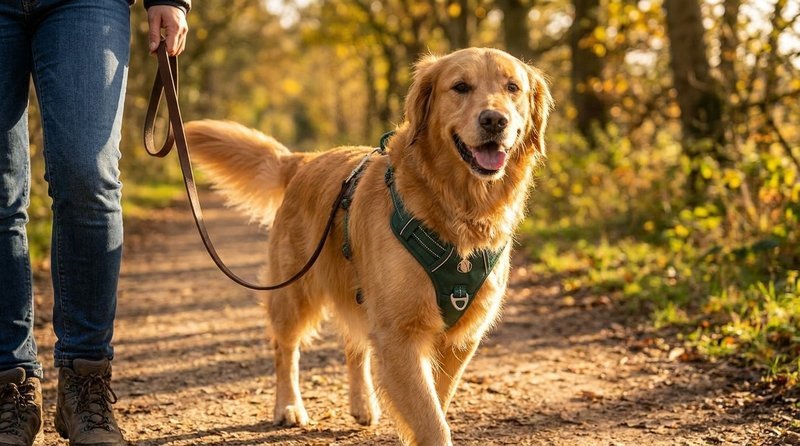
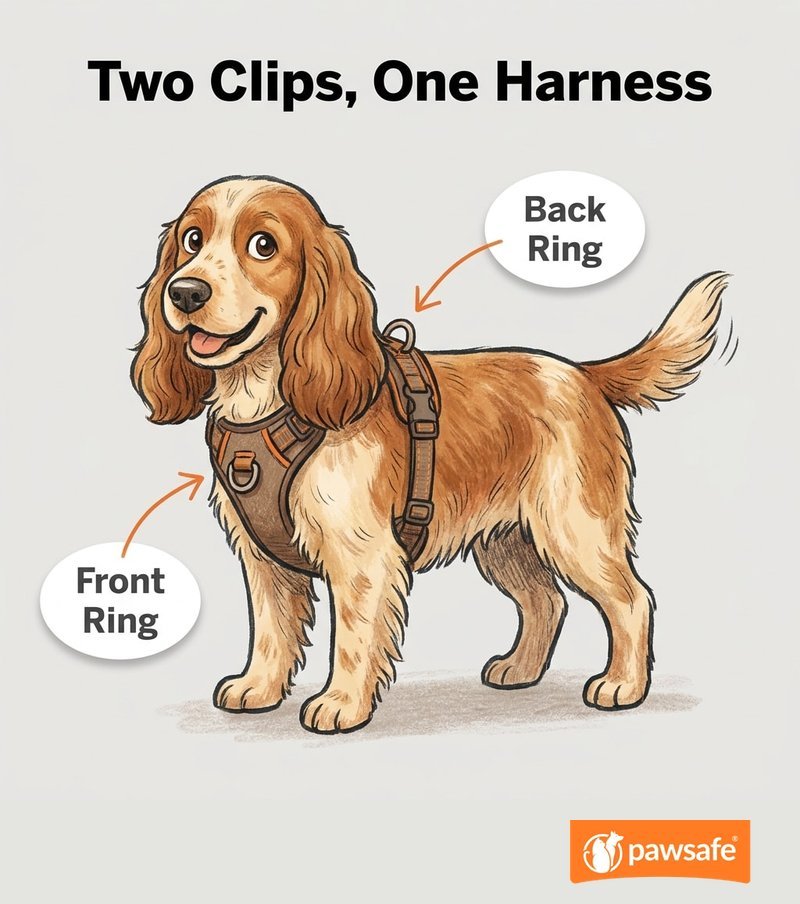
A front-clip vs back-clip harness choice comes down to where the leash attaches. A front-clip harness connects at the center of the dog’s chest, so when the dog pulls, the leash turns them back toward the handler, improving control for pullers and leash training. A back-clip harness attaches between the shoulder blades and allows free forward movement, suiting calm, trained walkers, small dogs, and running. Dual-clip harnesses include both attachment points. Fit and strap position affect comfort and control as much as clip location.
Two harnesses can look almost identical on the rack. Move the leash ring from the back to the chest, though, and the whole walk can change.
If your dog turns every walk into a tug-of-war, you’re in good company. In a 2019 survey of 2,531 dogs, 82.7% were reported to pull on the leash. Pick the wrong clip position and you either make that pulling easier or hand yourself no real control. Pick the right one and you get a genuine head start.
Here’s what actually matters with a front clip vs back clip harness: the honest mechanics behind each one (no myths), a 10-second comparison table, a simple way to choose by your dog’s behavior, body, and activities, a puppy section most guides skip, and realistic expectations if you’re buying for pulling. We test harnesses on our own dogs, and we’ve helped 300,000+ pet parents sort out their walking gear - so let’s make this an easy call.
Table of Contents
- Front Clip vs Back Clip Harness at a Glance
- How a Front-Clip Harness Works (and Why It Reduces Pulling)
- How a Back-Clip Harness Works (and When It's the Better Pick)
- Front Clip vs Back Clip Harness: How to Choose
- Do Front-Clip Harnesses Actually Stop Pulling?
- Can You Use a Front Clip on a Puppy?
- Why a Dual-Clip Harness Settles the Debate
- Fit Matters More Than the Clip
- Frequently Asked Questions
- The Bottom Line on Front Clip vs Back Clip Harness
Front Clip vs Back Clip Harness at a Glance
If you only have a minute, this table covers the core of the decision.
| Feature | Front-clip harness | Back-clip harness |
|---|---|---|
| Leash attaches | Center of the chest | Between the shoulder blades |
| Best for | Pullers, reactive dogs, leash training, busy areas | Calm loose-leash walkers, small/sensitive dogs, jogging, hiking |
| What the dog feels | A pull turns the chest and shoulders back toward you | Pressure stays in line with forward movement |
| Main tradeoff | Leash can pass near the front legs; needs a snug, centered fit | Offers less help redirecting a strong puller |
| Also known as | No-pull harness, a dog harness that clips in front | Standard or everyday harness |
Quick verdict: reach for the front clip when you need to manage pulling, lunging, or training in distracting places. Reach for the back clip when your dog already walks nicely and you want comfortable, unrestricted movement. Want both in one harness? That’s what dual-clip designs are for - more on that below. For the full field-tested breakdown of specific models, see our hands-on dog harness reviews.
How a Front-Clip Harness Works (and Why It Reduces Pulling)
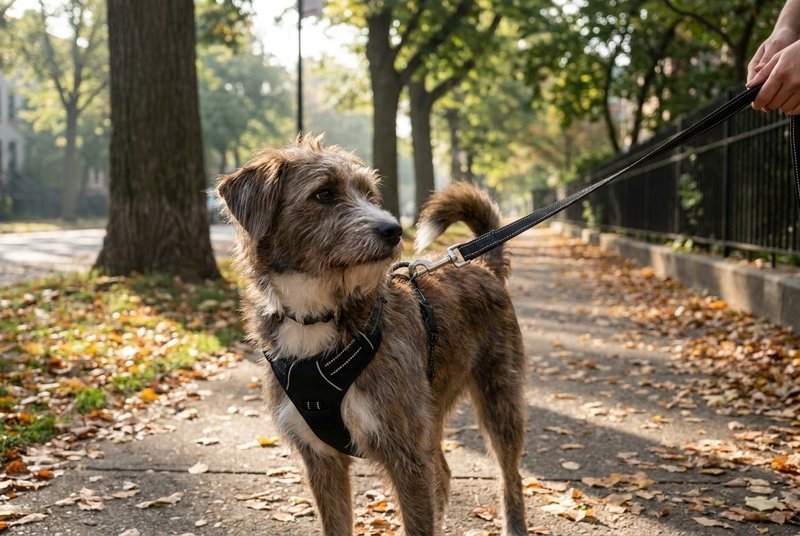
A front-clip harness - the kind of dog harness that clips in front, at the sternum - works because of simple leverage. When a dog harness clips in front, the leash sits at the chest instead of over the shoulders, and that small change does the heavy lifting. When your dog surges ahead and you’re behind or slightly to one side, the leash pulls on the front of their chest at an angle. That off-center force rotates the chest and shoulders back toward you, so some of their forward drive gets turned into a sideways turn instead of a straight-ahead haul.
Think of walking a bicycle. Hold it only by the back of the seat and it can veer wherever it wants - you’re just along for the ride. Grab the handlebars instead, and the moment the front wheel turns, the bike comes back toward you with barely any effort. A front clipping dog harness is the handlebars.
You’ll also hear this explained with dramatic ideas like an “opposition reflex” or a “sled-dog instinct.” Be a little skeptical there. Dogs do lean and strain against pressure, but there’s no solid evidence for a single hardwired reflex that makes every dog pull against a back clip. Everyday pulling is better explained by excitement, walking speed, sniffing, and simple learning - if pulling has reliably gotten your dog to the next lamppost, they’ll keep doing it. Veterinary sources like VCA Animal Hospitals describe the front attachment plainly: it turns the dog back toward the handler.
The catch: a front clip manages pulling. It doesn’t teach your dog what to do instead. Used well, it makes a great training moment - your dog turns back, and you reward the slack leash and the check-in. Used as a magic fix, it just leaves you steering a frustrated dog.
How a Back-Clip Harness Works (and When It’s the Better Pick)
A back-clip harness puts the leash ring on top, between the shoulder blades. Because that pull lines up with the direction your dog is already moving, there’s no turning effect. For a dog with decent leash manners, that’s exactly what you want: comfortable, unrestricted movement and a leash that stays up and out of the way.
The flip side is honest, too. With nothing redirecting them, a determined dog can lean straight into the chest and shoulder straps and pull with real force. This isn’t just theory. In one study of 52 shelter dogs, leash tension was markedly higher on a back-connection harness than on a collar, and a separate 2025 study found the same pattern - dogs generated more force in a padded back-clip harness than in a flat collar. A back clip doesn’t create a puller, but it won’t slow one down.
Where the back clip shines:
- Dogs who already walk politely on a loose leash
- Relaxed “sniff walks” where your dog gets more range
- Jogging, hiking, and long-line adventures, once leash skills are solid
- Small or sensitive dogs who don’t need much redirecting
One more note for flat-faced (brachycephalic) breeds and any dog with a delicate windpipe: a well-fitted body harness of either style is far kinder than clipping to the neck. Just make sure no strap or panel rides up onto the throat.
Front Clip vs Back Clip Harness: How to Choose
Forget the label and choose by the job. Run your dog through these four filters and the answer usually falls out quickly.
By behavior
- Pulls, lunges, or is still learning? Start with a front or dual clip for the extra steering.
- Walks calmly on a loose leash already? A back clip keeps things simple and comfortable.
Stop Your Dog Pulling On Their Leash
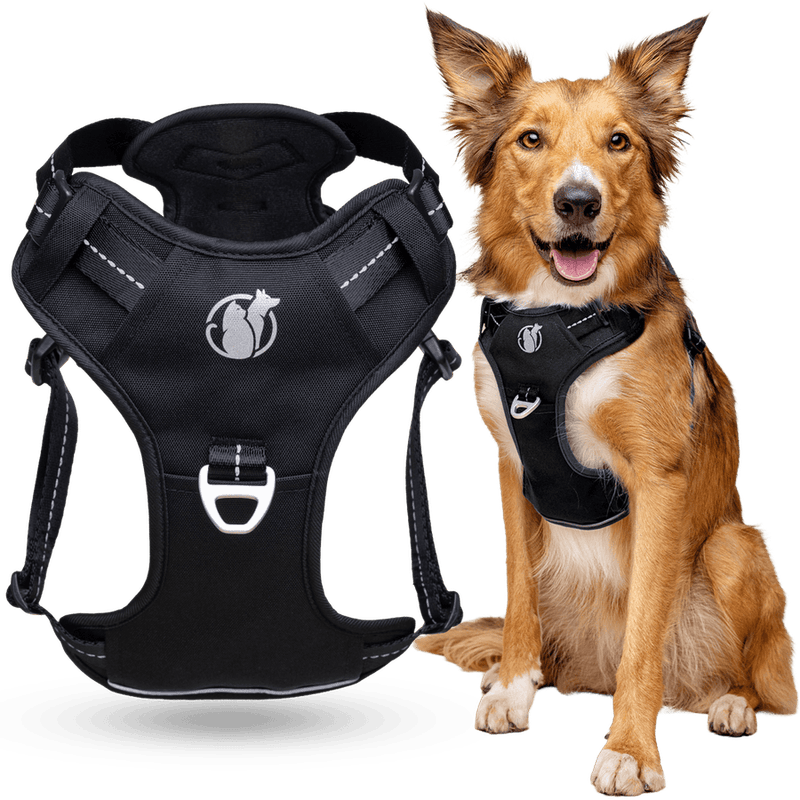
The Steady+Style No Pull Harness uses front and back clip points to redirect pulling, so you get immediate, gentler control and can actually enjoy the walk again.
Shop Now 👉Better Walk Guarantee • 90-Day PawSafe® Promise
By body
- Small or toy breeds: lightweight hardware; a back clip if they’re calm, a light front/dual clip if they pull.
- Deep-chested or narrow-waisted dogs: prioritize a highly adjustable or escape-resistant design so it can’t rotate or gape.
- Thin-coated breeds (Greyhounds, Boxers, many pit bull types): look for wide, soft, smooth straps to prevent chest and armpit chafing.
- Strong, powerful dogs: the front clip gives you leverage a back clip can’t.
By activity
- Training sessions and busy streets: front clip.
- Running, hiking, and sniff walks: back clip on a well-fitted Y-shaped harness.
By handler
If there’s a big strength mismatch between you and your dog, the front clip’s redirection is your friend - it turns muscle into steering.
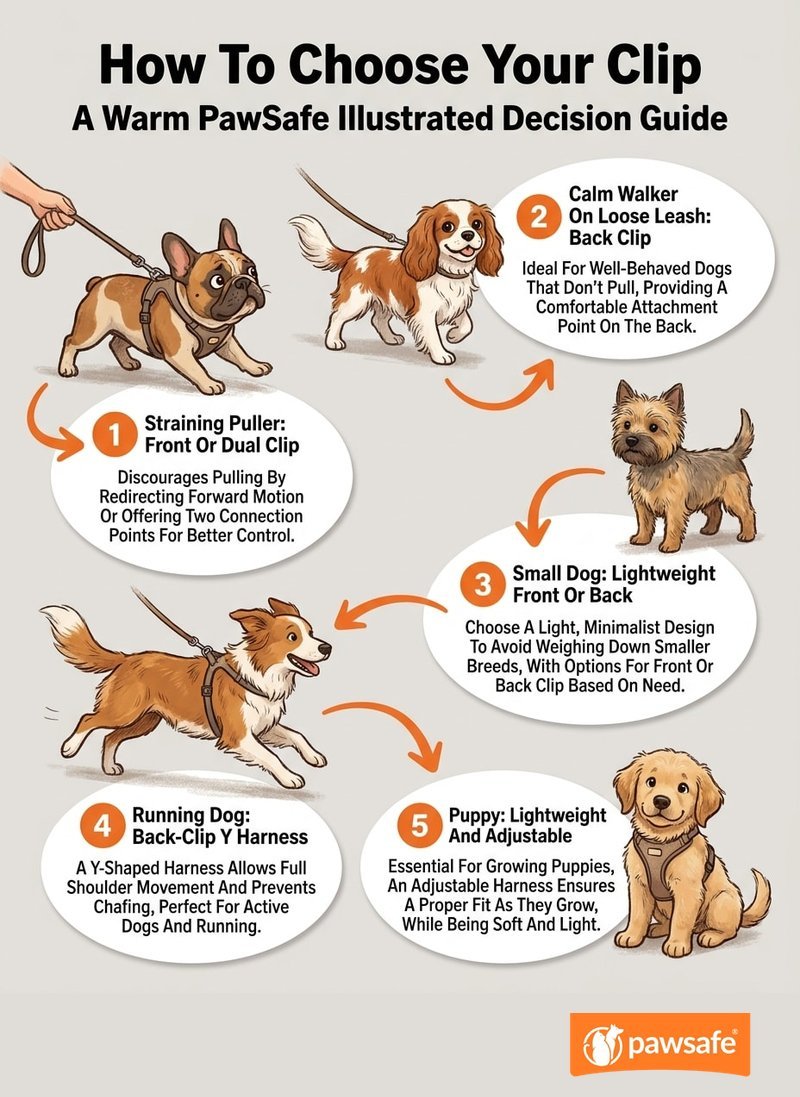
A quick reference:
| Your dog | Best starting point |
|---|---|
| Strong, habitual puller | Front or dual clip + training |
| Reactive / lunging | Secure front or dual clip, work below threshold with a pro |
| Reliable loose-leash walker | Back clip |
| Runner / hiker (trained) | Back-clip Y harness |
| Brachycephalic / trachea-sensitive | Harness (not neck), often a comfy back clip |
| Small puller | Lightweight front or dual clip |
| Puppy | Lightweight, non-tightening, adjustable; front clip if control is needed |
This mirrors what the American Kennel Club recommends: front attachment for extra control over pullers, back attachment for dogs with good leash manners, and dual-clip designs when you want flexibility.
Do Front-Clip Harnesses Actually Stop Pulling?
Short answer: a front-clip no-pull harness reduces and redirects pulling, but it doesn’t erase it. When shoppers search for a dog harness, front clip, no pull, they’re usually hoping the gear will do the training for them. It won’t - and any brand that promises otherwise is overselling.
Here’s the realistic version. The front clip changes the physics so pulling stops working as well, which buys you calmer, more controllable walks starting on day one. That’s genuinely valuable. But loose-leash walking is a skill your dog has to learn, and the equipment just makes teaching it easier. Leading veterinary and training bodies treat no-pull harnesses as management tools, not shortcuts.
Pair the harness with a couple of simple habits:
- Be a tree: the instant the leash goes tight, stop. Only move forward again when it softens. Pulling should never get your dog where they want to go.
- Reward the check-in: every time your dog looks back at you or returns to your side, mark it and treat. You’re paying them to stay connected.
The clip buys you control, but the training is what lasts - our step-by-step guide on how to stop a dog pulling on the leash covers the rest of the routine.
Reward-based training is also the approach animal-behavior experts endorse. The American Veterinary Society of Animal Behavior recommends reward-based methods and advises against choke, prong, and shock collars - a front-clip harness plus treats is the safer, kinder path to a dog who chooses to walk with you.
Can You Use a Front Clip on a Puppy?
Yes - a front clip puppy harness is perfectly appropriate, with a few common-sense caveats. There’s no research-backed minimum age for a front attachment. What matters is that the harness is lightweight, doesn’t tighten around the body, is sized correctly, and leaves the shoulders and armpits clear.
Because puppies grow in spurts, fit is the whole game. Recheck the straps every few wears and after any visible growth, keeping the two-finger rule (below) in mind.
Introduce it gently so the harness always predicts good things:
- Show the harness and feed a treat.
- Reward your pup for sniffing the straps and buckles.
- Reward them for moving their head or feet through the openings.
- Fasten it briefly, feed or play, then take it off.
- Add a light leash indoors before heading outside.
- Keep early sessions short - the AKC suggests roughly five to ten minutes for puppies - and stop before frustration sets in.
Starting good habits early pays off, and a front clip gives you gentle control while your puppy figures out that walking near you is where the fun is.
Why a Dual-Clip Harness Settles the Debate
Real walks change block to block. Your dog might amble calmly past the quiet houses, then light up at a squirrel, a patio full of diners, or the school-pickup crowd. A dual-clip harness - one with both a chest ring and a back ring - lets you match the attachment to the moment.
A simple routine: clip to the front ring for focused training or high-distraction stretches, then switch to the back ring for a relaxed sniff walk once your dog settles. Some handlers use a double-ended leash on both rings for extra steadiness; if you do, treat the back line as the stable connection and the front as gentle steering - never seesaw or keep both taut.
What to look for in a genuine dual-clip harness: a real chest D-ring (not a flimsy fabric loop), a secure back D-ring, a snug and centered fit, padded contact points, and ideally a top handle for close control. Our own Steady+Style No Pull Harness is built exactly this way - a reinforced aluminum front D-ring at the chest to redirect pulling, a rear D-ring for relaxed walks (and for clipping into a dog seatbelt), a padded chest plate, sturdy Duraflex buckles, a padded grab handle, and reflective stitching, in sizes XS through XL (10-132 lbs). Rabbitgoo, 2 Hounds Freedom, and several others make solid dual-clip harnesses too; the right pick is the one that fits your dog and holds a centered chest ring.
A dual clip is worth it when one dog’s needs shift by environment. If your dog walks happily on a back clip and never pulls, you don’t need one.
Make Every Walk Feel Under Control
Adjustable comfort design helps reduce leash tension fast so walks become calm, consistent, and more enjoyable for both of you.
Shop Now 👉Better Walk Guarantee • 90-Day PawSafe® Promise
Fit Matters More Than the Clip
The best clip position in the world can’t rescue a badly fitted harness. Before you judge any style, get the fit right:
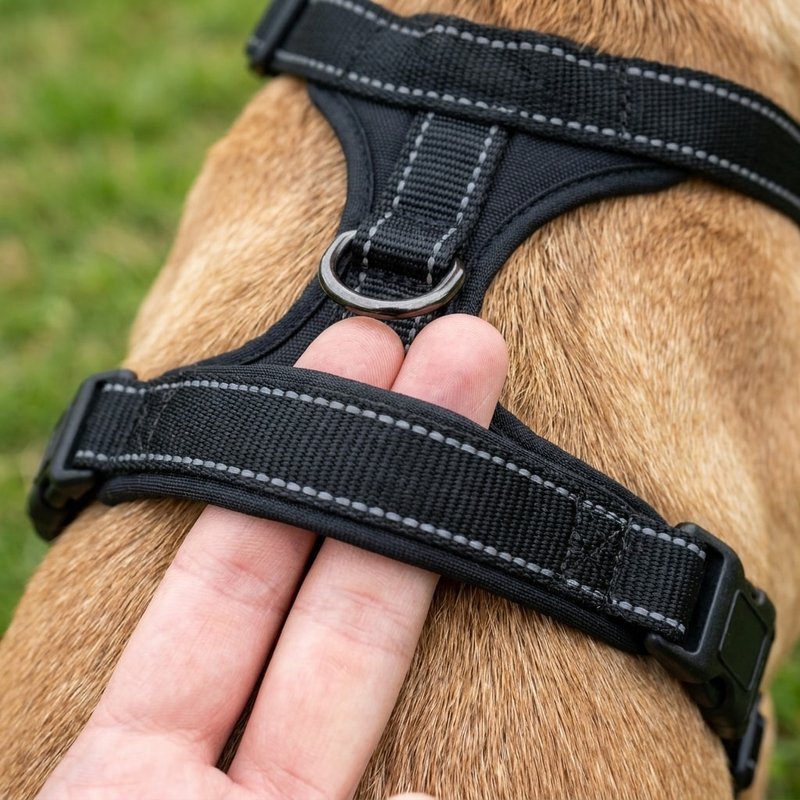
- Two-finger rule: you should be able to slip two flat fingers under each strap - snug, not loose. Also confirm the harness can’t be pulled back over your dog’s head.
- Girth strap behind the front legs: it should sit on the ribcage, not up in the armpit or across the elbows.
- Center the chest panel: under light leash tension, a front ring should stay centered on the sternum, not sag toward the legs.
- Check the movement: your dog should walk, turn, sit, and lie down freely, with no strap creeping onto the throat.
- Don’t run on the front clip: for sustained jogging, switch to a stable back-clip Y harness once leash skills are solid - a front leash can cross the front legs at speed.
Measure your dog’s chest girth at the widest point behind the front legs, then compare it to the maker’s size chart rather than guessing by weight alone. If a harness rotates, gapes, or rubs, stop and re-fit or resize. Watch thin-coated breeds especially for redness or hair loss at the sternum and armpits.
If you’re still mapping out which style suits your dog, our guide to the types of dog harnesses walks through every design, and you’ll find more walking-gear help across our dog harness guides.
Frequently Asked Questions
Is a front-clip harness better for dogs that pull?
Usually, yes, for immediate control. A chest attachment turns a pulling dog back toward you instead of letting them drive straight ahead. Controlled research shows dogs pull with less force on a front-connection harness than on some other equipment. It manages pulling, though - it doesn’t teach loose-leash walking on its own.
Does a back-clip harness make my dog pull more?
It doesn’t teach pulling, but it can let a dog pull harder. Because the leash sits over the back and follows the dog’s forward motion, there’s no turning effect, so the dog can lean straight into the straps. Two studies found dogs generated more leash force in a back-clip harness than in a collar.
Can I use a front-clip harness on a puppy?
Yes, if it’s lightweight, non-tightening, correctly sized, and introduced gradually with treats. There’s no research-backed minimum age for a front clip puppy harness. The main job is fit: puppies grow fast, so recheck the straps every few wears and keep early sessions short and positive.
Enjoy Calm Walks Starting Today
Dual-attachment harness distributes pressure and helps turn tug-of-war outings into relaxed, bonding strolls from the first use.
Shop Now 👉Better Walk Guarantee • 90-Day PawSafe® Promise
Do front-clip harnesses stop pulling completely?
No. A front clip changes leverage and direction, but it doesn’t tell your dog what to do instead. Some dogs keep pulling or learn to brace sideways. Pair the harness with reward-based training - reinforce a slack leash and checking in with you - to actually change the behavior.
Front clip or back clip for a small dog?
Choose by behavior and fit, not size. A calm small dog often does well on a lightweight back clip that keeps the leash clear of the legs. A small puller may do better with a front or dual clip. Small dogs can pull surprisingly hard for their weight, so protecting the neck still matters.
Can the leash get tangled with a front-clip harness?
It can, especially with short-legged dogs, a loose chest panel, too much slack, or lots of direction changes. Keep the front ring centered on the chest and manage the leash so it doesn’t hang below the body. A shorter (not retractable) leash held with light bridge tension helps.
What is a dual-clip harness, and do I need one?
A dual-clip harness has both a chest ring and a back ring, so you can switch attachment points as the walk changes - front for training or busy streets, back for relaxed sniff walks. It’s handy when one dog’s needs shift by environment, but a calm loose-leash walker doesn’t require one.
Is a front- or back-clip harness safer for my dog’s neck?
Both keep routine leash force off the neck as long as the harness stays below the throat, which is why veterinary sources recommend harnesses over neck attachments for dogs with tracheal or airway issues. Strap position and fit protect the neck more than the ring location alone.
The Bottom Line on Front Clip vs Back Clip Harness
Clip position changes the physics of your walk - that’s the whole story of the front clip vs back clip harness question.
- Front clip: attaches at the chest, redirects pullers and reactive dogs, and shines for training and busy places. It manages pulling; it doesn’t teach.
- Back clip: attaches on the back, frees comfortable forward movement, and suits calm walkers, small or sensitive dogs, and running - but lets a strong dog pull harder.
- Dual clip: gives you both, so you can switch as the walk changes.
- Fit and training: matter as much as the clip. Get the two-finger fit right and reward a slack leash.
Choose by the job - your dog’s behavior, body, and activities - and you’ll rarely go wrong. If your dog switches between calm strolls and full-tilt excitement, a well-built dual-clip harness like the Steady+Style covers both without a second purchase. Measure your dog, pick the clip for the job, pair it with a few treats and patience, and walks stop being a workout and start being the best part of the day.